By Michael Every of Rabobank
Escalate To Immolate?
It takes a pretty big development to push the BOC, the FOMC, and the upcoming BOJ, BOE, and ECB meetings off the financial front pages – but yesterday’s and this morning’s news does in some eyes and headlines.
We’ve warned the Iran War would ‘escalate to de-escalate’, and crucial regional desalination plants had briefly looked to become targets. Markets reacted –Brent around $112, 1-month TTF €54 at time of writing– to Israel, in coordination with the US, striking Iran’s largest gas field, to which Tehran threatened retaliation against GCC oil and gas fields – and it has done so.
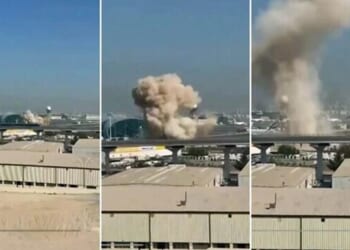
Qatar has reported extensive damage at the world’s largest LNG export plant at Ras Laffan, which provides around 20% of global supply. Moreover, there are claims the Saudi back-up Yanbu oil pipeline that leads to the Red Sea (where the Houthis are still ominously quiet) may have been hit. That remains unconfirmed, but it would be dramatic in its impact if it were proven to be true, with millions of extra barrels of oil a day taken off the market.
Reports from Israel say the Iranian gas field was responsible for domestic supply and the blow was intended as a warning shot to Tehran to stop them targeting regional energy facilities. It seems to have had the opposite effect. The fear now is not just lower supply flows but, alongside damage done to oil wells by shut-ins, of supply destruction. The fat tail risk is we might see a downwards spiral into ‘escalate to immolate.’
Qatar expelled Iran’s military and security attaches and warned continued Iranian attacks would be met with further measures “in a manner that ensures the protection of its sovereignty, security, and national interests”; Saudi Arabia said it and the GCC have the right to take military action against Iran “if deemed necessary”; Kuwait arrested 10 Hezbollah operatives for an alleged plot to attack “vital installations”; the US is reportedly weighing reinforcements as the war enters possible new phase, including troops; Axios claims ‘Trump aides foresee Iran endgame divide: “Israel doesn’t hate the chaos”’.
Moreover, Trump posted, “I wonder what would happen if we “finished off” what’s left of the Iranian terror State, and let the Countries that use it, we don’t, be responsible for the so called “Strait”? That would get some of our non-responsible “Allies” in gear, and fast!!!” Next, read the long thread from shipping expert @Johnkonrad, who argues this could be a US ploy to take control of the maritime insurance industry from the UK and force European ocean carriers to reflag their commercial ships to the US to gain both insurance and physical protection in Hormuz, effectively creating a large US merchant marine without the need to build one (for now). Finally, consider that ocean freight rates are skyrocketing in places, and even giant firms are telling clients they have the right to invoke a 19th century law allowing them to drop off cargo at the nearest convenient port and leave it to the importer’s expense to store and ship it on when possible.
That was followed this morning by further suggestion –via an Economist article, it appears– that the US might consider a crude oil export tariff or an export ban to curb energy prices. This would do little to help with expensive diesel, etc., but it would certainly throw ‘one price’ global energy markets into a further tailspin, widen the gap between Brent and WTI, already the largest in 11 years, and risk disrupting Asia and Europe to try to cushion the US. If it had the refineries to make it work, one wouldn’t rule it out – which speaks to where we may all head.
The market is largely pricing in a US oil export ban: Brent less WTI spread is the widest in decades (ex the negative WTI print). Export ban would landlock US oil, sending it sharply lower while sending Brent soaring pic.twitter.com/3YSLlVNZcx
— zerohedge (@zerohedge) March 19, 2026
Against these actual and potential structural, not cyclical shocks, it’s no surprise the Fed left rates on hold, as expected. Yet all they really had to add on the war was that “the implications of the developments in the Middle East for the US economy are uncertain.” Impressive work, if true – but then again, they couldn’t have known that Ras Laffan and Yanbu would be discussed as and then immediately after they met. (Though that was evidently a risk.)
Even so, because it’s how central bank economic models work, the new Summary of Economic Projections says, ‘Move along, nothing too much to see from a major Middle East war’. It now has notably higher (if not truly high) headline and core inflation, both 2.7% in 2026, before they fall rapidly to 2.2% in 2027 and 2.0% in 2028. Note that our US Strategist Philip Marey has now changed his call to two Fed cuts this year, in September and December and, depending on how the war develops, we could be dropping another rate cut from our forecasts in the coming weeks.
Using similar ‘I see no no ships’ modelling techniques, the RBA just released its latest financial stability report, which the local financial press summarises as, “Households can handle global shocks, interest rate pain.” That’s as pre-war and pre- the previous rate hike Aussie jobs data showed the total up 48.9K, well above the expected 20K, but full-time work collapsed with the unemployment rising to 4.3% from 4.1%, which was not expected. Q4 Kiwi GDP was also disappointing at just 0.2% q-o-q vs. 0.5% expected.
In short, central banks have faced ‘exogenous’ shocks now in 2020 and 2021 from Covid; in 2022 and 2023 from the Ukraine war; in 2024 and 2025 from the Middle East via the Houthis and the Red Sea, then US tariffs; and now in 2026, from a new Middle East war. At what point in this decade might a backdrop of ‘escalate to deescalate’ going to be taken as at least partially endogenous, and ‘escalate to immolate’ as the matching very fat tail risk?