If the unstated intention of the Iran war was to give far more leverage to Russia, and – paradoxically – to Iran, by legitimizing their sanctioned oil exports in a world suddenly starved of energy, then mission accomplished.
Just days after the US “temporarily” lifted sanctions on Russian oil stored on sanctioned tankers, Secretary Scott Bessent said Thursday that the Trump administration may suspend sanctions on Iranian oil already at sea in a bid to clamp down on energy prices.
“In the coming days we may unsanction Iranian oil that’s on the water, about 140 million barrels,” he said on Fox Business, adding that “In essence, we will be using the Iranian barrels against the Iranians to keep the price down for the next 10 or 14 days, as we continue this campaign.”
U.S. Treasury Secretary Scott Bessent:
In the coming days, we may unsanction the Iranian oil that’s on the water. pic.twitter.com/7OJN7t1ZtT
— Clash Report (@clashreport) March 19, 2026
It’s the latest play weighed by the administration to stabilize the oil market against price shocks since the U.S. and Israel launched their joint operation in February. The maneuver could free up 140 million barrels of Iranian oil for global use, Bessent said.
It’s one of several “levers” Bessent said the administration has at its disposal, as Iranian attacks cripple the Strait of Hormuz, whose blockade has shuttered roughly 20% of the world’s oil supply. The administration could also make more oil from the Strategic Petroleum Reserve available, Bessent added. The administration already started making 172 million barrels from the SPR available.
“So we have lots of levers, we’ve got plenty more that we can do,” Bessent said. “Some countries are going to do more, the U.S. could unilaterally do another SPR release to keep the price down.”
The White House has discussed adding up to 100 million more barrels to the administration’s pledge last week, Politico reported citing a person familiar with the plan.
“Some military advisers are concerned [about] draining so much, and are pushing for more like 50 million barrels on the concern that further destruction of oil and gas infrastructure in the [Middle East] region could leave the country vulnerable from a reserve standpoint,” this person said.
A spokesperson for the Department of Energy — which controls the SPR — said in a statement following Bessent’s interview there were currently no plans for another release.
“The United States has taken several actions thus far to mitigate disruptions to energy markets,” DOE spokesperson Ben Dietderich said. “While the U.S. continues to consider all options to keep markets supplied, there are currently no plans for an additional SPR release.”
Bessent comments come a day after the US Administration announced a 60-day waiver of the Jones Act shipping law, temporarily allowing foreign-flagged vessels to move fuel, fertilizer and other goods between US ports
Which leaves unsanctioning Iranian oil as the most likely next step.
The plan is being floated at a time when a massive, nearly $70 gap has opened in price between oil delivered to Asia via Oman, which is now trading at $167/barrell and WTI which serves the US market at $97. Meanwhile Brent, last trading at $113, is rising and is increasingly disconnected with WTI on fears the US may ban oil exports, undoing Barack Obama’s 2015 decision, and landlocking US production.

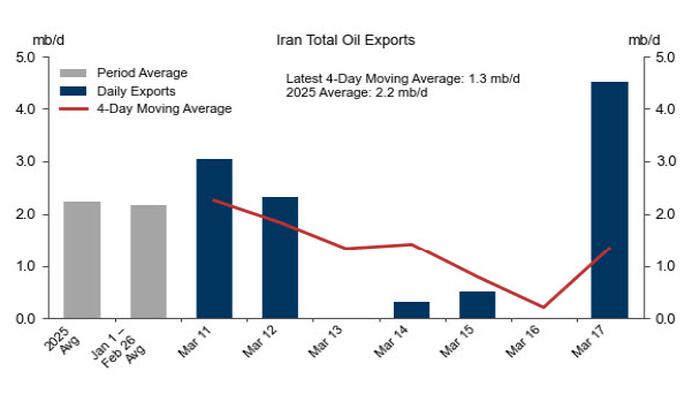
What is remarkable about the Bessent proposal is that it comes just as Iranian oil exports surged on March 17 to over 4 million barrels after being heavily depressed for the past few days. If Iran can sustain this level of exports, it would be more than double the pre-war daily average of just over $2 million barrels!

Oil and product flows through the strait have plummeted from roughly 20 million barrels a day to just “a trickle,” the International Energy Agency reported last week, marking the largest supply disruption in history. U.S. gas prices are up by more than 85 cents per gallon from the start of the war. Bessent called the blockade a “temporary chokepoint” and implored American allies to help secure the strait.

“They’re the ones who need this oil,” he said. “The U.S., we’re an oil exporter.”
Yet while China is especially reliant on Gulf oil, having been traditionally the biggest customer, China also has a strategic petroleum reserve that it quietly filled up in recent years, and which currently has ~1.5 billion barrels, or more than the entire 1.2 billion reserve across IEA member nations. The question then becomes is Beijing willing to dip into its reserve while Asian prices remain elevated (or perhaps stoop so low as to purchase US oil), or is it waiting for a more strategic moment, like the invasion of Taiwan before starting the SPR drain.