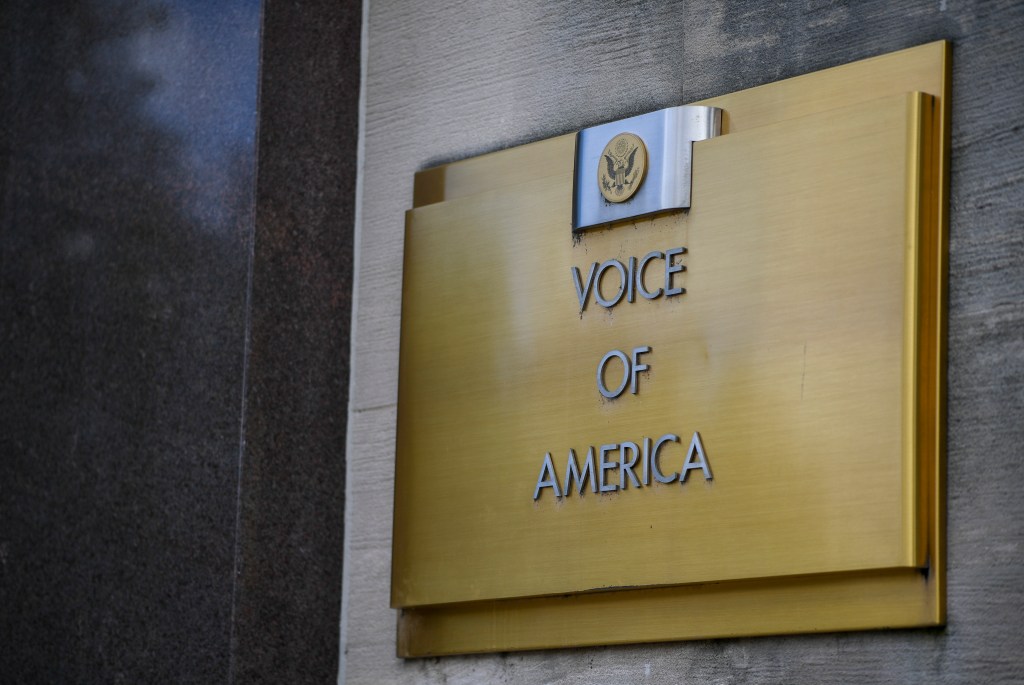
Cycling through several senior titles, Lake oversaw a drastic drawdown of USAGM operations, placing nearly every VOA staffer on paid leave, canceling agreements with paid contractors, and reducing broadcasts to roughly an hour each day on just four language channels. Lake also changed the editorial tenor of VOA’s broadcasts, signing a deal to distribute the content of One American News Network on government-funded channels.
But on Tuesday, U.S. District Judge Royce Lamberth declared Lake’s gutting of the agency was unlawful. Ruling on two related cases—one brought by VOA employees and one by its director, Michael Abramowitz—Lamberth ordered VOA to restore operations and bring back 1,042 employees who had been placed on leave. The decision followed a case earlier this month in which Lamberth ruled Lake had been illegally appointed to her position and lacked authority to run the VOA. Lamberth wrote that Lake’s actions were “arbitrary and capricious,” violating the Administrative Procedure Act and defying congressional appropriators who channeled $643 million to USAGM earlier this year, ordering the agency to draw up plans to restore services.
USAGM oversees a broad portfolio of entities responsible for U.S. international reporting and broadcasting. VOA is meant to act as America’s voice in the world and is legally mandated to provide U.S. policy positions alongside its reporting, as a federally operated outlet housed within USAGM. But there are also news nonprofits that draw a large portion of their funding from U.S. government grants—like Radio Free Europe/Radio Liberty, Radio Free Asia, and the Middle East Broadcasting Networks—and these function more like regional news organizations, often filling reporting gaps in countries with limited press freedom.
USAGM’s mission, although not its precise institutional setup, began during World War II, when a federal foreign information agency set up a radio program to counter Axis propaganda, claiming to bring “voices from America” to German audiences. (The program was later absorbed into the Office of War Information.) “The news may be good for us. The news may be bad. But we shall tell you the truth,” read announcer William Harlan Hale on the first broadcast in February 1942.
As the Cold War developed, the CIA began funding covert radio broadcasts behind the Iron Curtain, creating Radio Free Europe for Eastern Europe and Radio Liberty for the Soviet Union (together shortened to RFE/RL). In the 1970s, Congress took greater control, funding the networks through direct appropriations and creating the VOA Charter in 1976, mandating that “VOA will represent America, not any single segment of American society, and will therefore present a balanced and comprehensive projection of significant American thought and institutions.”
As it gained a reputation for balanced news, USAGM became the media of choice for many people living under communism. Nicholas Cull, a historian of U.S. public diplomacy at the University of Southern California’s Annenberg School, told TMD that during the period of martial law in Poland between 1981 and 1983, 80 percent of Polish citizens tuned into USAGM stations weekly. “Nobody in the U.S. has had 80 percent [audience share] since World War II!” he noted.
After the Cold War, USAGM was created to oversee the entire apparatus, with new programs for different regions, such as Radio Farda for Iran and Radio Free Asia for Asian countries with limited press freedoms. In 2024, USAGM broadcasts reached a total of 427 million weekly viewers and listeners, according to an agency report. In countries with low press freedom or access to electronic media, its reach can be wide: 45 percent of adults in Niger listened to a USAGM broadcast in 2024. Since March 2025, all VOA television and radio programming to sub-Saharan Africa has been suspended—ending 62 years of broadcasting in 17 African languages.
The broadcast services represent a distinctive American approach to public diplomacy and international broadcasting. As Erik Nisbet, a professor at Northwestern University’s school of communication and an expert in international state-sponsored media, told TMD, “That promotion of democratic values, of information rather than persuasion, information rather than propaganda, is what [the U.S. believes] will serve our interests best.”
America’s biggest adversaries have a very different approach. “Without platforms such as Voice of America and other similar platforms, we are allowing Russia, China, Iran, to absolutely control the information space,” Ivana Stradner, a research fellow at the Foundation for the Defense of Democracies who studies Russian information warfare, told TMD.
China, for example, has expanded broadcast operations across Africa, not only by opening its own bureaus and dedicated African news stations, but by offering free syndication to journalists on the continent. Its outlets often push stories that depict China as a more preferable partner to African nations than the U.S. and its allies. In Russia, the Kremlin plans to increase funding for state-run media by 54 percent compared with previous planned budgets, boosting campaigns that target Russians, Ukrainians, and residents of NATO countries with disinformation about Russian progress in Ukraine and messaging aimed at convincing citizens that Western sanctions are ineffective.
“If you don’t have international broadcasting that has that American perspective, then [viewers] will be getting the Russian perspective, the Chinese perspective, the Iranian perspective,” Lisa Curtis, a senior fellow at the Center for a New American Security, a national security official in the first Trump administration, and the current board chair of RFE/RL, told TMD.
When the Trump administration began to move against VOA and RFE/RL (including by suspending grants for the radio broadcasts, later reversed by courts) last year, Russian state-run media reacted gleefully. “Today is a holiday for me and my colleagues at RT and Sputnik. This is an awesome decision by Trump!” said Margarita Simonyan, editor-in-chief of the Russian-controlled RT network. “We couldn’t shut them down, unfortunately, but America did so itself.”
But several experts who oppose a total shutdown of the agency noted that USAGM’s operations need reform. An increasingly oppositional relationship with the executive branch, stretching back to the first Trump administration, made managing journalists difficult, Ilan Berman, a senior vice president at the American Foreign Policy Council and a board member of RFE/RL, told TMD.
Some journalists have rejected oversight and claimed complete editorial independence, angering the legislators who are responsible for providing them with taxpayer funding. “How do you make it so that you preserve journalistic independence yet still align everything with American priorities?” Berman asked.
There have also been issues of basic competence. VOA’s Farsi-language service has recently faced criticism for eschewing coverage of the Iranian opposition—especially Reza Pahlavi, the son of the last shah of Iran. One journalist claimed earlier this month that he was abruptly fired as part of the network’s broader censorship of Pahlavi coverage.
“Obviously, the [Iranian] government’s not going to tell [the Iranian people] who the opposition groups are,” Berman noted. “So if they don’t have good information, how are they going to judge whether it’s safe to come out? How are they going to judge who to support?”
Matthew Armstrong, a public diplomacy expert and former member of the Broadcasting Board of Governors (USAGM’s predecessor), told TMD that USAGM will likely be vulnerable to ideological manipulation moving forward. Even if VOA’s charter mandates that journalism follow standards of transparency and fairness, “an absence of governance” from lawmakers means it’s unlikely the guidelines will be enforced, he argued.
Transforming USAGM into a simple propaganda organ, rather than a semi-independent news broadcaster, risks undermining its effectiveness, Geoffrey Cowan, the former director of the VOA during the Clinton administration, told TMD. The U.S. government’s broadcasting efforts were founded on the belief that the “only effective form of ‘propaganda’ was information that people would find was accurate,” he said. If U.S. broadcasting loses its reputation as a consistently reliable source of information, he said, overseas audiences might come under the influence of different actors.
The White House may yet resurrect VOA as a different kind of news organization than the one originally envisioned. On Wednesday, USAGM named Christopher Wallace, the former news director at Newsmax—a pro-Trump cable news network that settled two major lawsuits related to false claims about the 2020 presidential election, paying a combined $107 million—as VOA’s next deputy director.
The administration, it seems, has no interest in returning to the status quo. “President Trump was elected to eliminate waste, fraud, and abuse across the administration, including at the Voice of America—and efforts to improve efficiency at USAGM have been a tremendous success,” said White House spokeswoman Anna Kelly in response to a request for comment from TMD. “This will not be the final say on the matter.”