IN THIS ISSUE:
- The Fight for an Honest Judicial Assessment of Climate Science Is Not Over
- Wind and Solar Waste Is Piling Up

The Fight for an Honest Judicial Assessment of Climate Science Is Not Over
In CCW 570 I warned of attempts by climate alarmists to undermine the independence of the judicial system by presenting biased information, written by climate activists, to judges in climate change cases. I touted as a victory that a biased chapter on climate change written by scientists and attorneys working for plaintiffs in climate lawsuits was dropped from the Federal Judicial Center’s (FJC) Fourth Reference Manual on Scientific Evidence, the science bible for the courts.
Under pressure from various states’ attorneys general, Judge Robin L. Rosenberg, director of the FJC, announced in a letter to West Virginia Attorney General John B. McCuskey that the FJC would remove the chapter on climate science from the manual. I noted at the time that although that battle was won, there was still work to be done to defeat multifaceted attempts to subvert justice in climate lawsuits by exercising undue influence on the judiciary. Specifically, the Environmental Law Institute hosts judicial junkets during which climate-activist scientists and lawyers spend days trying to indoctrinate judges on how and what to think about climate change.
It seems, however, that even the FJC victory I celebrated may have been only a partial win. As several allies in the fight for climate realism have subsequently pointed out, there is still a lot of bias in what remains of the fourth edition of the FJC’s science reference manual.
Researcher Roger Pielke Jr., Ph.D. points out that the National Academies of Sciences, Engineering, and Medicine (NASEM), which helped write and assemble the science manual, are defending the biased climate chapter’s initial inclusion and have published it at their website. Writing on his Substack channel, The Honest Broker, Pielke notes,
- Congressional Democrats want an investigation of why the FJC removed the climate chapter;
- State Attorneys General, 27 of them and all Republicans, want an investigation of why the NASEM has not removed the climate chapter;
- Some authors who wrote other chapters in the Manual penned an open letter decrying a “political attack by the attorneys general on a carefully and rigorously prepared scientific publication should concern us all”;
- The two authors of the climate chapter wrote their own 10-page defense of their effort.
The problem is twofold, Pielke writes. It’s not just that the chapter’s authors have conflicts of interests and cite the work of those involved in the lawsuits on plaintiffs’ behalf as being dispositive on the topic of oil companies’ legal liability for damages from climate change—a fact at issue in the cases—but even worse, the climate chapter itself was ghost-written, thus violating “established scientific integrity standards.” Pielke continues:
The reason ghost authorship is taken seriously—in medicine, in the sciences, across research fields—is that authorship is not merely about credit, but accountability. Readers, peer reviewers, and the public rely on the author list to assess who performed the work resulting in publication, what their expertise and perspectives are, and what interests they may bring to the effort. Strip that information out and you undermine a central basis for trust in science and science as applied to policy.
In this case, the ghost authors are explicitly interested parties who work for institutions formed to advance climate litigation as a strategy to change law and/or have written extensively on and provided written or oral testimony in active climate lawsuits.
One might ask what’s the problem if the chapter has been “omitted”? The problem is that although it has been removed from one document, the chapter has not been eliminated or repudiated. Omitted but not officially withdrawn, the chapter remains on the NASEM website’s landing page, still bearing the FJC’s official logo, suggesting endorsement.
On top of that, the fourth edition document remains full of similar bias. The Hon. Jason Isaac, CEO of the American Energy Institute, who wrote a scathing, detailed critique of the climate chapter, documents the bias in an article titled “The Climate Fox in the Judicial Henhouse.” The NASEM’s defense of the chapter and full report and appearance of the FJC’s logo might be thought by some to count as an official endorsement of the report by the federal government: the entire budget of the FJC and much, if not most, of the funding for the NASEM comes from the federal government, either through appropriations or contracts, Isaac notes.
Isaac writes,
[T]he Fourth Edition of the “Reference Manual on Scientific Evidence,” produced by the National Academies of Sciences, Engineering, and Medicine, the taxpayer-funded center embedded contested, plaintiff-driven climate litigation theories into one of the most authoritative reference works relied upon by judges nationwide.
The result was not neutral guidance on the scientific method. It was an evidentiary framework that tracked the legal strategy of climate plaintiffs.
The reference manual is not a blog post. Judges rely on it when evaluating expert testimony, determining admissibility, and weighing causation in complex cases.
Historically, it focused on methodology, how science works, what courts should ask, and where uncertainty lies. The Fourth Edition marked a sharp departure.
Isaac identifies problems throughout the fourth edition, including biased presentations of the state of science and the law, rather than a neutral examination of various scientific issues that might come before the court, and illegitimate standards for accepting evidence as accepted science and pertinent to cases. Isaac writes,
[T]he revised manual continues to elevate a narrow set of activist-aligned authorities in sections purporting to explain “how science works.”
Judges are directed to the writings of Michael Mann and Naomi Oreskes as examples of scientific consensus, without disclosure of their advocacy roles or involvement in litigation narratives.
The manual warns that disagreement over “settled science” may reflect strategic manipulation by stakeholders, explicitly citing climate change alongside tobacco. That is not neutral instruction. It primes judges to view skepticism as suspect.
The problem extends beyond climate.
The manual repeatedly imports ideological frameworks under the banner of scientific context. Judges are instructed that scientific knowledge is shaped by identity, positionality, and intersectionality. Citations emphasize race, gender, and sociological perspective as factors in evaluating expertise. …
The consequences are serious. When contested theories are embedded in trusted judicial reference materials, judges may treat disputed factual predicates as resolved before adversarial testing occurs. One side enters the courtroom with its framework already normalized. Public confidence in judicial neutrality erodes. …
Restoring integrity does not require hostility toward science or courts. It requires restoring boundaries. Judicial education must return to explaining methods, uncertainties, and limits, not endorsing contested conclusions. Conflicts of interest must be disclosed. Advocacy must remain outside institutions charged with impartial adjudication.
Isaac suggests the appropriate remedy is for Congress to withhold funding for the FJC and the NASEM until they get back to presenting science objectively, and withdrawing the fourth edition of the FJC’s science manual entirely until then. The courts could continue using the third edition until an unbiased, objective, balanced presentation of the scientific matters under discussion and legal debate is developed and published.
Sources: Climate Change Weekly; CO2 Coalition; American Energy Works; The Honest Broker
Wind and Solar Waste Is Piling Up
Climate Change Weekly previously examined a serious but rarely fully discussed problem with solar and wind industrial facilities: end-of-life waste.
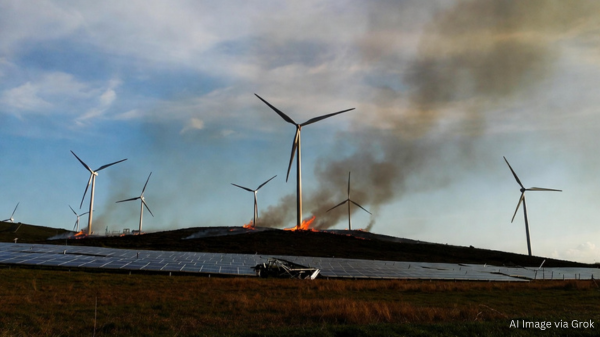
This is not a problem for the distant future but for now. Many early wind turbines and solar panels are nearing their end of useful life, or even being replaced early as new, more-efficient panels and more-powerful turbines become available. In addition, emergency situations are causing further waste, such as hailstorm damage in Texas in 2024 and more recent damages in Indiana and Illinois, where vast industrial solar facilities were destroyed by storms, including hail and tornados, taking the facilities offline and creating a clean-up problem, with many nearby residents and communities expressing concern about potentially toxic chemicals leaching from the shattered panels.
In a 2023 post, I noted that a few media outlets—very few—had begun to recognize and acknowledge the mounting (pun fully intended, when you consider the huge piles of turbine blades, shafts, and panels) and pressing problem of what to do with wind and solar waste.
Recycling panels is challenging and expensive. It costs $30 to recycle each solar panel, to recover between $3.00 and $8.00 worth of minerals, metal, and glass. By contrast, it costs approximately $1.00 per panel to ship used panels to a landfill, and slightly more to ship inefficient used panels for reuse in developing countries overseas, shifting the waste problems elsewhere.
Because of the economics, less than one in ten solar panels are recycled. With millions more panels being installed each year, the problem is growing.
“The reason you do not see more companies doing solar panel recycling is because the economics don’t make sense,” A. J. Orben, vice president of We Recycle Solar, told GreenBiz back in 2023 when I first reported on the problem. “It costs more to break a panel down and recover the raw materials than what the raw materials themselves are worth.”
The waste problem tied to industrial wind is even greater. Although the metal in the towers and machinery can be recycled, it it difficult to do anything useful with the massive blades other than shred them into small bits for select uses, which is very expensive. It costs between $440,000 and $675,000 per unit to decommission and dispose of each onshore wind turbine from base to blade, with the process of dismantling offshore wind turbines topping $1 million, according to estimates. The value of the material from the towers and gear boxes is about $28,000 per unit, or far less than a tenth of the cost of dismantling. As a result, the metal, gears, concrete, and other materials often wind up in landfills, as do the composite blades after they’ve been crushed at great expense and with large emissions of carbon dioxide from the machinery used to haul and crush them. The blades are mostly landfilled or just left to decompose slowly above ground, wasting considerable space.
Five years ago, journalist Duggan Flanakin described the disposal methods and the problems the industry faced then, which have only grown along with the number and size of turbines:
A separate tractor-trailer is needed to haul each blade to a landfill, and cutting them up requires powerful specialized equipment. With some 8,000 blades a year already being removed from service just in the United States, that’s 32,000 truckloads over the next four years; in a few years, the numbers will be five times higher.
Some wind energy companies cut the huge blades into short sections before sending them to landfills, because most landfills lack cutting tools. Today’s turbine blades are 20 percent longer and their towers up to 200 feet taller than most of those currently being landfilled.
Turbine disposal costs are upwards of $400,000 apiece [HSB note: see the updated, larger cost figure above]. That means $24 billion to dispose of the 60,000 turbines currently in use in the U.S. The cost and the toll on existing landfills will rise as more, longer, heavier blades reach their end of life.
Over the next 20 years, the U.S. alone could have to dispose of 720,000 tons of waste blade material. Yet a 2018 report predicted a 15% drop in U.S. landfill capacity by 2021, with only some 15 years’ capacity remaining. We will have to permit entirely new landfills simply to handle wind turbine waste—on top of mountains of solar and battery waste.
Not every landfill is certified to handle wind turbine waste, and many that are have decided to refuse to do so because the cost in terms of space is just too great. Closing landfills early because there is no more room in the pit or pile is expensive, requiring communities to find new landfills or other ways to dispose of waste. Setting aside so much space in public landfills for companies already profiting from huge government support, with the costs borne by taxpayers and communities, makes less and less sense for local governments.
That has led wind profiteers to a different “solution”: piling up decommissioned turbines on open land aboveground. Thousands of acres are covered by turbines left to decompose over time, with unknown environmental impact, on land useful for purposes other than wind junkyards. This practice is controversial, and state and local governments are increasingly fighting the wind industries’ growing number of unregulated piles of unusable waste.
In 2023, I noted some in the media had started to report on the waste problem, but such coverage and analysis has waned until recently. Academics and analysts have lately begun to show renewed interest, perhaps because the mounting problem has become impossible even for those in their ivory towers and board rooms to ignore.
The London School of Economics (LSE) recently reported on Australia’s solar waste problem. Although recognizing the problem is the first step to fixing it, the LSE article unfortunately offers no new solutions: it calls for governments to force solar companies to take back old solar panels for reuse or recycling. That’s all well and good, except it doesn’t address the cost of doing so, which is why they do so little of it at present. With the cost of recycling and reuse so much higher than that of simply landfilling the waste, forcing solar companies to do so means they will simply pass that cost on to consumers or ratepayers, such as by adding a disposal fee for each panel. With solar still being more expensive than traditional sources of energy, this will only make already fast-rising power bills even more costly.
Maybe Australia isn’t facing the affordability crisis that residents of the United States are concerned about, but I doubt it, since credible estimates suggest Australians should expect to see their power bills rise by 24 percent by mid-2026 alone. Adding large solar disposal fees to ratepayers’ bills, even if hidden or somehow innocuously labeled, doesn’t seem like a good way to ensure lower prices—or politicians’ re-electability—unless Australian voters are different from those in the United States, where opinion polls show an unwillingness to pay higher energy prices to fight climate change.
The LSE is not the only academic institution to acknowledge the problem of the renewable energy waste stream, however belatedly. A recent article posted in the Harvard Business Review (HBR), titled “The Dark Side of Solar Power,” details how subsidies and efficiency improvements are leading many consumers to purchase solar panels for the first time, and others to replace their existing solar panels, with more-efficient models, before the subsidies run out. The result: a glut, not temporary but long-term, in unwanted solar panels.
The authors of the HBR analysis write,
If early replacements occur as predicted by our statistical model, they can produce 50 times more waste in just four years than IRENA anticipates. …
Alarming as they are, these stats may not do full justice to the crisis, as our analysis is restricted to residential installations. With commercial and industrial panels added to the picture, the scale of replacements could be much, much larger.
The industry’s current circular capacity is woefully unprepared for the deluge of waste that is likely to come. The financial incentive to invest in recycling has never been very strong in solar. While panels contain small amounts of valuable materials such as silver, they are mostly made of glass, an extremely low-value material. …
As a result, solar’s production boom has left its recycling infrastructure in the dust. …
The direct cost of recycling is only part of the end-of-life burden, however. Panels are delicate, bulky pieces of equipment usually installed on rooftops in the residential context. Specialized labor is required to detach and remove them, lest they shatter to smithereens before they make it onto the truck. In addition, some governments may classify solar panels as hazardous waste, due to the small amounts of heavy metals (cadmium, lead, etc.) they contain. This classification carries with it a string of expensive restrictions—hazardous waste can only be transported at designated times and via select routes, etc.
Like the LSE article, the HBR analysis identifies the problem but its solutions fall far short: make recycling great, as if there were a magic way of doing so without massive government subsidies or forced industry retrieval and treatment, the costs of which will ultimately fall on consumers.
Government subsidies and mandates created the renewable waste problem. The solution to this is not more expensive, misguided, government mandates or subsidies, but ending wind and solar incentives and mandates, which are solely responsible for the huge waste stream, including the land disrupted by mining and the toxins endemic to wind and solar power throughout the supply chain including mining, refining, construction, installation, decommissioning, and disposal.
Sources: CFACT; Harvard Business Review; London School of Economics; Climate Change Weekly