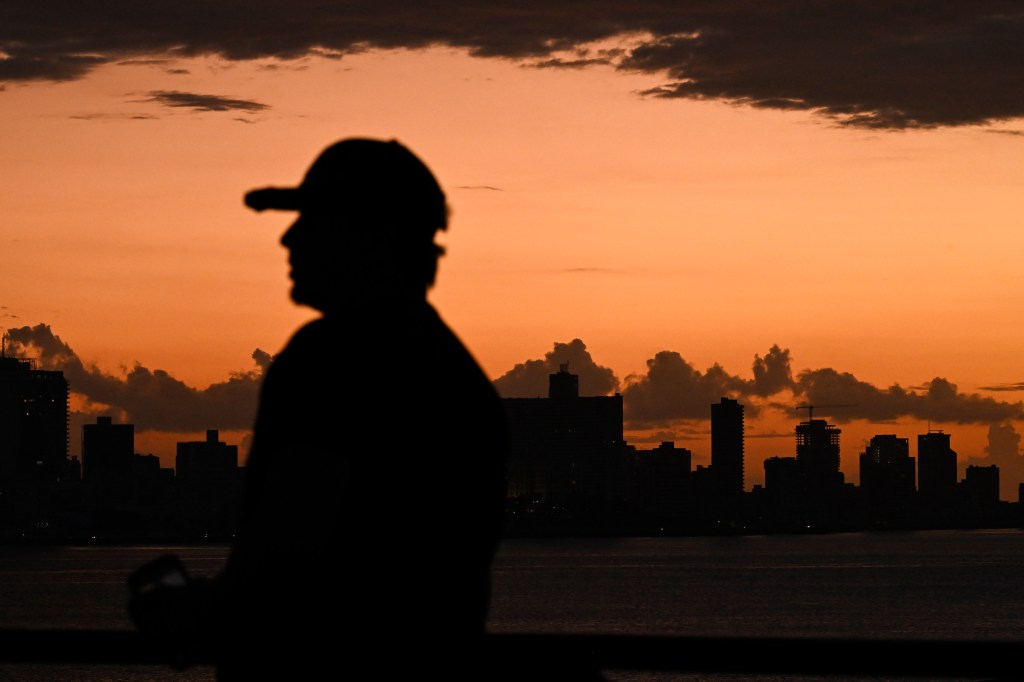
On Saturday, Cuba went dark for the second time in six days. The latest blackout marked the fourth time in four months that the island’s population of roughly 10 million people was left without electricity, running water, or reliable hospital care.
A week earlier, hundreds of protesters in the central Cuban city of Morón stormed the local Communist Party headquarters, dragged furniture and files into the street, and set them on fire. Demonstrations have since spread to other provinces.
Adding to the general sense of chaos, a magnitude 5.8 earthquake struck eastern Cuba in the early hours of March 17, compounding the misery on the island. Meanwhile, in Washington, President Donald Trump said he believed he would have “the honor of taking Cuba,” while Rep. Carlos Giménez of Florida declared that “liberty is only weeks away.”
It is tempting to hope that Cuba’s government—starved of fuel by an American blockade, unable to keep the lights on, and facing the most sustained unrest since the 1959 revolution—is approaching its well-deserved end. But the regime is negotiating, not collapsing, and the conditions that have enabled American pressure to work—starting with a fuel blockade that has left the island without reliable electricity—have a limited shelf life.
What caused the blackouts?
The two latest blackouts that have triggered the latest crisis are structurally unlike any that preceded them. Cuba’s grid has collapsed before, including four times in the last three months of 2024 and at least twice in 2025.
But every prior failure had an identifiable mechanical cause and a feasible path to recovery. After the March 16 blackout, Cuba’s energy ministry reported that no equipment failures were detected at the moment of disconnection. Instead, the grid simply could not sustain itself. Cuba generates nearly all of its electricity by burning oil and diesel in thermoelectric plants, most of which were built with Soviet technology in the 20th century and have long exceeded their intended lifespans.
Saturday’s collapse was caused by a single unit shutdown at the Nuevitas thermoelectric plant that triggered a cascading blackout across the entire country, which shows that the Cuban electric system can no longer absorb even minor disruptions.
The distinction matters because while an equipment failure can be repaired if parts and fuel exist, a system collapsing from chronic fuel starvation is a more serious situation. Cuba has received no significant fuel delivery since approximately January 9, the longest gap in at least 12 years, according to the commodity tracking firm Kpler. Shipments of Venezuelan oil that once amounted to upward of 50,000 barrels per day stopped entirely after the United States captured Nicolás Maduro on January 3 and began blocking fuel transfers. Cuba’s other major supplier, Mexico, halted shipments in late January after facing threats of American tariffs.
After the March 16 failure, Cuba’s grid was technically reconnected in 29 hours, which indicated that some diesel reserves were still available at the time. After the March 21 collapse, restoration was slower—by the following morning, only 72,000 of Havana’s customers had power, leaving most of the city’s 2 million residents entirely in the dark. The interval between total failures is becoming shorter, while recovery efforts are becoming more complicated.
Two Russian tankers recently appeared to be headed for Cuba, but only one remains on course. The Sea Horse, which is carrying approximately 200,000 barrels of immediately usable diesel, now seems to be traveling towards Venezuela after weeks of erratic navigation in the North Atlantic. The Anatoly Kolodkin, a Russian state-owned vessel loaded with 730,000 barrels of Urals crude and sanctioned by the United States, the European Union, and the United Kingdom, remains on course for the port of Matanzas with an estimated arrival of late March or early April.
The fate of these tankers over the coming days is the most consequential near-term variable in the crisis, but Washington has made it clear that it intends to keep the fuel from arriving; the U.S. Navy has intercepted or deterred several Cuba-bound fuel vessels since December. If the administration is successful, catastrophic grid collapses will continue.
Are the most recent protests different from previous ones?
The protests that began on March 7 have now persisted for more than two weeks, which exceeds anything in modern Cuban history, including the July 11, 2021, protests that remain the benchmark for recent anti-government unrest on the island.
Three features distinguish this wave of unrest from everything that came before. First, the protesters have shifted from making material demands to political ones. The blackout-driven protests of 2022 through 2024 had a political component, but they were dominated by calls for electricity and food. In Santiago de Cuba’s Micro 9 neighborhood on March 15, an independent journalist reported that demonstrators “were calling for the downfall of the dictatorship.”
Second, the government’s response has been unusually limited. After every previous protest event, the government would blame the United States and label participants as counter-revolutionaries, drunks, or mercenaries. Police repression was ruthless and immediate.
On March 14, despite the significance of protesters burning a Communist Party building, Cuban President Miguel Díaz-Canel still blamed the United States but called the frustration “understandable” given the oil blockade and their complaints “legitimate.” He warned against vandalism but did not issue a combat order or invoke the sedition framework that has sent protesters to prison for decades.
The ongoing negotiations between the United States and Cuba is the most straightforward explanation for Díaz-Canel’s reticence–if Cuba were to crack down on protesters now, the United States would have a justifiable pretext for launching a direct intervention. America’s decision to intervene in Iran was at least partially in response to Iran’s brutal response to anti-government protests, and Díaz-Canel is being forced to avoid suppressing protests in a way that will trigger an American response while still keeping them contained.
Third, the emigration escape valve that has relieved pressure from previous waves of unrest is now closed. Between fiscal years 2022 and 2024, more than 500,000 Cubans reached the U.S. southern border—the largest mass migration in Cuban history, exceeding the 1980 Mariel boatlift and the 1994 Rafter crisis combined.
Cuba’s population dropped roughly 10 percent from 2020 to 2024. The people who left were disproportionately young, resourceful, and angry, and these demonstrations are more remarkable for being carried out by a population that is composed of a greater share of Cubans who are less disposed toward protesting. The population remaining on the island is enduring conditions materially worse than those that produced mass exodus waves in the past, and now they have nowhere to go.
What comes next?
None of this means the government is about to fall. Cuba’s security apparatus has not fractured, and Cubalex, the primary human rights legal organization tracking detentions, has documented at least 14 arrests across 12 days, a number that reflects targeted repression of journalists and known activists rather than either mass roundups or genuine restraint. Roughly 1,200 political prisoners remained in Cuban jails as of February, a figure that functions as both an ongoing travesty and a grim deterrent.
The most revealing signal of the crisis is the emerging role played by Raúl Guillermo Rodríguez Castro, the grandson of former President Raúl Castro, now 94 but still regarded by the administration as the island’s real seat of power. Rodríguez Castro, an officer in the Ministry of the Interior who has headed Cuba’s equivalent of the Secret Service since 2016, holds no formal government title but controls physical access to his grandfather and functions as his intermediary.
The New York Times recently reported that Secretary of State Marco Rubio and Rodríguez Castro were working on a negotiation that would see Díaz-Canel relinquish his office. This would allow a figurehead to assume the presidency while Rodríguez Castro operates as the real power.
If this occurs, the United States might ease sanctions and allow emergency fuel to arrive. As in Venezuela, Trump would likely declare that he achieved “victory” while leaving much of the regime structure intact to prevent instability. While this outcome is possible in broad strokes, the New York Times’ reporting on the Rodriguez Castro-Rubio talks has significantly complicated the choreography, because any departure by Díaz-Canel now reads as compliance with a published American demand, which makes it significantly harder for him to leave. Rubio’s anger at the story may reflect acknowledgment of this calculus.
Given this, it’s possible that Díaz-Canel will resist removal. In a recent appearance on NBC’s Meet the Press, Cuba’s deputy foreign minister stated that the Cuban military was preparing for U.S. military action, and that “the nature of the Cuban government, the structure of the Cuban government and the members of the Cuban government” were nonnegotiable. Hardliners in the Cuban government might come to reject the negotiating track altogether, creating unpredictable splinters in the military and necessitating more direct U.S. involvement.
Barring this more dramatic break, present conditions in Cuba may slowly grind on. While life in Cuba would become even more nightmarish without fuel or aid, the regime has previously weathered times of extraordinary suffering. The Special Period, an economic crisis precipitated by the collapse of the Soviet Union, killed thousands through malnutrition-linked disease, and the government survived, which provides a sobering precedent for what the Cuban government is willing to subject its people to in order to cling to power.
To date, the Trump administration’s pressure has worked. It has meaningfully brought Cuba to the table for the first time in a generation and produced concessions in the forms of prisoner releases and investment rights for members of the Cuban diaspora. And now it has a real shot at forcing Díaz-Canel out and beginning the process of liberating Cuba from the misery that has ruled it since 1959.
To make sure Cuban freedom is not lost for another generation, the administration could make additional demands during the negotiating process. It could demand that the Cuban military conglomerate GAESA’s monopoly over tourism and retail be opened to competitive private enterprise, including American firms, under transparent ownership rules. Connor Pfeiffer of the Foundation for Defense of Democracies has recently argued in favor of secondary sanctions on foreign entities that transact with businesses on the State Department’s Cuba Restricted List, which would give such demands teeth.
The administration could also demand that the remaining 1,200 political prisoners be released on a verified timeline, not in batches of 50 designed to generate goodwill without meaningful accountability. American officials could demand that the Cuban government legalize independent media and lift restrictions on Starlink, because no economic opening will survive without the transparency to sustain it. And they could make clear that any sanctions relief will be staged and conditional, tied to independently verifiable benchmarks rather than to promises from the Cuban regime.
Each one of these items is something the Cuban regime could grant under sufficient pressure, and the pressure has never been greater. The diaspora investment concession announced on March 16, which allows Cubans abroad to own private businesses on the island for the first time since the revolution, was unthinkable six months ago. It happened because Cuba ran out of options, and it is still out of options.
Our current window of opportunity will not stay open forever. The conditions that created our present leverage—a subservient Venezuela, a compliant Mexico, a collapsing grid, and unprecedented protests—are not a permanent or sustainable state of affairs. The Cuban people have taken to the streets at enormous personal risk, providing the domestic pressure that gives American demands their legitimacy. The least this administration owes them—and Americans—is a deal that ushers in meaningful economic and political transformations.