In the days of Vichyfrance, many a loyal Frenchman clenched his fist against those of the Catholic clergy who actively collaborated with the Nazis and urged their flocks to do likewise. The tightest-clenched fists were those of pro-Ally Catholics themselves. Among the prelates suspected: Msgr. Francois Auvity, Bishop of Mende. He recently apologized in a pastoral letter for having advised French youths to accept forced labor in Germany.
—“Religion: Purge in France,” Time. November 19, 1945
The very reverend François-Louis Auvity was one of several French bishops who threw their weight behind the collaborationist Vichy government during World War II. He wrote sermons and pamphlets pushing the faithful toward cooperation with the Nazis, even to the point of accepting slavery in service of the German war machine.
How did a Catholic bishop end up supporting those who sold his nation’s sovereignty to a sworn enemy? How did he come to collaborate with the immiseration of his own people? How did he work alongside a regime that shipped French Jews to the concentration camps? The story is a complicated but interesting one: It is the story not only of Auvity but of the many who supported the Vichy government during World War II.
In that frothy age in France, there were many forks in the road. A person did not wake up one day and decide to collaborate with the Third Reich. There was a slow, almost imperceptible process of decision whereby someone was led one way or another. Of those who counted themselves faithful Christians, many adapted to Vichy, but many others stood against it in favor of a different idea of France—and a different idea of faith.
It is instructive, however, to consider how individuals who began from similar starting points went two separate ways. Some, like the philosophers Jacques Maritain and Étienne Gilson, saw the wickedness of Vichy for what it was, while others, like Bishop Auvity, compromised themselves morally step by step. How to maintain moral clarity and avoid a blind wandering into wickedness is a question of perennial importance. This age in France can tell us something about it.
Much of this drama goes back to the Dreyfus affair of 1894, when the French Army officer Alfred Dreyfus—who also happened to be Jewish—was falsely charged with treason and espionage. This case so overtook France it became a central political divide: One was either a Dreyfusard or an anti-Dreyfusard, supporting his innocence or arguing for his guilt. Those who had targeted Dreyfus won in the short term: The poor soldier was convicted and sent to Devil’s Island. The event eventually became a proxy for the highly polarized divide between liberal and conservative French society.
Initially, the Dreyfusards were a diverse coalition of many different political beliefs, but, in time, they crystallized into a more uniform leftism. In their zeal for reform and their own distaste for forces of conservatism, they pushed forward a more aggressive secularism, aiming to diminish the presence of Christianity in French public life. In response, many Catholics were driven further to the right. Maritain, a young philosopher and recent Catholic convert, was troubled by these developments and gravitated toward a new rightist party, Action Française, which had become the main bulwark against the secular liberals.
Action Française expressed the political philosophy of the author Charles Maurras, who argued that the decadence of France was caused by a coalition of Protestants, Freemasons, Jews, and foreigners. His solution came to be called “integral nationalism” or “integralism,” a restoration of the alliance between throne and altar—that is, a destruction of the Republic. For Maurras, the problems of modern France stemmed from putting individuality above the organic community that was the French nation. Most individuals, in Maurras’ view, were “imbeciles” who needed to be taught obedience and loyalty by the church, so that a king could properly rule. What was needed was a return of a monarch and a state religion, which could unite the people toward a common cause: namely, the glory of the French nation.
Maritain had been attracted to Maurras early on because he was concerned about the secularism, materialism, and individualism of the French Third Republic. But as time went on, it became clear to him that Action Française stood, above all, for a form of statism and not for an authentically Catholic society. The church in Rome saw this too, and, in 1926, Pope Pius XI condemned Action Française and decreed that Catholics could not, in good conscience, participate in it. The movement, according to the Holy See, had erred by putting politics above faith, making faith but an instrument for political success. The Holy Father condemned Maurras for the view that “the State, formed by a few privileged people, is everything, and the rest of the world nothing,” and for “re-proposing slavery!”
This was an important turning point in French politics; it weakened Maurras’ influence. The Pope’s message also helped Maritain detach from the party binary that had defined French culture, and to begin to leave behind Maurrassisme. He was coming to see that Maurras’ integral nationalism was in fact a vehicle for racism and despotism. Maritain later wrote to the Catholic philosopher Yves Simon that associating with Action Française was “one of the greatest errors of my life.”
Would a Christian gravitate toward the Catholic de Gaulle, who embraced the French Republican mode of government, or would he embrace Vichy?
During the 1930s, Maritain developed a new expression of Catholic political philosophy which he called “integral humanism.” In this view, neither the secular absolutists nor the integralist rightists were correct. The church belonged in public, helping to shape society for the better, but not by means of the coercive power of the state. The spiritual needs of man as well as his freedom of conscience must both be respected. Democracy needed to be preserved, not on the basis of “individualistic liberalism” but on “a heroic sense of the dignity of the human person.” The pope expressed Maritain’s own view in a 1937 letter to French bishops: Love, not coercion, was the way to spread the faith to those who opposed it. “It is by charity that [Christ] won souls and caused them to follow Him. There is no other way for us to win them.”
At the start of the war, Maritain escaped to America. Back in France, the Vichy government was set up as a Nazi-approved authority for France, after the rapid capitulation of the old government. In the midst of this national embarrassment, Gen. Charles de Gaulle escaped to England and set up a rival government, Free France. Here was another decision point. Would a Christian gravitate toward the Catholic de Gaulle, who embraced the French Republican mode of government, or would he embrace Vichy?
Many Catholic leaders and thinkers spoke out against fascism and integralism. Bishop Saliege of Toulouse spoke courageously and movingly against the persecutions of French Jews. Notable writers like Yves Simon, Henri de Lubac, and Georges Bernanos voiced their dissent against Franco’s Spain, Vichy France, and Nazi Germany.
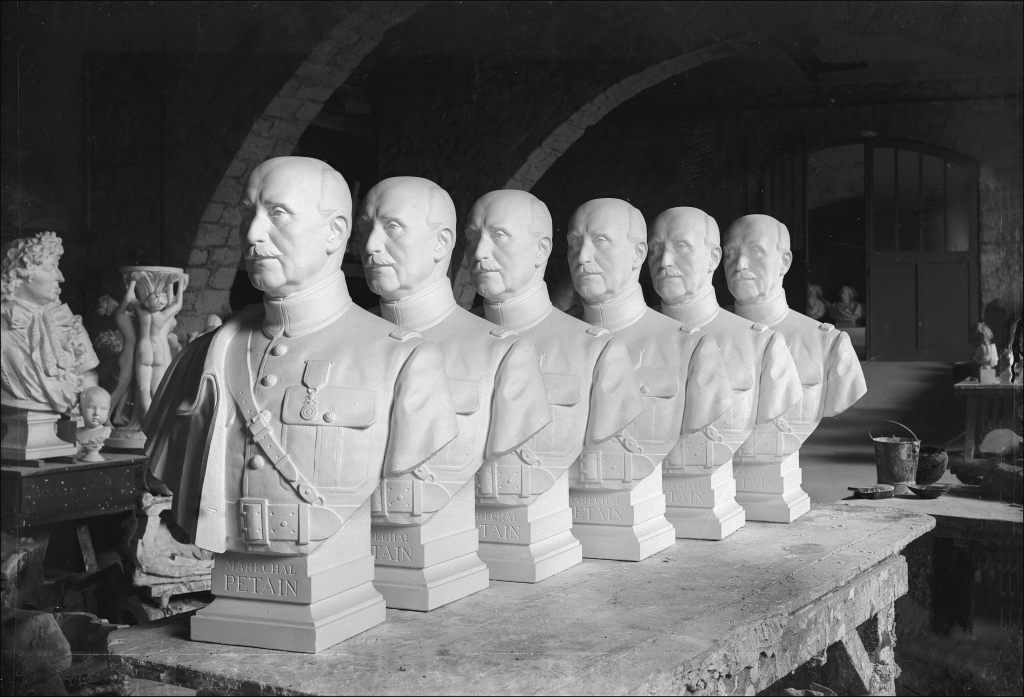
But these protests were not enough to counteract the fear and loathing some Catholic leaders felt for the supposed coalition of Freemasons, Protestants, Jews, and foreigners. Among these was the famed Dominican theologian Réginald Garrigou-Lagrange, who wrote publicly in support of Vichy and declared support for de Gaulle a mortal sin. For Garrigou-Lagrange, there was them, namely, the anti-clerical left, and us, the followers of Vichy. For the same reason, he was an avid supporter of the murderous Spanish dictator Francisco Franco. In a letter to Maritain, he wrote, “I am entirely with the Marshal [Petain, the leader of the Nazi collaborationist government], I see him as the Father of the patrie, blessed with a good sense verging on genius, and as a truly providential man.” Étienne Gilson, the anti-Vichy Catholic scholar, wrote in dismay that Garrigou-Lagrange’s public support for Maurras and Vichy had given Catholics permission to support Vichy in good conscience.
Bishop Auvity was not so much an intellectual as Garrigou-Lagrange, but surely the blessing of the esteemed scholar would have made him feel solid on his collaborationist footing. To the end, Auvity operated out of a fear of the liberal Republicans, and at each decision point he decided to go whatever direction would most clearly work against them. And so he embraced Vichy, and Vichy led him to embrace collaboration with the Reich, and this led him to preach to the faithful that they ought to obey and be loyal to Vichy, even to that dreadful point of urging them to allow themselves to be taken to Germany for unpaid labor. Auvity’s hatred for his traditional political enemies led him—he who thought he was defending old Catholic France—to betray his country to a foreign power and to fail in the duties of his faith.
C.S. Lewis, the English contemporary of these men, described well the dynamic that many faced in these heady and awful years: “The devil always sends errors into the world in pairs—pairs of opposites. And he always encourages us to spend a lot of time thinking which is the worse. You see why, of course? He relies on your extra dislike of the one error to draw you gradually into the opposite one.”
Charles Peguy was a French poet and philosopher who helped lead Maritain toward Christian faith. He died in World War I, but wrote a fascinating essay on the political dynamics of the Dreyfus affair and the years that followed. Péguy himself had been a passionate Dreyfusard. In support for Dreyfus, he saw all the noble qualities of a just and virtuous France.
As time went on, however, he saw this movement curdled by political power into a mere ideology. What had begun with righteous and noble ideals had become just another political faction, and one which was, in his view, materialist and enthralled with power.
“Everything begins as a mystique and ends as a politique,” Péguy wrote. By “mystique” he meant the transcendent commitment to a certain ideal. One enters into public life inspired by notions of justice, liberty, fairness, and right, but in the actual action of politics, one faces repeated temptations to compromise, to put victory above truth and virtue. The great danger is that this process can be imperceptible to the person undergoing it. “An action begun as a mystique continues in politics, and we do not notice that we are crossing the dividing line. Politics devour the mystique and we fail to jump out.” Without knowing it, we make little choices to compromise on telling the truth, or to use underhanded means to achieve our ends, or to slander our opponents. As time goes on, the compromises get deeper and deeper, and we risk losing ourselves altogether.
A reckoning had come, in the end.
It is possible, however, to jump off this terrible train at any point. Maritain did it. Péguy wrote that a person with his or her heart in the right place can discern, finally, where the dividing point is that separates support for one’s ideals and the embrace of the brute political power struggle. If a person chooses to jump out, he will be called a traitor by his political compatriots. But for those who stay on board the train of moral compromise, Péguy had harsh words: “The real traitor, in the full sense of the word, in the strong sense of the word, is the man who sells his faith, who sells his soul and gives himself up, loses his soul, betrays his principles, his ideal, his very being, who betrays his mystique and enters into its corresponding politique.”
Although Péguy died before the establishment of the Vichy government, his words sound like a prophecy about the likes of Auvity. His warning is a perennial one for those who wish to engage in politics in good faith, whether they are on the right or left. “Above all, one must be careful of continuing,” he wrote. “Continuing, persevering, in that sense, is all that is most dangerous to justice and to intelligence itself. To take one’s ticket of departure from a party, from a faction, and never to bother where the train is rolling to, and above all, what it is rolling on, is to put oneself resolutely in the very best situation for becoming a criminal.”
Auvity was eventually forced by Pope Pius XII to resign for his actions during the war, along with other vocal, pro-Vichy bishops. A reckoning had come, in the end. Some church leaders, like Bishop Saliege of Toulouse, had been brave and clear-eyed and kept their honor. But Auvity and those like him had passed up every chance to hop off the train. How might things have gone differently for the suffering French people if they had?