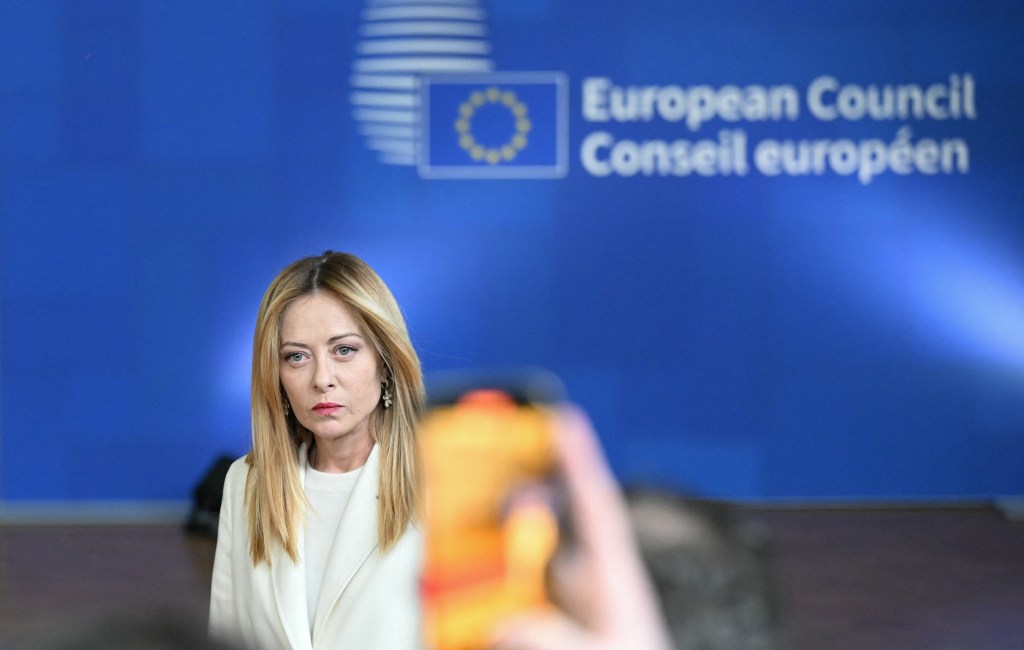
According to a February YouGov poll, Meloni’s net approval rating was 21 percentage points underwater last month—not great, but significantly higher than leaders in the U.K., Germany, Spain, and France. The referendum presents her with both opportunities and political risks ahead of next year’s parliamentary elections, and she has accordingly kept her distance.
Simone Benvenuti, an associate professor at the Department of Law at Roma Tre University, noted that Meloni did not actively campaign in favor of the reform amendment until recently. If Italian voters reject the amendment, Benvenuti told TMD, “I think she will suffer less political impact, precisely because of this political calculus she made that it’s better not to invest too much in directly in political campaigning.”
“Obviously, she did public speeches supporting strongly the referendum,” he continued, “but not in such a way as Matteo Renzi in 2016.”
Meloni began ramping up her public support for the reforms only in the run-up to Election Day, declaring at a campaign event last week, “If the reform doesn’t pass this time, we will probably not have another chance.” But she has simultaneously argued that the reforms will both enhance the judiciary’s independence and prevent judges from issuing decisions that she dislikes, particularly on immigration.
At that rally, Meloni said that, if voters reject the reform, “We will find ourselves with even more powerful factions, even more negligent judges, even more surreal sentences, immigrants, rapists, pedophiles, drug dealers being freed and putting your security at risk.” She told the Italian daily Il Dubbio last week that the reform aims to make the justice system “more modern, fair, accountable, and independent, free from political pressure,” and in a video released earlier this month, she called the amendments “absurdly common sense proposals” to make the courts “more autonomous, more accountable and, above all, free from political constraints.”
During a conference of Italy’s lower legislature, the Chamber of Deputies, Justice Minister Carlo Nordio, a Meloni ally, said the proposal should not be seen as a “punitive” measure against the judiciary, but as “a coherent reform because judges are impartial and third-party, and citizens should perceive them as such.”
The ballot’s phrasing has only amplified the confusion:
Do you approve the text of the law revising Articles 87, paragraph 10, 102, paragraph 1, 104, 105, 106, paragraph 3, 107, paragraph 1, and 110 of the Constitution, approved by Parliament and published in the Official Gazette no. 253 of 30 October 2025 under the title ‘Provisions Governing the Judicial System and the Establishment of the Disciplinary Court?’
Currently, the career track for both magistrate judges and prosecutors runs through Italy’s High Council of the Judiciary, the Consiglio Superiore della Magistratura (CSM). To qualify for either of those roles, applicants must pass a national legal exam, the same test regardless of the applicant’s preferred occupation. CSM then manages the appointments, promotions, transfers, and disciplinary actions of elected judges and prosecutors. Two-thirds of CSM members are elected by their fellow judges and prosecutors, with the remaining third comprised of law professors and lawyers elected by Parliament.
That would all change if voters approve the amendment this week. The reform would split CSM into two independent branches, one for judges and the other for prosecutors, and a third institution, the High Disciplinary Court, would be created to handle misconduct cases involving both judges and prosecutors—a function currently performed by a department within the CSM—with no appeal to Italy’s Supreme Court.
Under the new system, a public prosecutor could no longer become a judge, and vice versa, and the two councils would no longer fill appointments with internal elections. Instead, the amendment proposes introducing a lottery system to select from a pool of qualified judges and, separately, prosecutors. Parliament would have the opportunity to nominate law professors and renowned lawyers for selection in the lottery.
But many details of how this would work in practice are still up in the air. “It’s really difficult to predict what could be the actual outcome of this reform,” Benvenuti emphasized. “The legislature, the Parliament, will have quite some leeway to define the details by implementing the constitutional reform,” such as defining the process for how members of the new two bodies replacing CSM are to be chosen.
“Obviously, the principle is that they will not be elected anymore, but rather selected by drawing lots,” Benvenuti said. “But then, how will this actually work? It’s up to the Parliament to define.”
Though Meloni has argued the proposed amendment would modernize the Italian courts, she has also faced pushback from the legal branch during her leadership. Judges blocked her plans to send migrants to Albania for processing, and separately, Italy’s audit court rejected a bridge construction project connecting mainland Italy to Sicily. “I don’t believe there’s any plan to subvert the will of the people,” Meloni said of the judiciary in October 2024. “I believe there’s a substantial disregard for the will of the people on the part of some [judges].”
Meloni’s tenure has been defined by a mix of pragmatic governance and frustrated ambition. On immigration—her signature issue—irregular Mediterranean arrivals dropped sharply from around 157,000 in 2023 to roughly 66,000 in 2024, despite the legal hurdles facing her Albania plan. On the economy, Italy’s GDP grew just 0.5 percent in 2025—sluggish, though outperforming both Germany and France. Unemployment has hit record lows, and the deficit has narrowed, but debt remains above 137 percent of GDP, and the Iran war is now threatening to be a further drag on growth.
Internationally, Meloni has cultivated a close relationship with Trump—who has called her “a great leader” and his “friend”—while maintaining credibility with European partners. In a speech to the Italian Senate on March 11, Meloni declared that the U.S.-Israeli strikes on Iran fell “outside the framework of international law” and that Italy “does not take part and does not intend to take part.”
Despite her moderate presentation, opponents of the referendum are concerned that the changes will erode Italian democracy’s system of checks and balances and fear that Meloni could try to emulate her ally, Hungary’s Viktor Orbán, who took greater control over the courts to consolidate his grip on power.
When the Italian legislature passed the proposal leading to the referendum in October 2025, opposition leader Elly Schlein was unsparing in her criticism. “This is not a reform that improves the justice system, nor does it help Italians,” she said. “It serves this government to have free rein and put itself above the laws and the Constitution.”
Cesare Parodi, the president of Italy’s National Magistrates’ Association (ANM)—a body representing Italian judges and prosecutors—has also come out against the referendum, warning that law professors and lawyers given a track into the new bodies could be unprepared for the role. “Not everyone who has a driver’s license can drive a Formula One car,” he said. But in Benvenuti’s mind, the “main unsaid concern” of the ANM is that this would noticeably reduce its members’ power in the legal system.
The referendum is ultimately a vote on Meloni’s leadership. But Benvenuti doubts the result, whatever it is, will provoke much public passion. “I cannot imagine people going into the streets because the referendum passed,” he said.