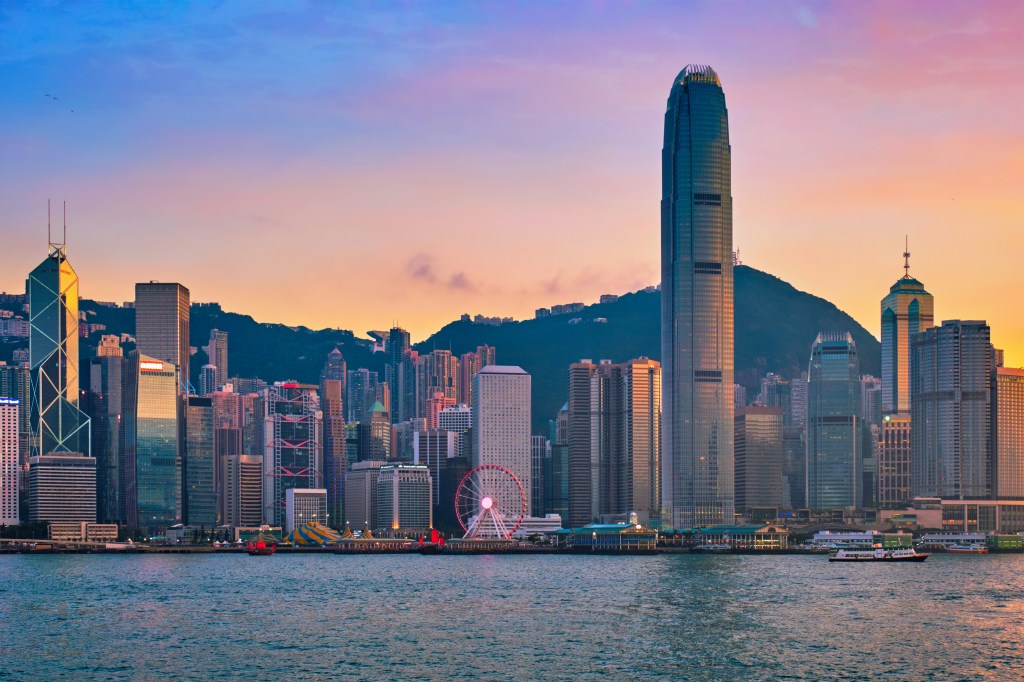
“Hong Kong is where East meets West.”
If you grew up anywhere in East or Southeast Asia in the early 2000s, chances are you heard that line more than once. I did. Growing up in Cambodia and attending a British international school, it was practically a refrain. The phrase captured, in a neat and enviable formula, what many of us hoped our own cities might one day become.
For 156 years under British rule, Hong Kong developed into a rare convergence point: anchored in Cantonese culture yet governed by common law, animated by global finance, and administered through Western institutional norms. Its streets moved to the rhythm of traditional Chinese virtues—family, hierarchy, thrift—while its courts operated under a British legal inheritance, its skyline rose on international capital, and its press spoke with a freedom uncommon in the region.
That fusion earned Hong Kong its enduring epithet: the Pearl of the Orient.
That reputation did not evaporate when the Union Jack came down in 1997. It was carried forward—at least in theory—under the framework of “one country, two systems,” billed as a constitutional guarantee that Hong Kong’s legal order, civil liberties, and economic autonomy would endure for 50 years after the handover. Sovereignty would rest with Beijing; institutional distinction would remain intact. For a time, the arrangement seemed workable. The judiciary retained its standing. Capital flowed in and out with confidence. Newspapers criticized officials with a candor seldom tolerated in Chinese-speaking cities. The compact was never seamless and often strained, but it held.
The first visible rupture came in 2014. Under the Basic Law—Hong Kong’s mini-constitution enacted after the handover—the chief executive would be chosen by universal suffrage. In August of that year, however, China’s top legislative body announced that although Hong Kongers could vote in the 2017 chief executive election, candidates would first need approval from a nominating committee dominated by pro-Beijing interests. To many in Hong Kong, the promise of democratic choice had been reduced to a controlled selection.
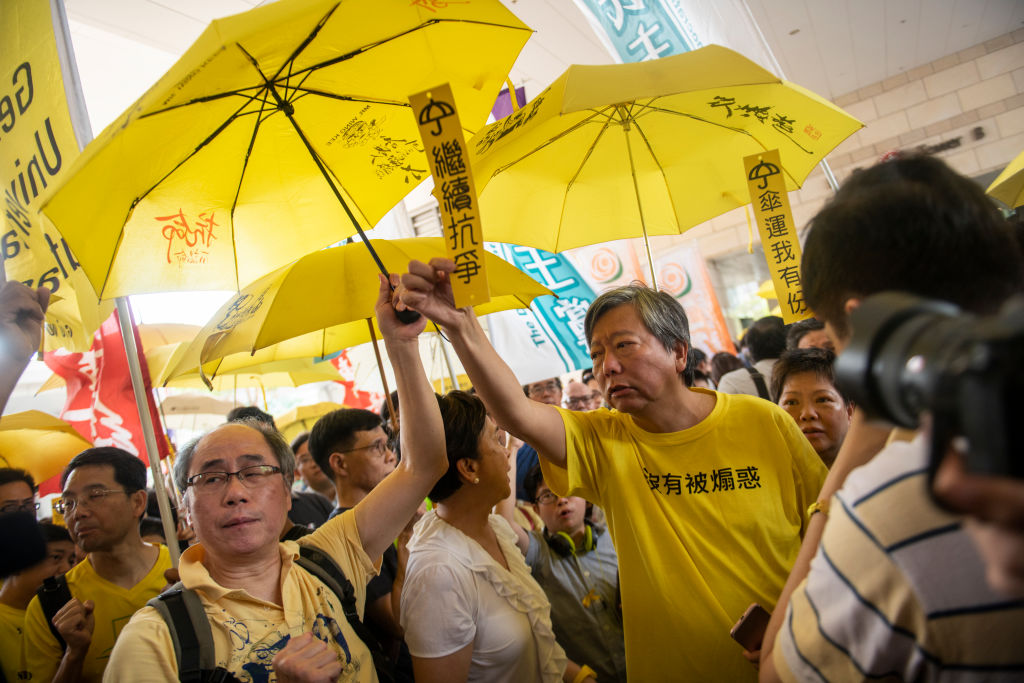
Student groups organized class boycotts. Activists and demonstrators blocked major roads in districts like Admiralty, Causeway Bay, and Mong Kok. On September 28, police deployed tear gas against largely peaceful crowds. Protesters raised umbrellas to shield themselves from pepper spray and other chemical irritants—an improvised gesture that soon lent the movement its name. At its height, tens of thousands filled the streets, demanding open nomination of candidates and the preservation of political freedoms they believed had been pledged to them. After 79 days, the encampments were dismantled, most of them cleared by police with little resistance as the movement’s energy ebbed. Beijing’s ruling stood.
Although the 2014 movement failed to secure its stated goals, it politically mobilized an entire generation of young Hong Kongers, exacerbating the strain between the city and Beijing. This generation had no lived memory of British rule, yet it came of age during the progressive encroachment of the Chinese Communist Party and amid an increasing influx of mainland migrants. For them, the inheritance at stake was a political culture rooted in common law and institutional tradition—one that, in Hong Kong’s case, predates even the founding of the People’s Republic of China in 1949. What many young protesters feared losing, then, was not a borrowed affectation from the West, but a civic framework that had made Hong Kong unique for 107 years longer than communism has molded modern mainland China.
What followed was not reconciliation, but a simmering interlude. The generation politicized in 2014 did not retreat into private life; it carried its disillusionment forward, watching closely as the boundaries of autonomy continued to narrow.
Five years later, Hong Kong ignited again—this time on a far larger and more combustible scale. In early 2019, the Hong Kong government introduced an extradition bill that would have allowed suspects to be transferred to mainland China for trial. Though formally put forward by Chief Executive Carrie Lam, the political atmosphere that made it conceivable took shape under the shadow of a consequential shift across the border.
In 2018, Xi Jinping amended China’s constitution to remove presidential term limits, clearing the way for him to remain in power indefinitely. Since then, China has moved away from cautious integration toward unmistakable consolidation in Beijing under the banners of national unity and the One China principle—marked by tightening controls in Xinjiang, sweeping media regulation, and the steady constriction of civil society.
Hong Kong’s semiautonomous legal order—long protected by an institutional firewall—stood as an anomaly within the People’s Republic. From Beijing’s vantage point, it posed latent risks: activists meeting foreign officials, localist sentiment hardening into political identity, open dissent unfolding in full public view.
The extradition bill would have pierced that firewall, triggering a surge of apprehension across the city. Many Hong Kong residents feared that mainland courts—where judicial independence is subordinate to party authority—would become the final arbiter in sensitive cases. Dissidents, journalists, even business figures could find themselves transferred into a legal system whose ultimate loyalty was political, not procedural. These concerns were not abstract. The earlier disappearances of booksellers and the sudden detentions of prominent tycoons had already eroded public trust. The proposed law seemed to formalize what many suspected was already possible.
By June 2019, the streets swelled with extraordinary numbers—approximately 2 million people in a city of roughly 7.5 million. Over the months that followed, confrontations between protesters and police escalated. Opposition to a single bill expanded into a broader civic uprising, coalescing around five demands: full withdrawal of the legislation, an independent inquiry into police conduct, amnesty for those arrested, retraction of the “rioter” designation, and genuine universal suffrage.
In form and tone, this movement diverged sharply from 2014. It was decentralized and largely leaderless, without a single organization directing its course. Tactics grew more confrontational—barricades erected overnight, Molotov cocktails hurled in desperation, laser beams cutting across clouds of tear gas. Its social base widened as well. Students remained at the forefront, but they were joined by lawyers, accountants, civil servants, small-business owners, and parents pushing strollers through marches that stretched for miles.
Carrie Lam withdrew the bill in September 2019. By then, the rupture had deepened beyond repair. In June 2020, Beijing imposed a national security law on Hong Kong, criminalizing “secession, subversion, terrorism, and collusion with foreign forces.” Beijing presented the measure as a necessary step to restore stability after what it characterized as near-insurrectionary violence. The law bypassed Hong Kong’s legislature and was enacted directly by the Standing Committee of the National People’s Congress (NPCSC).
The timing was decisive. The COVID-19 pandemic had scrambled global diplomacy. Western capitals were preoccupied with overwhelmed hospitals and collapsing economies. Media bandwidth splintered. Governments that might have coordinated a forceful response turned inward. In that vacuum, the Chinese Communist Party moved with clarity of purpose. The national security law remade Hong Kong’s political order in full view of a distracted world.
Electoral rules were rewritten to ensure that only “patriots” could govern. Prominent activists were jailed or driven into exile. Opposition media outlets shuttered one by one. Apple Daily, among the city’s most outspoken pro-democracy newspapers, was forced to close in 2021 after hundreds of police officers raided its newsroom and arrested senior editors and executives. Its final front page read: “Hong Kongers bid a painful farewell in the rain.”
Apple Daily’s founder, 78-year-old Jimmy Lai, was charged with “colluding with foreign forces” under Hong Kong’s national security law. On February 9, 2026, he was sentenced to 20 years in prison. The severity of the punishment confirms what many had long suspected: Beijing’s promise to let Hong Kong govern itself was always provisional, always revocable.
In its 76 years of rule, the People’s Republic of China has rarely confronted a figure quite like Jimmy Lai. He is wealthy. He commanded a mass readership through his newspaper. He possesses an unyielding moral core and the temperament of a self-described “troublemaker.” Any one of those traits would invite scrutiny in a system wary of independent centers of influence. Combined in a single man, they rendered him intolerable.
His case reaches beyond the fate of a stubborn newspaperman. It signals the final inversion of a wager first placed in the late 20th century: that China’s ascent would move toward institutional convergence rather than away from it. Hong Kong was meant to demonstrate that Chinese sovereignty could coexist with liberal norms. That assumption shaped Western engagement and informed Beijing’s own reform calculus. But Lai’s sentence suggests that the experiment has now been adjudicated—and reversed.
To understand how that wager took form, one must return to the late 1970s.
After the devastation of the Great Leap Forward, the convulsions of the Cultural Revolution, and the death of Mao Zedong, China entered the era battered and economically adrift. It was into this landscape that Deng Xiaoping stepped. Across the border, meanwhile, Hong Kong had become one of Asia’s most dynamic financial centers—confident, commercially fluent, and plugged into global markets. Beijing could not fail to notice the contrast.
Affluence also financed new instruments of authority. Capital enabled technological sophistication; technological sophistication enabled pervasive monitoring. Global integration multiplied interdependencies, reducing the leverage of outside pressure. The prevailing wager assumed prosperity would mellow power. It did not account for the possibility that power would harden itself through prosperity.
Deng studied Hong Kong’s success closely as he launched Reform and Opening-Up. In 1980, Shenzhen—then little more than a fishing town—was designated one of China’s first “special economic zones,” chosen in no small part for its proximity to Hong Kong and the example it offered. The mainland’s laboratory of controlled capitalism rose in the shadow of a city that had already proved what secure property rights, enforceable contracts, and an independent judiciary could yield.
When Prime Minister Margaret Thatcher and Chinese leaders signed the Sino-British Joint Declaration in 1984, setting the terms for Hong Kong’s eventual handover, many Western policymakers regarded the moment as more than a diplomatic settlement. They treated it as a proof of concept. As China integrated into the global economy, Hong Kong’s institutional framework was expected to exert a demonstration effect—showing that economic prosperity is inseparable from social and political liberties. Engagement, so the argument ran, would not merely enrich China; it would gradually liberalize it.
The decision to support China’s accession to the World Trade Organization (WTO) rested on the same premise: that sustained exposure to global markets and liberal norms would, over time, temper political centralization and encourage moderation. When advocating for Permanent Normal Trade Relations with China—thereby clearing the path for WTO entry in 2001—President Bill Clinton framed the argument in explicitly transformative terms:
“By joining the WTO, China is not simply agreeing to import more of our products; it is agreeing to import one of democracy’s most cherished values: economic freedom. The more China liberalizes its economy, the more fully it will liberate the potential of its people—their initiative, their imagination, their remarkable spirit of enterprise.”
Clinton was hardly alone in that conviction. Two years after China’s entry into the WTO, American economist Milton Friedman voiced a similar expectation in an interview with Young America’s Foundation:
“I predict that China will move increasingly toward political freedom if it continues its successful movement for economic freedom. […] Hong Kong had complete economic freedom when it was a colony of the British. It had no political freedom whatsoever. There were no votes. It all came down from a benevolent dictator—Britain. So, economic freedom is a necessary condition for political freedom.”
Indeed, the confidence of the early 2000s was not born of naïveté. South Korea industrialized and democratized. Taiwan’s political opening followed decades of export-driven growth. Even in postwar Europe, commercial integration preceded and reinforced political pluralism. The logic seemed observable, even empirical. Prosperity widened the space for autonomy. Property created stakeholders. Education produced expectations. History seemed to move along a discernible arc.
Nonetheless, history is not hydraulic. It does not flow inevitably toward liberty simply because markets expand. Wealth can diffuse authority; it can also entrench it. The middle class does not automatically become a revolutionary class that agitates for political change. Just as often, it becomes cautious—protective of gains already secured, skeptical of upheaval. The more one has accumulated, the more one stands to forfeit, especially when persuaded that paternal stewardship made that rise possible.
The People’s Republic understood this dynamic.
By every material indicator, Reform and Opening-Up succeeded beyond what even its framers might have imagined. Yet rather than allowing markets to dilute party supremacy, the CCP absorbed markets into its governing architecture. Growth became not a solvent of control but a pillar of legitimacy. Economic mobility justified central authority. If rising living standards are visible, if infrastructure gleams, if national pride swells, then political pluralism can be reframed not as destiny but as risk. Stability becomes virtue. Dissent becomes ingratitude. Centralization becomes prudence.
These questions are about the hierarchy of our moral attention. They force us to ask whether our political passions are governed by principle or proximity—whether outrage is stirred by injustice itself or by the comfort of denouncing it at a safe distance.
Affluence also financed new instruments of authority. Capital enabled technological sophistication; technological sophistication enabled pervasive monitoring. Global integration multiplied interdependencies, reducing the leverage of outside pressure. The prevailing wager assumed prosperity would mellow power. It did not account for the possibility that power would harden itself through prosperity. And finally, the theory that economic integration would bend political power toward liberty has met its counterexample in a prison cell.
The line I heard as a schoolboy—“Hong Kong is where East meets West”—once signified synthesis. That slogan has curdled. Today, Hong Kong is where East confronts West—a frontline in a contest between rival orders. Pax Americana or Pax Sinica: a world anchored in liberal democracy against the ascendancy of a technologically fortified authoritarian order.
Jimmy Lai understood those stakes, and he knew exactly what world he wanted to live in. A British citizen, a media magnate with ample means to depart before the knock on the door came, he chose to stay. “I will not betray my people,” he said. “They listened to me and they trusted me—I will not leave them.” In doing so, he accepted the full weight of the state. The cost has been his freedom—and likely the remainder of his life.
Lai’s 20-year sentence carries an unmistakable warning: Speak too freely, and your families may pay the price. For many in Hong Kong, Beijing’s campaign to fold the city fully into a political system most never chose—one their parents or grandparents fled from in 1949—feels less like reunification than civilizational colonization. It marks the reassertion of centralized authority over a society long accustomed to liberties as profound and familiar as any ancestral rite.
In recent years, American campuses have been flooded with demonstrations on behalf of Gaza—often articulated in the charged language of colonialism and genocide, and frequently silent about Hamas’ atrocities. The moral vocabulary has been expansive, emphatic, and relentless. Meanwhile, thousands of Chinese students are studying in the United States; some come from Hong Kong.
Will American students extend their moral vocabulary to this cause? Will they stand beside their Chinese classmates, who must weigh conscience against filial duty? Or will this frontier remain conveniently peripheral? The same questions could be asked of Hollywood and the entertainers who issue political declarations at nearly every major event. Will that industry find its voice for artists of Hong Kong and Chinese origin who have faced pressure for dissent? Or will market access dictate discretion?
But these questions are not, in the end, about student activists or celebrities. They are about the hierarchy of our moral attention. They force us to ask whether our political passions are governed by principle or proximity—whether outrage is stirred by injustice itself or by the comfort of denouncing it at a safe distance. It is easier to protest what carries no personal cost. It is harder to confront a rising power capable of retaliation. The test of conviction has always been whether it survives contact with consequence.
Those who live securely within the free world often mistake it for something expansive and self-sustaining, as though liberty were the default setting of civilization rather than a hard-won deviation from the norm. But the perimeter of the free world is not drawn by coastlines or treaties. It is traced by resolve and sustained by the willingness of citizens to defend principles that cannot defend themselves.
When we fail to stand with those who guard that perimeter—journalists, dissidents, publishers, the stubborn men and women who refuse to bend—the line recedes. Not always dramatically. Often quietly. A newsroom closes. A trial proceeds without protest. A sentence is handed down and absorbed into the churn of the news cycle. The contraction is incremental, almost administrative. And then, one day, we look up and find that what once felt secure now rests on thinner ground.
It may already be too late for Hong Kong. Yet the next tremor will not wait; it is gathering across the strait in Taiwan. There, the question will not concern the fate of a single publisher, however courageous, but whether a self-governing society of 23 million souls can chart its own destiny free from coercion. If Hong Kong has shown how autonomy may be constricted from within, Taiwan will test whether it can be extinguished from without.
That trial will not be decided by statements or summits, nor by the choreography of diplomacy, but by sterner measures. It will turn on whether the free world still recognizes the boundaries of its own perimeter—and whether it possesses the will to defend those who stand upon its outposts.