Authored by Jeffrey Tucker via The Epoch Times,
The International Energy Agency in Paris has released a new and urgent document that it wishes all nations with energy struggles to adopt.
Many are doing that now.
The website even maintains a spreadsheet updated daily to celebrate the countries that are following its plan for controlling energy use.
Before explaining why none of this will work, let’s look at what they are suggesting.
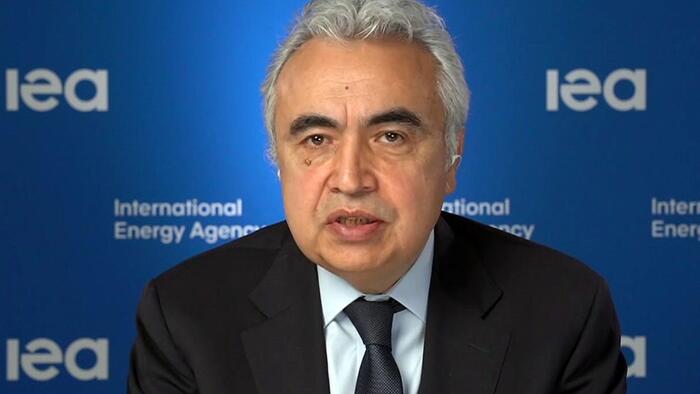
Seeming out of nowhere, the head of the IEA, Dr. Fatih Birol, is being quoted in the high-end press as the world’s expert.

His Wikipedia page says that he is from Turkey but works closely with China on the “energy transition.”
Indeed, he has been a member of the Chinese Academy of Engineering since 2013.
Inspired by the manner in which governments were able to control communication and people during the COVID crisis, the IEA advises the following:
1. Work from home where possible. You read that right: we are back to languishing at home and consuming entertainment through laptops. Some governments (Indonesia, Vietnam, Pakistan, Philippines) have already adopted this policy loosely, with new measures such as four-day work weeks. IEA comments: “Displaces oil use from commuting, particularly where jobs are suitable for remote work.”
2. Reduce highway speed limits by at least 10 km/h. That means lowering all speed limits by 6-7 miles per hour, which is really nothing more than a method to create an annoyance. The IEA says “lower speeds reduce fuel use for passenger cars, vans and trucks,” but is that even true? Not always. Boggy traffic creates more stop/start situations that cause more gas consumption.
3. Encourage public transport. That exhortation has been the dream of city planners for probably 50 years. Not everyone can do this of course and a mandate like that will cause many just to stay home. In this case, IEA is probably correct: “A shift from private cars to buses and trains can quickly reduce oil demand.” But not for the reason you might think. It just means more staying at home.
4. Alternate private car access to roads in large cities on different days. Now we are getting to a policy that drove an entire generation batty in the 1970s. In those days, even/odd license plates were allowed access to gas but this is more intense. Alternating access would require a massive policing effort, one that is without precedent. IEA comments: “Number-plate rotation schemes can reduce congestion and fuel-intensive driving.”
5. Increase car sharing and adopt efficient driving practices. This is easily done in the same way police enforce HOV lanes. You cannot drive alone. You must have other passengers if you are going to be out on the road. One can imagine a future in which people routinely grab a family member or friend to sit in the passenger seat for compliance purposes. IEA comments: “Higher car occupancy and eco-driving can lower fuel consumption quickly.”
6. Efficient driving for road commercial vehicles and delivery of goods. Here we get to the old essential/nonessential divide. Commercial deliveries are allowed because we have to live somehow but driving to the park for a picnic or visiting friends and families is not.
7. Divert LPG [Liquefied Petroleum Gas] use from transport. This is the planner’s vision to preserve propane for “essential needs.”
8. Avoid air travel where alternative options exist. You will surely notice that this is already happening. My recent flight bookings have doubled in price. Because of the limited government shutdown, airport security lines can be 2-3 hours. People miss flights or simply bail out and go home. This is also causing connections to fail. Events this weekend that relied on travel are a bust. IEA comments: “Reducing business flights can quickly ease pressure on jet fuel markets.”
9. Where possible, switch to other modern cooking solutions. Earlier we saw an exhortation to save propane for cooking but here we see that this is not recommended either. We are supposed to switch to electric appliances. IEA comments: “Encouraging electric cooking and other modern options can reduce reliance on LPG.”
10. Leverage flexibility with petrochemical feedstocks and implement short-term efficiency and maintenance measures. This advice is directed toward energy plants to switch from one source to another to conserve oil. This suggestion reaches deep into industrial planning and would require draconian enforcement.
There are features of this plan that surely remind you of what we went through just a few years ago for purposes of controlling infectious disease. It’s uncanny how there is a spooky overlap between those methods and these. They all require staying home, hunkering down, reducing consumption, complying with edicts, feeling afraid both of shortages and of methods of enforcement.
To be sure, you could say that the International Energy Agency has no actual power. It was founded in 1974 to monitor global energy use. It has more recently been a top advocate of net-zero energy policies associated with what is known popularly as the “Great Reset.” It is not a private organization as such but a non-government branch of the Organization of Economic Cooperation and Development, meaning quasi-official but without the power to enforce its edicts.
In this way, the IEA bears some resemblance to the World Health Organization that is within the United Nations framework. The WHO has no enforcement power either but its pandemic declaration and recommendation to the world that everyone adopt the methods of the CCP had a major influence. It has what is called soft power—not coercion but authoritative and something that every government can use as cover for misdeeds.
Most people today have never heard of the IEA, but the same was true of the WHO just six years ago, until it became a controlling force in our lives. At one point, Internet censorship was so intense that YouTube announced that it would not permit any video that contradicted the advice of the WHO. That really happened. The same could happen here as well.
None of these measures will reduce the price of oil, gas, or anything else. What you don’t consume, someone else will. This is the whole point of rationing, to make sure that resources flow to uses deemed essential and away from those deemed unessential.
A quick note on air travel: I’ve noticed for years now that it has become ever more arduous and expensive and invasive. It’s to the point that I would rather take a 6-hour train ride than a 90-minute flight. That’s especially true now that you need to get to the airport 3-4 hours ahead of your scheduled flight to have any hope of getting a seat. At some point, it just becomes too much and people decide that it is not worth it. Thus the goal is achieved of essentially putting an end to commercial airline traffic.
To be sure, all this could end in a matter of weeks. If peace dawns in the Middle East, the Strait of Hormuz is opened, and refining capacity grows, the price will fall. Also the Transportation Safety Authority could come back to work and the lines fall. Normalcy would return. Prices go way down and everyone chills.
How likely is that to happen? My intuition suggests that it is not likely. We seem to be headed into another lockdown situation under different excuses and with a different goal. I hope I’m wrong.
Regardless, none of these measures being pushed today are going to ameliorate the problem. The only result will be to increase the control grid over your life.