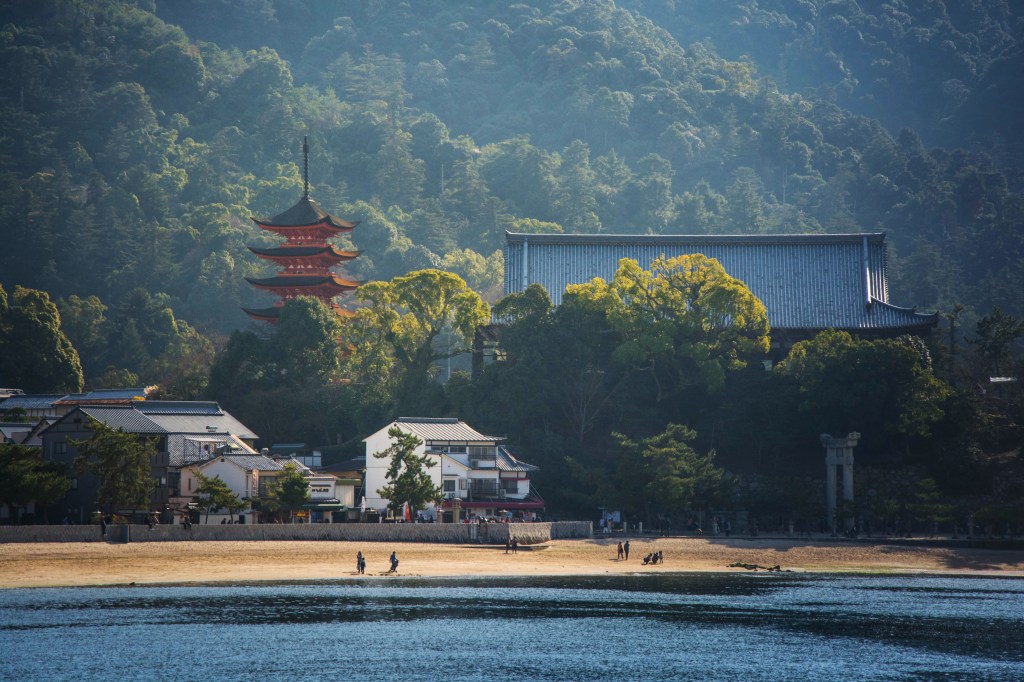
Hiroshima is one of the most beautiful cities in Japan. Whenever I visit, the first thing that immediately sticks out to me is nature. Rivers flow into the main metropolitan area, which itself is home to numerous parks and clean streets adorned with greenery. To the north lies the Chugoku Mountains, which are covered in lush forests and snowy peaks. To the south is the Seto Inland Sea, one of Japan’s most vital waterways and an azure landscape dotted with picturesque islands. Miyajima has its famous giant red torri gate and curious deer who follow tourists for food. Okunoshima, better known by its moniker Rabbit Island, is populated by hundreds of bunnies due to their lack of natural predators.
Nagasaki, too, is one of the country’s most underrated destinations. The charming European architecture owes partially to the city’s surprisingly deep Christian tradition, while its fresh seafood and renowned champon ramen come highly recommended. Nagasaki’s artificial island Dejima carries historical importance for being the only place Westerners could visit Japan during the isolationist Edo period, with its current reconstruction now serving as a fascinating museum. Go off the beaten path to Nagasaki Bio Park and you can pet the zoo’s adorable capybaras, which have gone viral on social media.
These descriptions paint a picture of fun travelogue destinations, but Hiroshima and Nagasaki are, obviously, inseparable from arguably the two most important, and tragic, moments of the 20th century. On August 6 and 9, 1945, the United States detonated two atomic bombs over these cities, and this and the Soviet Union’s subsequent invasion led to the official surrender of Japan less than a month later.
The higher estimates place those killed in each place at around 140,000 and 70,000 people, respectively, but that does not include the thousands more who suffered and died from the long-term effects. Going to either city’s museum and peace memorial will provide you with a harrowing education on the leukemia, severe burns, birth defects, and social discrimination Japan’s declining population of atomic bomb survivors known as hibakusha have dealt with throughout the past 80 years. It’s not just a Japanese tragedy either; Korean civilians and even American prisoners of war count among the victims.
Hiroshima and Nagasaki are now synonymous with all nuclear-related issues. The fierce debate over whether it was “right” for the U.S. to utilize the atomic bombs has not diminished despite the decades that have passed. Christopher Nolan’s Oppenheimer, a biopic on the eponymous scientist who led the Manhattan Project, once again brought these discussions to the forefront when it hit cinemas in 2023. Many praised it for its nuanced take on the man himself, but arguably the most notable point of criticism was Nolan’s choice to not show the destruction of Hiroshima and Nagasaki itself after the bombs were dropped. As Spike Lee put it: Out of the film’s three-hour runtime, there should have been “some more minutes about what happened to the Japanese people. People got vaporized.”
Contrary to the backlash Americans thought it would receive, Japanese reception of Oppenheimer was generally positive, and the film performed well at the box office. Reception in Hiroshima itself was somewhat more mixed, with some echoing Lee’s criticisms, while others praised Nolan’s direction and storytelling. In short, it was essentially the same discussion the rest of the world had about the film—hardly some huge controversy that caused nationwide outrage across Japan.
This is perhaps the biggest point that Americans miss when it comes to discussing Hiroshima and Nagasaki. If you visit Hiroshima and Nagasaki today, you will not find signs of bitterness or hostility. People go about their lives as normal without constantly obsessing over the past. During my last visit to the Hiroshima Peace Memorial, which contains the only surviving structure from the bombing, the mood was solemn, not angry. I took a picture of a Japanese family, and when they learned that I was an American living in Japan, we had a pleasant conversation that was anything but confrontational.
It should go without saying, but times have changed and people have changed. Japan as it exists in 2026 bears no resemblance to the Japanese Empire that waged a war of conquest against Asia. While education about the atomic bombs is part of the mandatory school curriculum throughout the country, the general consensus is that it was the tragic end to a tragic war that should never be repeated again. For decades, there has been a rich discourse around Japan’s role in the conflict. Films such as Fires on the Plain, The Human Condition, and Under the Flag of the Rising Sun are critical of the consequences from wartime decisions made by Japanese leaders, while other works like Barefoot Gen, Children of Hiroshima, and even the original Godzilla address the atomic bombings themselves from a variety of perspectives.
Unsurprisingly, this is a highly politicized issue on both sides of the Pacific. In the United States, left-leaning progressives cite Hiroshima and Nagasaki as examples of brutal American imperialism, while those on the right such as Tucker Carlson and Pat Buchanan condemn the bombings as part of their overall revisionist framing of World War II as an “unnecessary” conflict. In Japan, progressives have historically been critical of both the Japanese government and the United States for the outcome of the war, and these individuals are typically at the forefront of the modern anti-nuclear movement. While this is not always a partisan issue in Japanese politics (former conservative Prime Minister Junichiro Koizumi is against nuclear power, for example), Japanese leftists often take their war guilt too far and end up carrying water for oppressive regimes like China. Conversely, the far-right use Hiroshima and Nagasaki to portray Japan as the victim, not the oppressor, while they engage in wholesale denial of war crimes to further a nationalist agenda. It should be emphasized that all of these are small but vocal groups that utilize selective evidence to push their respective points of view.
The Japanese government itself has repeatedly apologized for World War II and acknowledged its role as an aggressor. Former Prime Minister Tomiichi Murayama’s 1995 statement on the 50th anniversary of the war emphasized in no uncertain terms that Japan “caused tremendous damage and suffering to the people of many countries, particularly to those of Asian nations.” While individual politicians have made controversial remarks to the contrary, subsequent prime ministers, even conservative ones like the late Shinzo Abe—who could not have been further away from Murayama politically—have upheld this as Japan’s official stance.
Both sides can argue whether this show of force was necessary, but we are judging the decisions of people who lived in the 1940s with the luxury of 21st-century hindsight. It is often forgotten by the American public that the United States had been waging an offensive against Japan with conventional firebombs for months before August 1945. Gen. Curtis LeMay’s incendiary raids over Tokyo in March 1945 are estimated to have killed 100,000 people in one night alone. Bombings of other cities led to the deaths of around 500,000 in total, far more than Hiroshima and Nagasaki combined. Amid that backdrop, the atomic bombs were viewed as an extension of what had already been occurring. Manhattan Project scientists had significant inklings about the short-term effects of the radiation, but the long-term effects were not yet fully understood and did not play a factor in the military’s decision.
As elucidated by historian Max Hastings, the mistaken notion that Japan was on the verge of surrender is also significantly divorced from context. It is indeed true that the Japanese economy had been almost completely destroyed by the war, that its major cities lay in ruins, and that the general populace was on the brink of starvation due to food shortages. At the same time, the Japanese government was highly fractured and not clear on what course it should take. Some factions wished to sue the Allies for peace, while militarists went as far as launching a failed coup to overthrow Emperor Hirohito on August 14 to prevent surrender and keep the war going. Could the Allies have fought on the ground all the way to the Imperial Palace in Tokyo, or even just blockaded Japan until the country’s leaders conceded?
Perhaps. But the fact that the United States military continues to award Purple Hearts today that were initially manufactured for a land invasion of Japan that never happened is a testament to the sheer number of casualties American leaders were anticipating. It is difficult to look at the available evidence and not come away with the conclusion that the atomic bombs were the least worst option based on what intelligence the U.S. had and the Japanese government’s lack of consensus on surrender. Shogun author James Clavell later said that if it were not for the atomic bombs, he and other prisoners of war would have likely been executed by their Japanese captors.
Regardless, there will certainly never be a final word on the subject. A Gallup poll conducted around the 80th anniversary of the bombings last year revealed that 35 percent of Americans viewed them as justified, 31 percent viewed them as unjustified, and 33 percent were unsure—a sharp change from 85 percent of Americans who supported the bombings when polled in 1945. More fascinating, however, is how the Japanese side views the end of the war. A Japan Broadcasting Corporation survey from 2015 revealed that 44 percent of Hiroshima residents, 41 percent of Nagasaki residents, and 40 percent of Japanese people nationwide believed that the use of the atomic bombs “was unavoidable.”
The fact that the U.S. military continues to award Purple Hearts today that were initially manufactured for a land invasion of Japan that never happened is a testament to the sheer number of casualties American leaders were anticipating.
Nearly forgotten today is the time when Oppenheimer visited Japan in 1960. One might have expected mass protests in the streets against the man. Yet this did not happen. There were no major demonstrations reported, and Oppenheimer was able to complete his lecture tour sponsored by the Japan Committee for Intellectual Interchange without incident. Despite the sensitive nature of his visit, the Japanese public appeared to be less interested in vengeance and more focused on understanding the atomic scientist’s work itself. Halls in Tokyo, Kyoto, and Osaka were packed with visitors who wished to hear about his research and views on the moral responsibilities of nuclear technology. Some today may be shocked at the apparent lack of ill will, but one has to remember that 15 years had passed since Japan’s surrender, the American occupation was over, and Japan was now a reformed nation that wished to be part of modern international society.
In Japan, Oppenheimer did not apologize for anything. Was that cowardly? I believe it was instead him acknowledging that what happened was already a part of history, and that learning from the past was the only thing that could practically be done. Decades later, this is also the best way to understand and reflect upon one of the most paramount chapters of history. Whether you believe that using the bombs was the correct decision or not, few are aware of their context and what caused the United States to come to this crossroads to begin with. Frankly, most Americans today are still quite ignorant about Hiroshima and Nagasaki. I recently wrote on social media about how I enjoyed visiting Hiroshima, especially compared to the lack of tourist crowds compared to where I live in Kyoto. But I received a few replies that brought up the atomic bomb as if there are no other compelling aspects to the city. It’s not just online discourse, either. More than a few Americans I’ve talked to are under the impression that the place is still radioactive (it’s not), while often forgetting that the residents, while they do not forget this part of their history, have processed and moved on.
Hiroshima and Nagasaki are not like Auschwitz or Dachau, where visiting is a dark experience with few traces of light. If those places are a somber tribute to the victims of the Holocaust, these cities are symbols of life, forgiveness, and our human capacity to heal. If they’re able, all Americans should go to Hiroshima and Nagasaki to learn about what happened. But once you leave the peace memorials, the rest of Japan is right there as living proof that beauty can arise out of destruction.
Americans have always had a difficult time wrestling with the darkest aspects of their history. Slavery, treatment of indigenous peoples, and other sins of the past are constantly at the center of political and social disputes, especially now as political polarization is worse than ever. The Japanese approach to Hiroshima and Nagasaki, however, shows a better way. Japan’s relationship with its Asian neighbors over historical issues may not be perfect, but when it comes to reconciliation with its former American enemy, there is perhaps no better success story. The United States and Japan have long buried the hatchet and maintain one of the strongest alliances on earth. If Japan is able to remember the past without being defined by it, Americans are more than capable of learning how to do the same.