If I were the president of Panama, I’d be watching the skies over my canal right now, as a bully who’s been punched in the nose and has something to prove will be looking for a pipsqueak he can rough up to reassert his dominance. And if I were the prime minister of Denmark, by no means would I assume that the threat has passed. A guy who ran for president vowing to take retribution on those who’ve crossed him, and who continues to exact it even against longtime MAGA allies, won’t forget how a bunch of Euroweenies showed him up.
“When scholars write about America’s decline, they’ll cite this episode as a hinge point. It’s genuinely one of the stupidest, self-defeating things a U.S. president has ever done.”
The Greenland saga isn’t over—but since it’s now been, uh, “paused,” we can pause, too, to take stock of it. I’m inclined to call it the biggest American strategic debacle of my lifetime that hasn’t (yet) involved a body count. The United States gave up something immensely, incalculably valuable and got squat in return.
Call it the art of the deal, I guess.
Going bankrupt.
I’m not a criminal, so the risk-reward calculus of committing a crime doesn’t occur to me intuitively. But if I were determined to mug someone in broad daylight, in full view of my neighbors, it seems to me I’d need to make sure I made away with something lucrative for my trouble.
That’s the only way to justify the immense risk involved. I might get caught, after all, or I might be assaulted by my victim or passersby. Even if I completed the mugging successfully, word would spread that I’m a thief and that those who encounter me should treat me accordingly.
I’d have a lot to lose from all of that, so I’d need to gain a lot in order to make it worth my while. What did the mugger-in-chief gain from pulling a gun on Denmark, and by extension NATO, and telling them to stick ‘em up?
He destroyed 80 years of eager European cooperation with America. For nothing.
Worse than nothing, actually. He’s incentivized Western powers to form a sort of “neighborhood watch” aimed at preventing future muggings by the United States.
I thought a casino would be the most profitable thing Trump would ever bankrupt, but bankrupting global trust in the world’s dominant power since 1945 in the span of a year is a catastrophe that warrants “Great Man of History” treatment. When scholars write about America’s decline, they’ll cite this episode as a hinge point. It’s genuinely one of the stupidest, self-defeating things a U.S. president has ever done.
Officials on both sides of the Atlantic will try to paper it over and deny publicly that the alliance has been “destroyed,” as life will be easier that way. For now, Europe still needs American help in Ukraine and an American backstop for NATO as it rebuilds its military capabilities, and its leaders surely understand that someone like Trump who divides reality into friends and enemies will be more willing to grudgingly continue that help if he’s still formally being treated as a friend.
But he isn’t a friend, and Europe knows it. “Our American Dream is dead,” one European Union diplomat told Politico this week. “Donald Trump murdered it.” Another diplomat described the summit being held today among European powers as a conversation about “de-risking” from the United States. A third went full Godwin, insisting that “we are past Munich now” with respect to the White House’s territorial ambitions and “we realize that appeasement is not the right policy anymore.”
Congratulations to the president and his voters for inspiring a Nazi analogy that isn’t entirely crazy. It’s a real achievement.
“Appeasement doesn’t work” is in fact the big lesson from this incident, another thing that makes the outcome worse than nothing from Trump’s perspective. By backing down after European leaders rallied behind Denmark against his tariff threats, he demonstrated that future victims of his bullying would be wise to make common cause against him. Canadian Prime Minister Mark Carney made the point explicitly in a celebrated speech on Tuesday, in fact: “The middle powers must act together,” he warned his European colleagues, “because if we’re not at the table, we’re on the menu.”
An economically powerful Western liberal bloc that used to operate more or less at the direction of the United States is now coming together to hold us in check. China, a sinister totalitarian state, is becoming a more attractive economic partner than America due to its comparative stability and will gain new opportunities for power projection by partnering with the European bloc in areas of mutual interest. (It’s already begun.) I can’t think of a more costly strategic mistake that didn’t involve thousands of U.S. troops dying.
And it may yet lead to thousands of U.S. troops dying long after Trump is gone. Given how this episode has destabilized the prevailing global order and inspired fear and loathing toward our country, America may have planted undetected seeds of future conflicts here that will sprout in the fullness of time.
The pursuit of Greenland went about as badly as it feasibly could have, right down to the president putting the planet on notice that he’s crazy with that deranged letter he sent to Norway’s prime minister. But at least it’s over now. Isn’t it?
The eternal shakedown.
It doesn’t sound over to me.
Lost in the hype over a supposed “deal” on Greenland yesterday was what Trump told European diplomats when he addressed them in a speech in Davos, Switzerland. “We want a piece of ice for world protection, and they won’t give it,” he whined. “You can say yes and we will be very appreciative. Or you can say no and we will remember.”
“We” might not remember, but he will.
I guarantee that he’ll try again at some point to mug Denmark and its allies for Greenland. “His overriding interest is to expand the map of the United States,” one Biden-era national security official explained to Politico. “Sooner or later he’s going to come back to that.” Indeed. Possessing the island is “psychologically important” to him, remember. Having strategic access to it isn’t what captivates him; what captivates him is the opportunity to take something of great value from someone else and knowing that there’s nothing anyone can do to stop him.
Some muggers do it for the money, some do it for the thrill. Character is destiny.
Another reason I’m confident that the president will try again is that it wasn’t really the resolve Europe showed in refusing to appease him that caused him to TACO in this case—not directly, at least. It was the sharp decline in the stock and bond markets that followed his tariff threats over Greenland, the same thing that spooked him into pausing his “Liberation Day” tariffs last year. Europe’s economic saber-rattling helped drive those markets lower, but if investors hadn’t flinched, I doubt the president would have backed off and sought a face-saving deal.
Trump’s ego is heavily invested in the reputation he gained during his first term as a prosperity president. Market tremors, especially in an election year, might be the last form of deterrence that’s effective against him. But there’s a problem: Per economist Arin Dube, markets have tended to adjust to his insanity over time. And as they adjust, the sharp shocks needed to deter him are destined to occur less frequently.
“The markets want to price in TACO, but TACO needs Trump to see stocks tank,” Dube explained. “So we get these cycles where Trump does stuff and nothing happens (because the market has priced in TACO) … which encourages him to do more stuff until the markets actually think he may not TACO and prices start to fall … which restores TACO.” The more sanguine investors become about him doing nutty stuff in the belief that he’ll retreat eventually, the less likely they are to panic-sell—which in turn means that sharp market declines, the very thing that causes Trump to reverse course, will happen less often and require higher thresholds of nuttiness to trigger them.
The next time he comes for Greenland, in other words, markets may be so inured to his brinkmanship that a huge selloff won’t begin until the 101st Airborne is parachuting into Nuuk. If you doubt that, consider how strong the S&P 500 has been over the last six months despite the fact that the president has dialed up tariffs to the historic degree I mentioned earlier. Investors, like voters, are to some degree boiling frogs.
A third reason he’s apt to revisit Greenland is that he’s taken an interest in developing his own bloc of international allies (well, cronies) who are likely to support him in whatever he does.
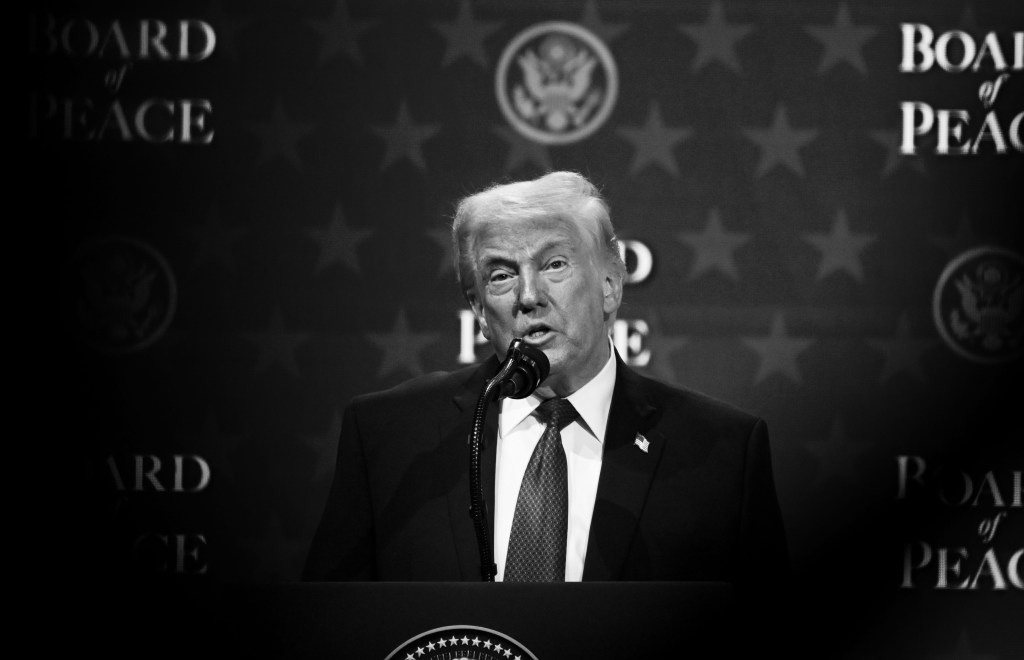
That would be the so-called Board of Peace, which was formed with United Nations backing to oversee the reconstruction of Gaza but is already turning into one of those familiar official institutions that exists chiefly to serve Donald Trump’s personal needs. Trump will serve as its chairman until he resigns—conceivably past the end of his presidency—and is requesting (although not mandating) $1 billion from each member as a condition of joining.
Nations that have already signed on include Saudi Arabia, Belarus, Pakistan, Uzbekistan—and Israel, which has little choice but to accommodate its patron. (China is mulling, Russia is bargaining.) European nations like France, Norway, Sweden, and Denmark have said no, however, causing Trump to react predictably. You can understand why they’re leery. This new body will inevitably see its remit drift from Gaza to rubber-stamping various bullying U.S. tactics abroad, a self-serving simulacrum of international consensus à la the Warsaw Pact. If Europe were to sign on, it would soon have to choose between letting itself be drafted into the effort to legitimize the president’s next dubious foreign power play or quitting.
In short, if Trump takes another stab at Greenland, he’ll do so knowing that numerous nations will be compelled to join him in arguing that, y’know, the U.S. really should own it. Strength in numbers: That’s all the more reason for him to try.
I expect he’ll wait until after the midterms, at which point he’ll have no remaining reason to care what voters or investors think of his policies apart from how those policies will shape his legacy. And what a legacy for a nationalist with delusions of imperial grandeur if he were to seize Greenland! That’s worth a market crash and an approval rating of 25 percent, don’t you think?
Collective responsibility.
Last night a tweet from a Danish economist caught my eye.
It addressed a subject for which my editors have given me some gentle yet firm flak lately, my habit of blaming “Americans” for Trump’s abuses. Aren’t I being a little glib in doing so?
“Americans” as a group didn’t elect the president. Americans didn’t even hand him a majority of the popular vote in 2024. Frankly, if that election were held again today, it’s a safe bet that many of the people who provided him with his margin of victory would find something else to do with their time. Trump voters bear blame for his attempted mugging of Greenland but surely Kamala Harris voters don’t.
Speaking as a Harris voter: Of course we do.
Not direct blame, of course, but we’re all Americans. We all consent to, and participate in, the democratic system that barfed up Trump. More to the point, we all contribute to the culture that shaped him and has delivered him to the precipice of autocratic power. If you believe in the concept of an “American People” to which we all belong, as I and most others do, I find it not the least bit troubling to say that the People collectively bear responsibility for the actions of their chosen leader.
Especially when they continue to enable him as he behaves like a degenerate gangster toward countries like Denmark that fought, and died, alongside American soldiers in Afghanistan.
“The problem isn’t Trump. The problem is the U.S.” wrote Lars Christensen, the aforementioned economist. “When the outside world observes Trump’s insane behaviour and his threats against allies, and we at the same time observe that there is no real action from the U.S. public, Congress, the U.S. Supreme Court, or the U.S. media about this insanity, we will all have to conclude that the U.S. accepts this behaviour.” What other fair conclusion can there be about the American People?
“Europe has now completely lost trust in the U.S. And so has Canada,” Christensen continued. “It is up to the people of the U.S. to demonstrate that Trump is an ‘outlier,’ and it is up to the American people to stop him.” Not only aren’t Americans going to stop him, it’s assuredly the case by dint of his fascist personality cult that Trump is less likely to be removed from office than other modern presidents were. Even his approval rating after a year of relentless insanity is scarcely different from George W. Bush’s or Barack Obama’s was at this point in their second terms.
And while hope springs eternal that postliberalism’s viability in America will die when Trump does, I think that’s naïve. Our allies “now know that there is considerable appetite in the American population for at least some form of Trumpism,” David French observed today, zeroing in on the nature of Europe’s disenchantment. “They know that one of the two American parties is firmly in the hands of people—including Vice President J.D. Vance—who may even be more hostile to NATO than Trump himself. They’ve watched as former Trump opponents, men like Marco Rubio, have been assimilated into the MAGA machine.” As Christensen said: This is an America problem, not a Trump problem.
Believe me, I understand and share the visceral impulse to disclaim responsibility for the actions of an idiotic gargoyle who was willing to wreck the Pax Americana for the sake of stealing an iceberg and then didn’t even steal it. But if there’s a consistent theme of this newsletter, it’s that we should reckon honestly and urgently with the national character of a people that preferred to put the fate of the planet in the hands of said gargoyle following a coup attempt and four criminal indictments. If it mortifies anyone to think that “Americans” collectively placed the gun in Trump’s hand that he used to try to mug Denmark, that’s good. It should. A little more collective shame among our population might go a long way.
As long as the American People continue to express a taste for postliberalism through their elections, postliberal scumbaggery is an “America problem.” Europeans won’t forget that when this is over, nor should they.