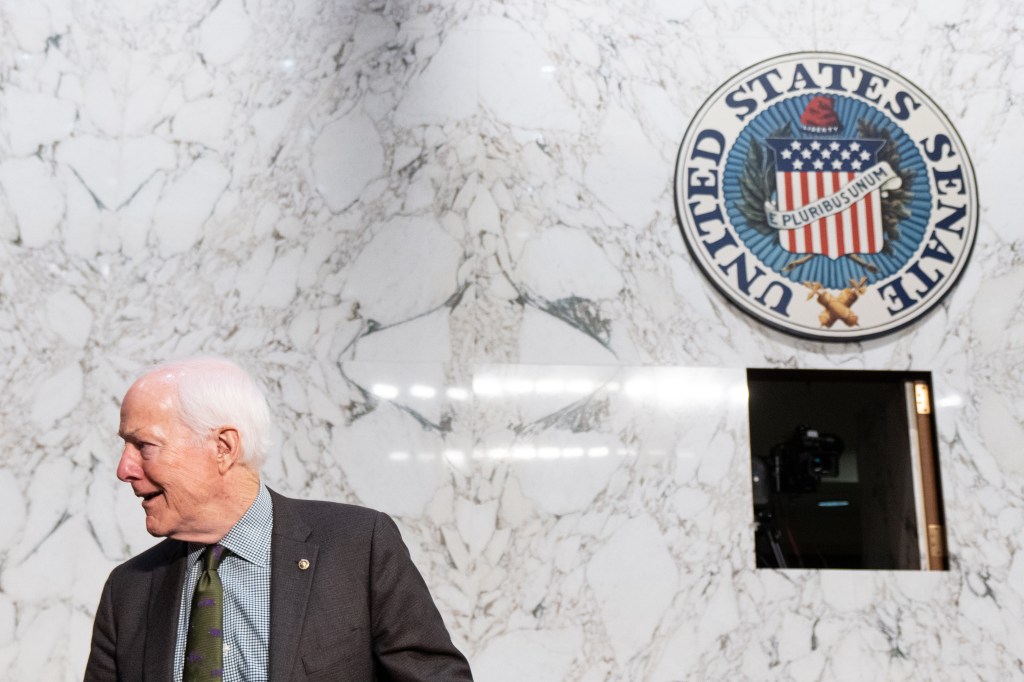
Why not stand up on your hind legs, act like a man, and demand that Congress do its duty in the consequential matter before you? You literally have nothing to lose—no future political prospects, no standing, no reputation. Even if you get reelected, you’re finished—well past the apex of whatever it once meant to be Sen. John Cornyn. On the other hand, you have much to gain. Redemption and reconciliation begin with penance. Now is the time—not after the election, not when things have calmed down, not when it seems Trump’s influence is once again waning—now. You do not have to wait on anybody: not Trump (who withheld his endorsement in part because he wanted to publicly humiliate you), not the voters, no one—only your own conscience. So pull the trigger, already.
If you will not do your duty, then you should resign.
And so I repeat my question: What, exactly, is the point of you?
Economics for English Majors
You have heard the expression: “It is an ill wind indeed that blows no one some good.” The phrase often is used in a way opposite to its meaning, to announce an “ill wind” that is an unalloyed evil. What the phrase actually is meant to communicate is something more like the proverb holding that “every dark cloud has a silver lining,” One man’s loss is another’s gain, etc. Seemingly catastrophic developments often end up being good for someone.
A little simple economics is enough to illustrate that: The Trump administration’s illegal war in Iran has sent oil prices higher, and that is almost always treated in the press as a self-evidently bad thing. The press is very funny about prices: Rising gasoline prices are bad, rising house prices are good until they aren’t, rising labor prices are pretty much always good, etc. But rising oil prices and rising natural gas prices are very, very good for many Americans: The U.S. energy industry is the world’s No. 1 producer of both oil and natural gas. The energy industry is pretty sophisticated about pricing: Unlike some industries with a more short-term view of the world, U.S. oil and gas keep their eyes on a pricing sweet spot: Prices high enough to keep their producing assets very profitable, but not so high as to lure new producers into the marketplace or to provide a spur to change consumer behavior.
Things that are good for the energy industry are not only good for a couple of fat-cat executives at big companies with names you have heard of. They are good for all sorts of people—white-collar, blue-collar, engineers and finance guys and truck drivers—and all sorts of communities from Texas to New Mexico to Pennsylvania. I remember a sign at a restaurant serving fracking crews in Pennsylvania advising customers not to worry about their dirty boots: “No mud on the floor, no cash in the drawer.” Of course, other Americans will howl at relatively high gasoline prices, and the guys who sell F-350s will experience some customer hesitancy at the margins if that $100 fill-up goes to $140.
Trade-offs! As Thomas Sowell says, “There are no solutions, only trade-offs.”
Words About Words
We first come across that “ill wind” business in The Proverbs of John Heywood, though one assumes, from the retrospective nature of that work, that the phrase had been around for some time. The proverbs are worth reading on their own, but I especially recommend this edition with a very entertaining foreword by Julian Sharman. Sharman describes the struggling state of English literature under the French-speaking Normans—“Norman yoke” and all that—who sought to suppress the language: “Antiquity was dead, but not without issue. Already patient monastics had begun to embalm the decaying Saxon saws and sentences in hideous cerements of rhyming Latin.”
“Hideous cerements of rhyming Latin” etc.—what a sentence.
Heywood’s Proverbs (a work originally bearing the title “A dialogue conteinyng the nomber in effect of all the prouerbes in the englishe tongue compacte in a matter concernyng two maner of mariages, made and set foorth by Iohn̄ Heywood”) is full of good and interesting stuff beyond that ill wind.
But you, to cast precious stones before hogs,
Cast my good before a sort of curre dogs.
And sawte bitches. Whiche by whom now deuoured,
And your honestee amonge theim defloured,
And that ye maie no more expence afoorde,
Nowe can they not afoorde you one good worde.
And you theim as fewe. And olde folke vnderstood,
Whan theues fall out, true men come to their good.
Whiche is not alwaie true. For in all that bretche,
I can no ferthyng of my good the more fetche.
Nor I trow theim selfes neither. If they were sworne.
Lyght come lyght go. And sure sens we were borne,
Ruine of one rauyn, was there none gretter.
For by your gyfts, they be as little the better,
As you be muche the worse. And I cast awaie.
An yll wynde, that blowth no man to good, men saie.
Wel (quoth he) euery wind blowth not down the corn
I hope (I saie) good hap be not all out worn.
I will nowe begyn thryft, whan thrifte semeth gone.
The “ill wind” proverb shows up in Henry IV Part 2:
FALSTAFF What wind blew you hither, Pistol?
PISTOL Not the ill wind which blows no man to good.
If ever I start a breakfast restaurant, I will call it The Norman Yolk.
Some shameless pedantry here: Press materials for a new movie about the Second Punic War related that Denzel Washington will play the role of “Hannibal Barca.” There was no such person as Hannibal Barca—the Carthaginian general known to history simply as “Hannibal” was the son of a man called Hamilcar Barca, but “Barca” was a cognomen (a nickname, really) meaning “lightning,” owing to his speedy military maneuvers. Think of the Roman examples Scipio Africanus or Gnaeus Marcius Coriolanus, each bearing a cognomen referring to a famous victory. The elephants-in-the-Alps Hannibal belongs to a family sometimes called the Barcids, after Papa Hamilcar’s nickname. Wikipedia reports: “Modern historians occasionally refer to Hannibal’s brothers as Hasdrubal Barca and Mago Barca to distinguish them from the multitudes of other Carthaginians named Hasdrubal and Mago, but this practice is ahistorical and is rarely applied to Hannibal.”
But, of course, there are times when it is important to know which Hannibal one is talking about.
Also, a potentially touchy subject: Hannibal was an African, but he was not black. I myself do not much care about the largely phony social-justice nonsense issue known as “representation” in Hollywood casting—and Denzel Washington is going to be great, because he’s pretty much great in everything—but the Carthaginians were a Semitic people who looked more like modern Arabs or Greeks. Denzel Washington also has been cast as Macbeth and Don Pedro, Prince of Aragon, in Much Ado about Nothing, roles that were not written with black actors in mind. Mix it up, I say.
The story of how certain Hollywood conventions arose over the years—why Romans and space emperors all have British accents—is surely an amusing one, and I assume that 10,000 linguistics dissertations have been written on the subject. (If not: Get to work!) The notion that characters with X characteristic must be played by actors with X characteristic is dumb and always has been. Scarlett Johansson had it right when she said, “I should be able to play any person, or any tree, or any animal,” and wrong when she reversed course. (As a writer, I am professionally obliged to hold the opinions, judgments, and unscripted words of actors in comprehensive contempt, and I do, but even actors sometimes get it right in spite of themselves.) I like Mel Brooks’ Yiddish-speaking Indians, but I like even better his response to an admirer who told him, “You couldn’t make Blazing Saddles today.” Brooks, a very wise man, replied: “You couldn’t make it then.”
And Furthermore …
I’m a gun guy, and I don’t make any apologies for that, but I do get why it creeps some people out and causes the occasional eye roll. From my inbox today: “We’ve Got an AK-47 for Every Budget!”
I’m sure you do, buddy. I’m sure you do.
I’m also a little bit of a watch guy, and I suppose it is time to reiterate my maxim that, in a democracy that maintains way too much of a cult of egalitarianism, public figures who wear Rolex watches are pretty much in for trouble. So long, Kristi Noem—it takes a lot to stand out as an embarrassing vulgarian in Donald Trump’s orbit.
My recommendation: Wear Vacheron Constantin instead. It’s the old The Devil Wears Prada issue: The kind of characters Lauren Weisberger wrote about in her novel do not actually go in all that much for logo-forward brands such as Prada and Gucci, but you want to use a brand name in the title that the proles will recognize, so it’s The Devil Wears Prada instead of The Devil Wears the Row or Satan Has a Thing for Loro Piana or Beelzebub Really Prefers Oni Selvedge Denim or whatever. The kind of people who get mad about other people’s conspicuous consumption know what a Rolex is and what it means. Maybe get a Roger W. Smith (if you have that kind of money) or a Nomos Glashütte (if you don’t want to spend the price of a pretty nice house on a timepiece) or something. A Rolex is just asking for trouble.
The author William Gibson once described the U.S. $100 bill as “the international currency of bad s–t,” and it isn’t the dollar value—it’s the symbolism. The devil pays with C-notes.
Elsewhere
You can read me on Texas politics in the New York Times here.
You can buy my most recent book, Big White Ghetto, here.
You can buy my other books here.
You can check out “How the World Works,” a series of interviews on work I’m doing for the Competitive Enterprise Institute, here.
In Closing
I do not think I would agree with James Talarico about very much when it comes to politics. I wonder about religion. I have met progressive Christians whose faith is more progressivism than Christianity, and, of late, many more of a practically identical kind among conservative Christians. It is interesting to me that in our time right-wing Catholics and right-wing Protestants feel—not without reason—that they have more in common with one another than either has with more liberal or progressive members of their own religious communities. It is difficult to place myself mentally in the kind of world where T.S. Eliot could write, without embarrassment: “Reasons of race and religion combine to make any large number of free-thinking Jews undesirable.” But I do believe that our more liberal social attitudes are the result of a hollowing-out of our religious faith and religious orthodoxy rather than the more desirable kind of liberalism that might come from a deepening of these.
From Dorothy Day, whose politics could not have been more disagreeable to me:
When I came home from the hospital to St. Joseph’s house on Chrystie Street I was filled with gratitude for having a house of hospitality to come to. We were one of those hospices the Holy Father was praying for. Up on the top floor Nelly Lampkin, as she told me her name was once years ago, tho she is generally known as Nelly Post, is failing. She is over eighty and for many years has lived on the Bowery. She was one of the sights at Sammy’s Bowery Night Club (it is hard to see Jesus in such people as go slumming in such a night club, enjoying the wrecks around them) and she was in and out of our hospice for many years. A few years ago she came home for good, and was anointed only to go out again with fresh vigor. Now she cannot leave her bed, though she tries to keep bright. When she got news of Tom’s leaving for Paris she said pertly, “Now he’ll be finding another little lady and forget all about me.” She weighs about sixty pounds and when she had to go up to Bellevue recently for a treatment, Isidore could easily carry her up and down the four flights of stairs. (P.S. Nellie died a week after this was written.)
Day’s politics were at times naïve and at times something worse than that, partly because she was part of a circle that was heavily influenced by such figures as I.F. Stone, a supposed progressive journalist who was, in fact, a Soviet agent.
But that part about it being hard to see Jesus in people who take human suffering and degradation as entertainment? She was right about that. And about much else, I expect.