
The Moment for a Pacific Charter
History shows that a document can inspire people to action. The Atlantic Charter did this for the Allies during World War II beginning in the summer of 1941.[REF] A document can also inspire disparate peoples to seek a better future as the 1975 Helsinki Accords unexpectedly did for suppressed peoples behind the Soviet Iron Curtain.[REF]
At a time when global competition has seriously imperiled regional stability in the South Pacific, a Pacific Charter can offer a new, much-needed course that once again relies on the inspired actions of the people.[REF]
This paper recommends a new framework that focuses specifically on addressing the challenges faced by the Pacific Islanders. Their circumstances are defined by a common set of realities: great distances between communities, limited public services, and limited markets of small populations that are unable to attract needed investment. A Pacific Charter would focus first on setting the conditions for intraregional collaboration and then on positive external investment and presence.
The realities in the Pacific spare no one: Commonwealth of the Northern Mariana Islands Governor Arnold Palacios passed away in July 2025 while being medically evacuated from Saipan. He had to be flown 120 miles to Guam where the nearest needed medical care was located.[REF] For most islanders like those in the outer islands of Yap where air transport is not an option, it means spending days sleeping topside on a dilapidated ferry to get to the nearest hospital or receive government services.
Meeting the needs of Pacific Islanders has always been challenging, and living in small, dispersed communities works against attracting investment and economic activity that could sustain needed services and healthy communities. Too often, the islanders have had to rely on support from outside the region—often an unhealthy dependence. This reliance has served less scrupulously as leverage against local leadership and populations.
The islands also face new dangers that are not of their own making. The danger from Latin American narcotic cartels is increasingly a local issue as the recent seizure of $2 billion of cocaine in Fijian waters indicates.[REF] And if left unaddressed, the economic impact of industrial-scale poaching of fish stocks by distant-water fishing fleets could be an existential threat to many island communities.[REF] Policing and protecting Pacific Island communities from these dangers and economic exploitation is simply beyond the limited capacities of individual island communities, some of which are territories of the United States.
Now, with a new global competition heating up and China covetously looking to these island communities, a new framework is needed that energizes principled unity of effort across the region. This framework must be formulated and implemented with due regard for the need to improve the lives of the islanders.
The New Great Game for the Pacific
As the Indo-Pacific becomes the primary battleground for geopolitical influence, the South Pacific is receiving a new wave of great-power interest. The most recent entrant is China with its willingness to use political leverage and intrigue to advance its narrow interests, which are often antithetical to those of the islanders. The challenge is not to resist China’s presence wholesale, but rather to filter it through an accepted framework that emphasizes transparency, respect for island communities, and intraregional development and security. The charter envisioned would inspire islanders to action working together through existing institutions like the Pacific Islands Forum (PIF); bilaterally with partner Pacific Island nations like the U.S. (the State of Hawaii, territories like Guam, etc.); and multilaterally with allied powers France, Australia, and New Zealand to inform and broaden the activities of the Pacific Quadrilateral Defence Coordination Group (P-Quad).[REF]
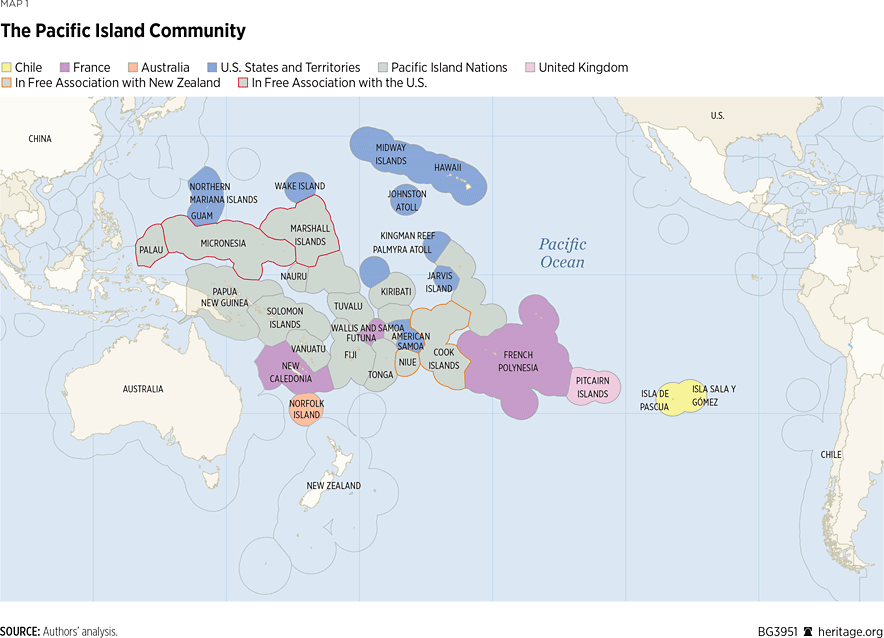
Much attention has been focused on the region’s strategic location, which neighbors key flashpoints in South and East Asia and sits astride critical military logistics lines, and maritime resources such as critical minerals and fish stocks. External countries are racing to capitalize on both, and this is leading to a number of partnerships with Pacific Island nations. While new extra-regional power engagements are not inherently detrimental, they have introduced additional competing interests into the region.
How Pacific Island nations choose to balance their need for investment from outside the region with their security interests will have far-reaching implications for regional unity. Past bilateral agreements have created points of friction. A secret security agreement between China and the Solomon Islands, for example, caused neighbors of the Solomons to worry about potential military presence from an unwelcome outside government.
In all instances, it remains prudent to remember the Pacific Way,[REF] which emphasizes collective commitment anchored in shared understanding, aspirations, and traditions. As Fijian Prime Minister Sitiveni Rabuka has cogently remarked, “a united region is a strong region.”[REF] Wise as those words are, however, regional solidarity is increasingly being undermined by factionalism, and the diversity of interests that once was a strength of regional organizations has become divisive. Nor is this an organic trend: It is encouraged by outside forces that are attempting to create new dependencies without assurances that the islanders would necessarily benefit.[REF] Broader intra-Pacific affiliations are being superseded by the interests of external actors, and the Pacific agenda is at risk of being shaped by powerful outside forces.
Against this backdrop, it is constructive—perhaps even necessary—to craft a Pacific Charter enshrining the principles that, if followed, can serve as the foundation of region-wide prosperity. Like the Atlantic Charter, a Pacific Charter would both inspire a sense of common cause and yield concrete results that are important to islanders by, for example, encouraging collaboration for intraregional development, guiding external actors to the most beneficial investments and partnerships, and fostering maritime security that carries with it tangible benefits ashore. The lesson of the Atlantic Charter and the Helsinki Accords is that affirming the right shared values to confront common challenges can inspire popular unity of effort.
It should be noted that the approach recommended here recognizes the sensitivities that can come with perceptions of it being an American-led proposal. This charter is not intended to impose values or dictate outcomes. Instead, it outlines how a regional charter built around shared principles can be useful in practice. Any eventual charter should be proposed, shaped, and assessed by Pacific Island peoples and nations and could be very different from the framework presented here. The proposed draft charter is intended as a first step in a new effort to strengthen the Pacific community.
Background
Pursuit of regional cooperation by the Pacific Island nations began as far back as 1947 with the establishment of the South Pacific Commission by Australia, France, New Zealand, the Netherlands, the United Kingdom, and the United States. In 1997, its “members adopted the name Pacific Community, and the organization became the Secretariat of the Pacific Community.”[REF] The PIF, created in 1971, has 18 member states and is dedicated to pursuing “a carefully considered regional strategy that reinforces commitment and working together to leverage our collective strengths and build a better future for our people.”[REF]
In recent years, however, regional unity among Pacific Island nations has been under mounting pressure. Great-power competition has transformed the region from a peripheral geopolitical space to a strategically contested domain. As Australia’s Foreign Minister Penny Wong has observed, major powers are now “locked in a ‘state of permanent contest’…over influence in the region.”[REF] With more external nations seeking footholds, island nations are increasingly forced to balance overlapping interests.
Recognition of the Pacific’s strategic importance accelerated in 2018, triggering a wave of bilateral initiatives. Australia launched its Pacific Step-up initiative that year, followed by the United Kingdom’s Pacific Uplift and Indonesia’s Pacific Elevation in 2019.[REF] The U.S. advanced similar aims in its 2019 Indo-Pacific Strategy.[REF] While broader external engagement is not inherently deleterious, the absence of coordination among island partners risks fragmenting regional consensus, rendering collective investments ineffective, and diminishing the voice of the islanders.
Despite the PIF’s having provided such measurable improvements in the standard of living as enhanced digital connectivity and targets to double online transactions by 2026, intraregional institutions have struggled to sustain regional unity.[REF] For example, at the 2025 PIF summit held in the Solomon Islands, member states were sharply divided over whether to include dialogue partners at the annual conference.[REF] These fissures have occurred previously; in 2021, five Micronesian states threatened to withdraw from the Forum because of leadership disputes.[REF] These political rifts, if they increase in frequency and impact, could undermine regional cohesion.
While nearly every regional body affirms some set of shared principles in its mission statement, adherence to these values remains malleable. Values are listed in a noncommittal manner at the outset, and the lack of express recognition of them as guiding principles renders them inadequate as a basis for engagements. Past efforts to codify regional values, such as the 1989 Pacific Charter on Human Rights, were ambitious but ultimately lacked the political resonance to endure. According to the current Executive Dean of the University of Canterbury Law School, “the main reasons for [the 1989 Charter’s] lack of influence” are its “lack of follow-up, an absence of opportunities for participation at the highest levels, and non-involvement of key stakeholders.”[REF]
Today, there appears to be a greater desire for such a proposal. The PIF’s 2050 Strategy for the Blue Pacific Continent outlines nine mutual principles that are supported by 16 Pacific Island nations.[REF] The next steps would be to build on these values and codify them in a normative framework that Pacific Island countries could endorse. There is precedent for such an arrangement; in 2025, Pacific leaders formally endorsed a non-binding framework, the Pacific Regional Labour Mobility Principles, a set of shared principles on labor mobility.[REF] Critically, however, for any such normative structure to endure, it must unlock real benefits and tangible progress that islanders can see and feel; values untethered to a vision will not trigger materially tangible action. A Pacific Charter, if successful, would provide a framework that could inspire the vision for specific projects.
Why a Pacific Charter?
A Pacific Charter would be, first and foremost, a document for the islanders—a pragmatic framework grounded in their experiences, cultures, and collective priorities. As a declaration of values and framework for acting with a shared sense of purpose, it would clarify “what we are living for.”
In this spirit, the Charter can serve as a unifying instrument to reaffirm fundamental ideals and strengthen regional solidarity. Endorsing countries would signal their intention to uphold and align their conduct with the Charter’s provisions, committing to act within a political and moral framework. At the same time, it is essential to note that the Charter would be a nonbinding document that carries no legal obligation but is instead enforced by the will of the islanders.
The effect of a Pacific Charter would be twofold. First, by articulating bedrock principles with which Pacific Islanders identify, it would encourage a regionwide unity of effort. In essence, the Charter would bolster norms in state and local conduct that in turn would guide both intraregional and international engagement. Too often, the rhetoric used in government documents does not resonate with individual islanders. As a result, the foregoing principles are frequently bypassed in favor of lucrative bilateral proposals. Several South Pacific nations, for example, have entered into infrastructure deals with China at key ports, permitting Chinese vessels to refuel and resupply.[REF] At the same time, illegal, unregulated, and unreported (IUU) fishing by Chinese fishing vessels has threatened the economic livelihoods of neighboring Pacific Island nations.[REF] Commitments to regional shared interests in sovereignty and transparency are easily upheld in rhetoric but often compromised when it is personally or locally expedient.
Second, the significance of a Pacific Charter lies in its affirmative function. When regional nations accede to a charter, they accept a standard of conduct beyond the mere expression of aspiration that is seen in mission statements. The Charter of Paris for a New Europe (Paris Charter), signed by 34 nations in 1990 and intended to unify a post-war Europe, solidified meaningful commitments to democracy, the rule of law, and human rights.[REF] Despite being nonbinding in nature, the Pacific Charter’s deliberative process would facilitate meaningful dialogue and normalized non-negotiable expectations of conduct.
The Pacific Charter’s intended overarching goal is explicit recognition and reaffirmation of the common principles of the South Pacific region. When states actively acknowledge and accept such a charter, they embed these standards into institutional memory. As with the Paris Charter, active commitment encourages national discourse to incorporate shared language and concepts, initiating a process of normalization. Over time, states begin to rationalize strategic decisions against a set of baseline principles. Additionally, the deliberation process will naturally bring together diverse nations into a shared space. At a time when Pacific regionalism is noticeably fragmented, shared dialogue would serve a reaffirming role.
Four Pillars of the Charter
The following are offered as four pillars of this framework that Pacific Islanders might profitably consider in formulating a Pacific Charter.
-
PILLAR 1: The sovereignty of nations is expressed through the free will of their peoples and affirmed by commitment to supporting governance that is both accountable and in service of the public good. Pacific Island nations have long asserted their sovereignty in the face of external pressures, first from colonial powers and more recently during a period of strategic competition among major powers. Sovereignty means the right of each nation-state—and, to a degree, each territory—to regulate its own domestic and external affairs, thereby enabling island communities to pursue peaceful and prosperous futures on their own terms.
Respect for sovereignty requires recognition of the authority of all states, regardless of their economic size or geopolitical power. Governing arrangements in the South Pacific range from compacts of free association to territorial governments, constitutional monarchies, parliamentary republics, and executive presidencies. Neighboring states and external actors must engage in ways that do not threaten to alter or disrupt current political power arrangements. In addition, there must be respect for and adherence to national laws. Illegal activities by outside actors undermine a state’s authority and can rightly be seen as a violation of sovereignty. Pacific Island nations must stand together in defending this principle to ensure that all countries have an equal platform from which to engage.
-
PILLAR 2: Embrace the diverse cultures, faiths, and heritage of all Pacific peoples and support the right of individuals to choose and preserve their traditions and ways of life. The Pacific Islands embody a rich mélange of religions and traditions.[REF] More than 90 percent of Pacific Islanders identify as religious, and for many, faith and culture are paramount in daily life and essential to one’s own identity.[REF]
The right to live in accordance with one’s beliefs is a fundamental human right and is enshrined in every major human rights charter. To uphold this right, states must protect people from religious or cultural persecution. Pluralism is a fundamental pillar of a just and prosperous society, and for the Pacific Islands, it underpins sustainable, long-term development. Research by the World Economic Forum has shown that regions with greater religious freedom tend to experience lower levels of corruption, higher levels of peace, and greater prospects for economic growth.[REF]
-
PILLAR 3: Recognize that regional collaboration is a vital mechanism for achieving shared prosperity and addressing shared challenges across the Pacific. The PIF’s 2050 Strategy for the Blue Pacific Continent represents the region’s first-ever comprehensive, long-term strategy for dealing with shared challenges and identifying areas for regional collective action. It is a critical milestone in advancing Pacific regionalism. However, for its vision to be fully realized, internal divisions within the PIF must be addressed.
Pacific Island nations acknowledge the ecological interdependence of their societies and economies, and many challenges they face are shared. A salient example is the tuna industry, which constitutes a critical source of revenue for many Pacific Island economies. Tuna stocks are migratory and routinely cross national boundaries, and seabed resources often span overlapping jurisdictions. These transboundary dynamics necessitate sustained intergovernmental coordination and policy harmonization. A compelling illustration is the Nauru Agreement’s Vessel Day Scheme (VDS), which demonstrates “how powerful small, developing countries can be when they organize and reach enforceable management agreements.”[REF] Under the VDS, signatory nations collectively have regulated catch to protect long-term tuna fishing and “pushed up license revenues during 2014–2018 in five of the PIC-12 [12 small Pacific Island countries], two to six times more than in 2009–2013.”[REF]
Many Pacific island communities confront similar challenges: geographically dispersed territories, small populations, and significant distances from major global markets.[REF] These shared constraints contribute to economic vulnerability and underscore the need for investment and extra-regional presence to meet the islanders’ needs. In light of these realities, Pacific Island nations prioritize mechanisms for economic coordination and resource governance.
-
PILLAR 4: Maintain unity against all coercive measures—whether military, economic, or political—that threaten the stability and peaceful development of Pacific Island communities and the regional order. Taken together, the Pacific Islands are the world’s most aid-dependent region. The aid they receive, for example, is five times higher per capita than aid received by countries in Sub-Saharan Africa. As a consequence, Pacific Island nations are disproportionately vulnerable to outside coercion.[REF] While development financing has improved their ability to handle natural disasters and finance growth-generating infrastructure, conditions imposed on developmental aid may infringe on their right of self-determination.
Tuna fishing, for example, is a major economic income source and vital to food security in 22 Pacific Island countries and territories.[REF] Importantly, 95 percent of all tuna caught comes from within Pacific Island exclusive economic zones (EEZs), and gains from IUU fishing are at the expense of local fishermen.[REF] The High Level Panel for a Sustainable Ocean Economy estimates that IUU fishing costs states between $10 billion and $23.5 billion. The protection of tuna fishing therefore represents economic security for many islands as do the potential benefits of seabed mining. Leading the effort to unlock the wealth of the Pacific seabed, the Cook Islands has attracted external investors, but Chinese investment and survey activity have ultimately strained the Cook Islands’ relationship with New Zealand.[REF]
For islanders, embracing China’s investments while at the same time working to curtail China’s harmful IUU activities has been an impossible task. Several South Pacific nations, for example, have entered into infrastructure deals with China that permit Chinese vessels to refuel and resupply at key ports.[REF] At the same time, as noted, China’s IUU fishing threatens the economic livelihoods and territorial sovereignty of neighboring Pacific Island nations.[REF] Principles like sovereignty, mutual respect, and accountability are often compromised when compromise seems to be the expedient response. As a matter of principle, Pacific Island nations should openly condemn and consider limiting economic and diplomatic cooperation with foreign nations that engage in any forms of economic exploitation or coercion. A Pacific Charter would provide both the basis and a framework for such collective action.
What Next?
Drafting a model Pacific Charter is only the first step, but it is a step that can inspire momentum for a regional unity that leads to greater economic development and security. Consultation with Pacific Island nations, territories, and community leaders is therefore critically needed to solicit key inputs for and refinement of a popular Charter.
Following this deliberative process, which could be led by institutions like the East–West Center, a major Pacific power should offer to host a Forum for the Pacific modeled on the 2022 and 2023 U.S.–Pacific Island Country Summits. At those summits, negotiations culminated in several landmark agreements, including new defense and maritime surveillance agreements, and a joint declaration outlining shared objectives for regional engagement. A similar high-level gathering would deliberate on a future Charter’s principles and conclude with the signing of a joint declaration of intent. A successful outcome does not require unanimous endorsement; nations that do not join initially can always join later.
Endorsement of the Charter is only an intermediary step, not an endpoint. For these values to be actualized, they must be integrated into regional and national decision-making processes. To that end:
- Regional bodies should consider amending their mission statements to reflect the Charter’s principles.
- The Charter could be integrated into a normative framework, similar to the African Peer Review Mechanism, to assess cooperation proposals.
- National governments should be encouraged to align policy strategies and legislative agendas with the values embodied in the Charter.
As mentioned, past efforts at Pacific regional cohesion and collaboration have been stalled by the lack of adequate resourcing and sustained senior-level engagement. To address this deficiency:
- The U.S. Congress should establish a Pacific Partners Commission to assess and recommend legislation to enhance sustainable island economies, provision of services, and collective security interests.
- The U.S. President should host a Forum for the Pacific by 2028 with the goal of presenting a Pacific Charter as a framework for sustained Pacific Islands prosperity.
- The U.S. President should name a Pacific Islands advisor within the National Security Council charged with overseeing an interagency task force for the Pacific Islands.
Conclusion
Intensifying great-power competition demands careful reconsideration of regional priorities, and the choices Pacific Island nations make today will undoubtedly shape the regional order for decades to come. In such a moment, it is imperative that strategic choices be grounded in first principles. Enduring regional unity requires mutual trust, and the best way to build that trust is by basing it on a charter that reflects the voices and aspirations of Pacific Island peoples themselves.
Allen Zhang is a Research Assistant in the Asian Studies Center at The Heritage Foundation. Brent D. Sadler is Senior Research Fellow for Naval Warfare and Advanced Technology in the Douglas and Sarah Allison Center for National Security at The Heritage Foundation.
Appendix
Proposed Pacific Charter
The peoples of the Pacific Islands affirm the following principles and encourage their adoption as a foundation for governance and meaningful engagements:
- Uphold Sovereignty and Individual Respect. We uphold the sovereignty of nations and affirm our commitment to supporting governance that is both accountable and in service of the public good.
- Foster a Pacific Community. We value the diverse cultures, faiths, and heritage of all Pacific peoples, and support their right to freely choose and preserve their traditions and ways of life.
- Pacific Intraregionalism First. We recognize that regional collaboration is a vital mechanism for promoting shared prosperity and addressing shared challenges across the Pacific. As such, the focus is on developing the capacity to meet the societal and economic needs of the Islands by the islands.
- Respectful and Reciprocal Relations. We stand against any coercive measures—whether military, economic, or political—that threaten the stability and peaceful development of Pacific Island nations or of the regional order.