America’s economy relies on shipping, domestically across the world’s most expansive river and intracoastal waterway system and critically through transoceanic routes. New analysis and simulation work done by The Heritage Foundation in a project called TIDALWAVE and published in a Heritage Special Report adds significant insights into the logistics dilemma the U.S. faces.[REF] While the U.S. faces a comprehensive sealift dilemma (military and commercial), this paper focuses on how to revive the foundational commercial shipbuilding sector. The criticality of a vibrant commercial maritime industry is supported by our nation’s experiences in two world wars and success in the Cold War era.
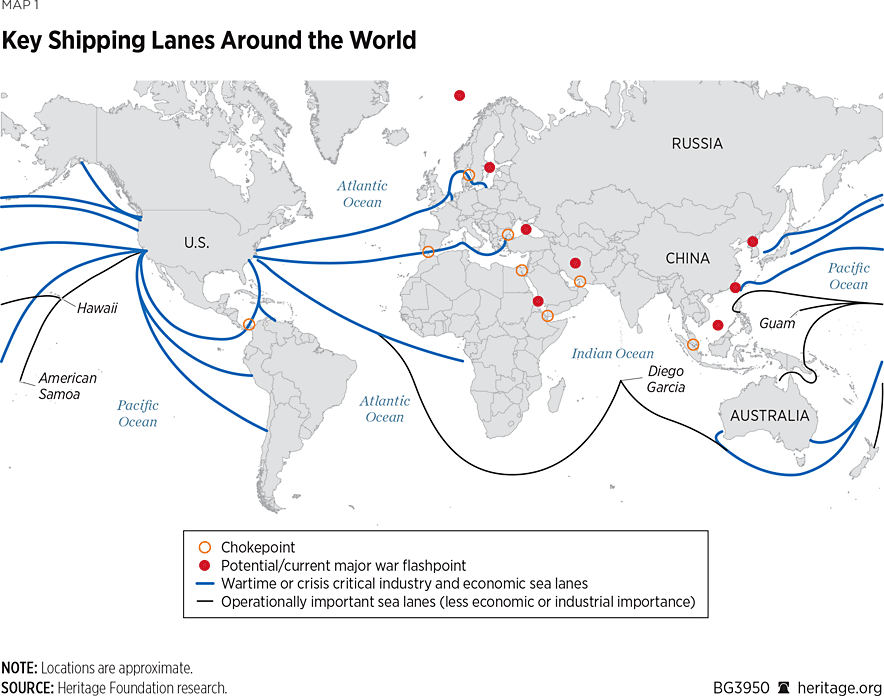
In the next major war, ensuring adequate shipping will be the deciding factor in achieving victory: It nearly derailed the Allies in World War I and World War II. With fresh memories of the failure of shipbuilding and shipping in World War I, policymakers and the President in the 1930s attempted to prevent a repeat of that failure. Corrective actions made in the 1930s were critical but too modest and resulted initially in a slowdown in military operations that prolonged World War II. Had more ships been available sooner, the last world war could have ended sooner, as it was inadequate shipping that slowed the movement of troops and material to the front; delayed the build-up of insurmountable ground, naval, and air forces against the Axis powers; and slowed the delivery of resources that fed freedom’s forge at home. Our leaders today struggle with the vital necessity of reviving a dormant maritime industry as a critical element in ensuring the survival of our Republic.
Before the end of 2025, President Donald Trump by executive order had set a deadline for presenting a national Maritime Action Plan. This plan, released February 13, 2026, is intended to guide national efforts to revive America’s strategically important maritime industry: shipbuilding, shipping, merchant mariners, and ports. That plan is comprehensive, but it does not address naval shipbuilding needs or how it integrates with a national maritime revival. This is necessary because the aggressive naval vision called the “Golden Fleet,” which would see battleships being built once again, has been tabled.[REF]
It is estimated that this endeavor will require growing the shipbuilding workforce by 250,000 and expanding the number of shipyards and their capacity. However, post–Cold War experience makes clear that naval shipbuilding alone will not be sufficient.[REF] This report provides a commonsense approach to meeting the shipping and shipbuilding needs of the nation while navigating the many challenges the nation faces.
Scope of the Problem and Consequences of Inaction
In April 2025, The Heritage Foundation hosted a seminar in which maritime industry and defense experts assessed what shipping would be needed for the nation to be free of hostile interference in peace and conflict. This exercise found that over 1,300 large commercial ships (greater than 1,000 tons) of various classes would be required. This correlates roughly with other assessments such as one by Maritime Accelerator for Resilience indicating that the nation would need 1,120 commercial vessels in the event of prolonged international conflict (assumed to be conflict with China).[REF] A study commissioned by the U.S. Maritime Administration and completed in December 2024 remains under wraps, but indications are that its conclusions will be similar to the conclusions reached in the above two studies.
Today’s stark reality is that the U.S. flagged fleet of 187 ships with a combined petroleum shipping capacity of 4,945,754 barrels (the U.S. imports 8.51 million barrels per day,[REF] about half of this via pipeline from Canada and Mexico combined) and a container capacity of 265,799 (in 2024, the U.S. moved over 2 million containers or 20-foot equivalent units [TEUs] per month[REF]) is inadequate,[REF] leaving the U.S. dependent on foreign-controlled shipping. In addition, the capacity of a ready reserve fleet intended to sustain the U.S. military in a regional conflict is questionable: A 2019 Turbo Activation exercise, for example, revealed that only 63.9 percent of 61 ships of the reserve fleet were ready for tasking within required timelines.[REF] Given this poor performance, a repeat large-scale Turbo Activation exercise to assess this fleet’s current readiness is long overdue. The urgency of the need to improve and grow the existing commercial fleet has been made ever more evident by recent analysis.
Project TIDALWAVE is further demonstrating the gaps in capabilities that would be involved in sustaining a yearlong Pacific war effort, and iterations of this expansive massive data analytics simulation for European and Middle East conflicts would help to demonstrate the shipping that would be required and where it would be needed. A key recommendation of this analysis and massive data analytics is that the nation must prepare for a protracted conflict, which includes acquiring the shipping needed to sustain a war effort and wartime economy—something the U.S. government and military have not had to contemplate since the height of the Cold War. A key finding of TIDALWAVE is that “fuel is the dominant endurance constraint for surviving forces” (specifically naval forces engaged in combat).[REF] Taken together, what is most irrefutable today is that current U.S. shipping is far from adequate.
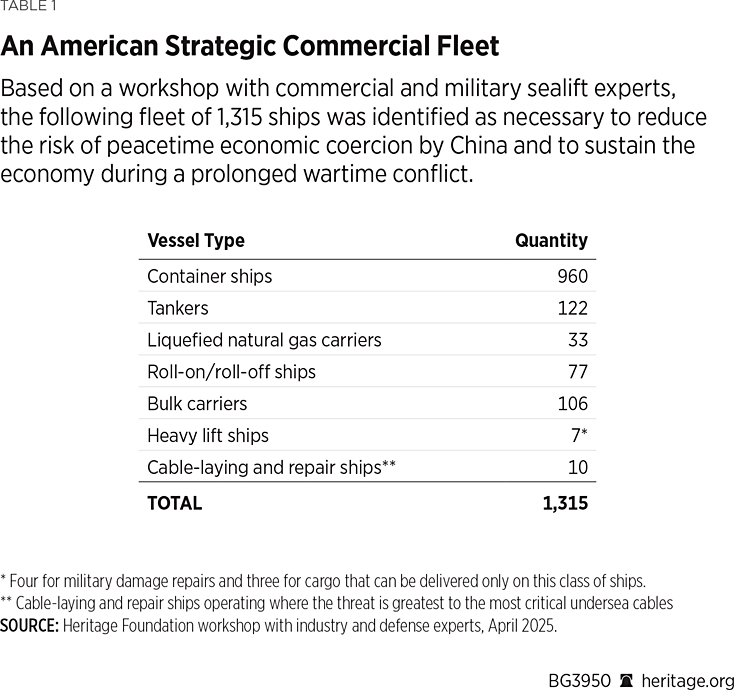
Analysis and tabletop exercises with industry and military experts already provide a good starting point. To mitigate today’s overreliance on China-controlled shipping, the nation will need a total of 1,315 additional U.S.-flagged/U.S.-crewed vessels of six different classes: 960 container ships; 122 tankers; 33 liquefied natural gas (LNG) carriers; 77 roll-on/roll-off (RO/RO) ships; 106 bulk carriers; seven heavy lift ships (four for military damage repairs and three for cargo that can be delivered only on this class of ships); and 10 cable-laying and repair ships operating where the threat is greatest to the most critical undersea cables. This total represents a conservative estimate that still assumes significant risk of Chinese interference. Acquiring the most critical elements of this fleet in the near term will require open market purchases, but this is not a sustainable solution and leaves the U.S. reliant on others to sustain such a fleet if nothing is done to rebuild domestic shipyards.
Building this national commercial fleet is currently beyond the capacity of America’s shipyards, the capabilities of its maritime academic institutions, and thoughtful administration by a fractured governing structure. Addressing this will require acting in concert with like-minded allies such as shipbuilding leaders Japan and South Korea and, most urgently, attracting capital to begin the necessary construction. Admittedly, there is a tenuous structure in place that could be used to begin America’s maritime revival—the so-called Jones Act fleet—but that is not the solution.
The Goal: A Globally Competitive Maritime Industry
On the eve of war in 1914, the U.S. merchant fleet carried about 10 percent of the nation’s trade, with European nations conveying the remainder.[REF] Today, U.S. shipping conveys less than 1 percent of America’s seaborne trade.[REF] As European ships were redirected or sunk, the American merchant fleet could not sustain the nation’s trade, let alone bear the demands of combat three years later when the U.S. joined the war. Wartime necessity led to a massive government shipbuilding program in which a new federal agency was formed to nationalize America’s shipyards and deliver a large merchant fleet—but not, sadly, before the war ended.
After the end of the war, that fleet was sold off for pennies, and the nation’s maritime revival once again predictably diminished along with the Navy. However, Congress, seeking to ensure that the nation’s economy and security would never again be so vulnerable, passed the Merchant Marine Act of 1920, known as the Jones Act. This act’s preamble remains the best articulation of the importance of commercial shipping:
It is necessary for the national defense and for the proper growth of its foreign and domestic commerce that the United States shall have a merchant marine of the best equipped and most suitable types of vessels sufficient to carry the greater portion of its commerce and serve as a naval or military auxiliary in time of war or national emergency, ultimately to be owned and operated privately by citizens of the United States; and it is declared to be the policy of the United States to do whatever may be necessary to develop and encourage the maintenance of such a merchant marine….[REF]
The Jones Act was intended to ensure that U.S. shipping retained an unfettered ability to carry the largest share of American seaborne commerce, but the act had a fatal flaw: It failed to recognize the importance of remaining competitive in the global marketplace to deliver a sustainable maritime industry. At a minimum, the act attempted to compel the existence of adequate domestic shipbuilding by requiring that all shipping between U.S. ports be conducted on domestically flagged, crewed, and built ships. The reality is that after a century of insulation from competition, today’s domestic fleet is commercially uncompetitive and unable to sustain distant military operations away from American shores. But reform, revision, or repeal of the Jones Act should not be a precondition for moving forward, and if repealed without a recovery plan, it could cause more harm than good in the event of war. Most urgent is the need to elevate and refocus America’s maritime industry on the strategic goal of gaining global competitiveness. The Jones Act is not the problem, but it also is not the solution.
Due to a small, captive market, dominated by a ruthless handful of politically connected interest groups, the domestic blue-water fleet that the Jones Act sought to bolster has instead relegated itself to carrying only the most inelastic cargo where no other alternatives exist, relegating America’s economic potential to dramatically inadequate maritime supply chains. Because of market distortions that this has caused and the resultant lack of demand, U.S. commercial shipyards have become upwards of 60 percent less efficient than overseas shipbuilders and are producing ships of limited ability to meet the Navy’s logistic needs—and at a 700 percent price premium.[REF]The most modern, productivity-enhancing capital improvements, such as automated welding systems that are prevalent in leading shipyards globally, remain elusive for most domestic shipyards for structural reasons that are impelled by politics and counterproductive policies. Moreover, American carriers are punished with an ad valorem tax when conducting maintenance overseas at more modern and cost-effective shipyards—a legacy of the Tariff Act of 1930 (though this does not stop American carriers from doing nearly all of their maintenance overseas given the considerably better capabilities and massive savings over domestic shipyard work).
Another failure has been the failure to ensure an adequate number of available and certified U.S. mariners that would be needed in a sustained crisis. While testifying before Congress in March 2020, former Maritime Administration Administrator Rear Admiral (ret.) Mark Buzby drew attention to the inability to train and attract U.S. merchant mariners with viable jobs.[REF] Another study from 2016 found a well above 15 percent shortage of needed crew members (a gap of approximately 2,000 trained and physically ready people), who in 2016 were an average age of 47 years old.[REF]While some experts have voiced serious concerns about this study, there is a consensus among experts that the nation has a problem ensuring that it has sufficient merchant mariners. The reality is that until the incentive structures and special interests’ dynamics change so that they actually align with vital national interests, little will change—something already weighing down the SHIPS for America Act, which was first proposed in December 2024 and as of January 2026 was languishing in various committees of Congress.
All of today’s political, economic, and regulatory realities combine to prevent the long overdue revival of America’s maritime industry and shipping. To break these iron shackles, we will have to address the conflicting interests of America’s ship owners, ship builders, port operators, longshore labor unions, and merchant mariners. Ostensibly, each of these interests would benefit from a revived American maritime industry, but getting there poses challenges to all of these groups that have combined to derail every attempt since World War II to revive this strategically important industrial sector. Threading the needle of these conflicting interests to break the endless impasse will require understanding each group’s concerns and interests.
Over its more than 100 years of existence, the Jones Act has been used by industry and financiers to maximize profits across a perpetually dwindling pool of players. It is no fault of the shippers or shipbuilders that this has changed the incentive structures and led away from conventional market dynamics and the competition that enables the pursuit of global maritime market share and the types of ships and shipbuilding that the nation’s security requires.
A good example of this is the success of Crowley Maritime, detailed by Forbes in an article titled “How This Billionaire Family Is Succeeding Despite the Collapse of the American Shipping Industry.”[REF] At the center of the story is Crowley’s $25 million purchase of one of the world’s oldest LNG carriers, the French-built American Energy, rescued from its grave to continue in its fourth decade of service. This purchase was made possible by a Jones Act waiver to meet a need to move energy from American LNG producers to Americans in Puerto Rico and stipends from the Maritime Administration that make up for the added 20 percent cost of operating such an old ship, maintenance of which will likely be done in state-owned shipyards in China despite ad valorem penalties for overseas maintenance done on Jones Act–compliant ships. In another example, America’s maritime industry celebrated a Chinese shipyard’s $100 million conversion of another, 42-year-old ship to an LNG-powered container ship Pasha George II; construction of a new ship would have been cheaper.[REF]
Yet when efforts are made to increase domestic shipbuilding to make such overseas purchases and waivers unnecessary, similar forces combine to prevent it. In addition to the handful of blue-water Jones Act carriers that are incentivized to favor overhaul of elderly ships rather than fleet growth with new builds, there are opponents that wish to keep shipping prices down in the face of new legislative initiatives.
When Congress proposed its bipartisan and widely supported SHIPS for America Act in December 2024 (and again in April 2025), naval shipbuilders and retailers took notice. Building on a U.S. Trade Representative 301 complaint begun under the Biden Administration because of Chinese unfair maritime practices, President Trump instituted fees on Chinese shipping—a proposal included in the SHIPS for America Act.[REF] This was a threat to continued cheap shipping of Chinese textile imports aboard foreign-flag ships and triggered a concerted and well-funded lobbying effort to kill the SHIPS for America Act and stall President Trump’s efforts to level the playing field for America’s maritime industry. Groups representing American companies paid the World Shipping Council $50,000 to kill fees on Chinese shipping, the National Retail Federation spent $2.27 million lobbying against the maritime revival effort, and the American Apparel and Footwear Association and Travel Goods Association together spent $238,819 lobbying lawmakers not to support the effort.[REF] The act also had American naval shipbuilders on edge.
Already under scrutiny for years of delays and significant cost overruns in naval shipbuilding, the Navy’s primary shipbuilders also saw a threat. In early 2024, after many months of forewarning, the Secretary of the Navy ordered a 45-day shipbuilding review that proved what everyone knew: Naval shipbuilding was broken.[REF] That review found that workforce shortfalls, incomplete design work, supply chain delays, and limited shipyard infrastructure had led to unacceptable delays.[REF] In the midst of the 45-day review, the Secretary of the Navy threw down the gauntlet, accusing naval shipbuilders of prioritizing Wall Street over the nation’s need for warships.[REF] The Secretary accused shipbuilders of using federal monies intended to grow their capacity for stock buybacks and dividend payments, a frustration recently echoed by President Trump in an executive order directing industry to prioritize the warfighter.[REF]
Moreover, with foreign capital such as the purchase of a Philadelphia shipyard for $100 million in December 2024 finalized, these same naval shipbuilders have lobbied Congress that any expansion of commercial shipbuilding would drain needed workers from their businesses. Because existing naval shipbuilders get the majority of their labor from within 50 miles of their shipyards, this argument makes no sense.
Labor adds another level of complexity to reviving America’s maritime industry. This was illustrated by the contentious dispute between the politically potent International Longshoremen’s Association (ILA), which controls labor across East Coast ports, and the U.S. Maritime Alliance (USMX) representing East and Gulf Coast ports. That dispute was inserted into the presidential elections in the fall of 2024, with both candidates ostensibly siding with labor over concerns that automation would kill union jobs.[REF] Had the ILA workers walked out, American ports through which 91 percent of America’s generic pharmaceuticals,[REF] 60 percent of its fruits, and 40 percent of its vegetables[REF] passed would have shuttered, triggering inflationary pressures at a politically delicate time. On January 8, 2025, the ILA and USMX reached a tentative deal that left questions about how to modernize America’s woefully underperforming ports without killing union port jobs unresolved.[REF]
While modern Asian and European ports benefit their economies with world-class productivity, many American ports remain some of the world’s least competitive, on par with developing nations, causing a significant dampening effect on the broader manufacturing and trade capabilities of the national economy. Failing to improve the performance of American ports will undermine an American maritime revival and make attracting shipping to our shores impossible with slower, costlier trade adding to the costs borne by American consumers and stifling our manufacturing potential.
Today, U.S. ports lag far behind the rest of the developed world’s ports in their efficiency. According to the World Bank’s most recent Port Performance Index, North American ports rank three times as low as East Asian ports; rank almost twice as low as ports in Central America, South America, and the Caribbean; and are not far ahead of ports in Sub-Saharan Africa.[REF] Moreover, the lack of technology makes U.S. ports unnecessarily dangerous. The rate of non-fatal injuries and illnesses for U.S. port workers is nearly double that of the entire U.S. workforce, and the fatality rate of port workers is five times as high as that of the overall workforce.[REF]
Modern techniques and equipment offer the ability to mitigate these dangers and, as proven in the auto industry, actually grow the workforce with added productivity and volume of workload. According to government labor figures, as the U.S. auto industry increased its use of robotic systems, labor grew by 116,000 new workers from January 2014 to January 2024. Over the same period, hourly wages increased 33.5 percent to $37.22 an hour.[REF] It is clear that if labor and port operators come to an agreement on modernization, worker productivity and occupational health should result in a considerable net gain for all.
However, modernization of American ports does not come without a security risk in the absence of commensurate strategy. In recent years, the discovery of unknown modems and serendipitous communications from port cranes to Chinese manufacturers has exposed the threat of cyber intrusions that could shut down American trade at the pier.[REF] It clearly would be in China’s interest to retain insight into and, potentially, control of U.S. port operations through modern port equipment.
This makes the presence of Chinese state-owned enterprises represented in the earlier ILA–USMX negotiations surprising. USMX is comprised of numerous foreign shippers and port operators with interests and assets in the U.S., but it is the presence of Chinese state-owned enterprise COSCO Shipping and Hong Kong–based OOCL that stands out.[REF] Their presence in the negotiations gives Beijing the ability to influence any agreement with implications for America’s economic security. Unsurprisingly, in November 2025, the ILA joined with representatives from over 60 countries in a Global Maritime Alliance to work against automation in dock work; it is unclear whether there is a Chinese presence in this body.[REF] If China sees a revived American maritime industry as a threat—and it does—then its presence in such negotiations will prove problematic.
Finally, the groups that should have the most influential voice in reviving America’s maritime industry—the merchant marine and associated educational institutions—have also been the most subdued. This is due in part to the fact that the agencies involved with this strategic industrial sector (the Maritime Administration in the Department of Transportation, the U.S. Coast Guard in the Department of Homeland Security, the Federal Maritime Commission, and the National Oceanic and Atmospheric Administration in the Department of Commerce) are scattered across various departments rather than located in one Cabinet-level, whole-of-nation, mission-focused department.[REF] This situation has contributed to bureaucratic lethargy without direct congressional oversight, easily coopted by special interests and without dedicated political leadership to advocate for the resources and authorities that are required for a national maritime revival.
At the same time, getting needed resources to private institutions training mariners, as well as the exceedingly rare naval architects who are vital to designing, building, and sailing the nation’s needed ships, has languished. Naval architecture is a specialized field of engineering that combines various competencies, and graduates with such a degree are critical in the design and manufacturing of ships. At a time when such engineers are in great demand in commercial industry, only a handful of institutions like the University of Michigan and Webb Institute are producing dozens of them annually when thousands are needed.[REF] The material condition of the Merchant Marine Academy at Kings Point, where students study in moldy, dilapidated buildings with frequent loss of heat and heated water in the winter months, is stark testament to the sad state of America’s merchant marine.[REF] Upcoming young mariners and naval architects deserve better if the nation is to attract the talent it needs to revive its maritime industry.
Needed: A New Approach
It is clear that, despite a year of apparent presidential interest in the cause but little progress, a new approach is needed—one that navigates the competing interests and neutralizes the unhelpful influences that seem to orbit around protection of the Jones Act as a law rather than actually delivering on its stated intent.
- First, the focus of the nation’s maritime revival must be on developing a globally competitive industry. This is a paradigm shift that does not need to conflict with or come at the expense of the existing Jones Act–compliant fleet.
- Second, a national unity of effort is required to direct resources and spend political capital where needed to grow shipbuilding, modernize ports, and energize lackluster institutions. The U.S. Government Accountability Office, for example, has found that the Maritime Administration lacks discipline and responsiveness in managing its shipyard grants, that its workforce has a 12.3 percent vacancy rate, and that 31 percent of its workforce is eligible for retirement.[REF]
- Third, the Federal Maritime Commission and the U.S. Department of State must be empowered to fight for America’s maritime industry in international institutions while fully achieving the nation’s maritime potential at home and in international trade.
Several commonsense steps are urgently needed to regain the momentum that was built up over several years but is now fast being lost.
Step One: Attract capital. President Trump’s embrace of the mission to revive America’s maritime industry has had a galvanizing effect, especially in attracting investments. Notable was the President’s March 4, 2025, address before a joint session of Congress and his endorsement of the need for American shipbuilding and creation of a shipbuilding office within the White House.[REF]
As indicated above, an article 301 complaint had been initiated in April 2024 against Chinese unfair practices in steelmaking and shipbuilding, which began a process to encourage investment in the U.S.[REF] A first mover whose success or failure could have far-reaching implications was South Korean shipbuilder Hanwha, making it the canary in the coal mine (or shipyard). Hanwha sealed a $100 million deal for a Philadelphia shipyard in December 2024 and has since committed an additional $5 billion to modernize and expand operations there.[REF] And Hanwha is not alone: Riding a wave of confidence that America is serious about reviving its maritime industry, tens of billions in investment capital is coming.
Two days after the President’s March 2025 joint session speech, French shipper CMA-CGM committed in the Oval Office to a $20 billion U.S. investment plan.[REF] It is estimated that $8 billion of this $20 billion will be part of a reflagging of ships under the U.S. flag. The first CMA-CGM Phoenix was reflagged in July.[REF] Then the President of South Korea in August committed $150 billion worth of investments in America’s shipbuilding sector, although this later cooled somewhat as a result of domestic Korean politics, sparked in part by the arrest of South Korean nationals at a Hyundai plant in Georgia for overstaying their visa waiver permits.[REF] Despite this, subsequent reporting indicated that HD Hyundai Heavy shipbuilder was still in talks to acquire an American shipyard in a deal that could be worth over $100 million.[REF] In addition, Canadian shipbuilder Davie bought Gulf Copper & Manufacturing Corporation with facilities in Port Arthur and Galveston, Texas, to build ice breakers beginning with a $1 billion capital investment.[REF] These icebreakers would constitute part of the orders for a fleet that could number 30 to meet both American and Canadian needs.[REF]
Not yet at the table are Greek shippers, who are big players in global LNG shipping. If Greek shippers follow suit with CMA-CGM, a deal could attract additional investment in port and ship repair capacities to sustain significantly expanded trade in American energy. This would be critically helpful in reducing allies’ dependence on Russian petroleum and providing secure energy for key allies in Asia. Despite years of combat, five European Union (EU) nations (Hungary, France, Belgium, Spain, and Slovakia) as a bloc have consistently ranked as the fourth largest importer after China, Turkey, and India. with almost $2 billion USD in Russian petroleum purchased as recently as December 2025. Between January 1, 2023, and January 12, 2026, the EU imported a total of €70.2 billion worth of Russian petroleum.[REF] All told, there is already a good chance that $200 billion could be flowing into the U.S. maritime industry. This is a good beginning, but it is far from adequate for what will be a decades-long national endeavor.
Noticeably silent among recent maritime investors is Japan, once the global leader and now third largest shipbuilder, but this may change soon. An October 2025 memorandum of cooperation[REF] is part of a $550 billion deal to revitalize American industrial capacity, to include development of small modular nuclear reactors and $600 million for ports infrastructure to expand energy trade with Japan.[REF] Additionally, Shipbuilders Association of Japan representing 17 Japanese maritime industry leaders has committed to investing $6.5 billion in the U.S. by 2035—$2.3 billion in private funds and $4.23 billion in Japanese government funds.[REF]
Despite this momentum, confidence is waning with respect to the ability of U.S. policymakers to sustain the current positive investment environment. Addressing this slackening momentum will require both renewed presidential commitment and bipartisan support for enabling legislation like the SHIPS for America Act.[REF] If this can be accomplished, investments should continue apace and at a scale to support meaningful growth of America’s industrial capacity. However, investments alone are not enough to build the American maritime comparative advantage in the global marketplace that is vital to delivering an enduring maritime industry that can avoid repeating the mistakes of the past.
Step Two: Nurture a positive vision of America’s maritime comparative advantage. The north star of America’s maritime revival must be to compete for an adequate share of the global maritime market. Nurturing a competitive American shipping and shipbuilding industry is the only way to ensure that the industry remains viable and able to meet national security needs. This means taking on the goliath of the day: China’s shipping, global ports operators, and shipbuilders who in 2024 produced 54.57 percent of global tonnage of commercial ships.[REF] A deal to purchase ports from Hong Kong–based CK Hutchinson Holdings Limited, to include strategically important ports on either end of the Panama Canal, has stalled under considerable pressure from Beijing to kill the deal.[REF] Trying to outcompete the Chinese Communist Party’s government-directed and government-subsidized shipping and shipbuilding model without new thinking is destined for failure.
A new maritime comparative advantage that leaps ahead of Chinese competition must integrate various techniques and technologies in a new logistic framework that includes innovators from various fields. Unlocking two key American strengths—accessing considerable private capital and attracting innovative leaders who have launched disruptive technologies like nuclear power, the internet, and the smart phone—will be critically important. The biggest challenge will be the need to buck the conventional wisdom, much as Elon Musk did with SpaceX’s reusable rockets and McLean did with container shipping. Attracting new energetic maritime industrial captains of change with proximity to financing, industrial centers, and research and education institutes is one way to light the spark of a new era in American maritime innovation. Fortunately, there is a proven method that, with a few adjustments, can do this.
Specifically, innovation incubators, a well-known approach in business, can provide the platform for maturing disparate novel approaches to realize a “revolution in shipping” for a new multi-modalism. An important feature of these maritime incubators is co-location of business and engineering support services to focus on and accelerate promising maritime enterprises near existing or planned shipyards. This will also facilitate the development of the workforce that will be needed. These efforts will usher in a new multi-modalism that also meets key near-term military operational problems.
A glimpse of what this revolution in shipping could be was detailed in a May 2023 Heritage Foundation report.[REF] This new multi-modalism would embrace new distributed manufacturing enabled by additive manufacturing, also known as 3D-printing of industry grade parts. One key feature of this revolution in shipping is a simple redesign of the ubiquitous shipping container. Novel containers would enable new economical modes of transport via small feeder ships, air drones, and heavy lift dirigibles cycling between ships at sea and logistic nodes inland. The goal would be to open many more points of entry and ease the logistic strain on overland transport at the few ports that currently are able to handle the largest of commercial ships without massively expensive and ecologically impacting infrastructure expansion and dredging.
To get more cargo moving while meeting international carbon mandates, small modular nuclear reactors could propel the largest container and LNG tankers at sustained high speeds without needing to be refueled in port. This in turn would mean that shipowners would have to adjust their current operational cost planning. A nuclear power plant would involve taking on the vast majority of lifetime operating costs up front. This would pose new stresses on ship financing, but it also offers advantages that include mitigating the impact of inflationary or speculative fuel prices and requiring fewer ships given higher sustained transit speed to move a fixed amount of cargo per sea route.
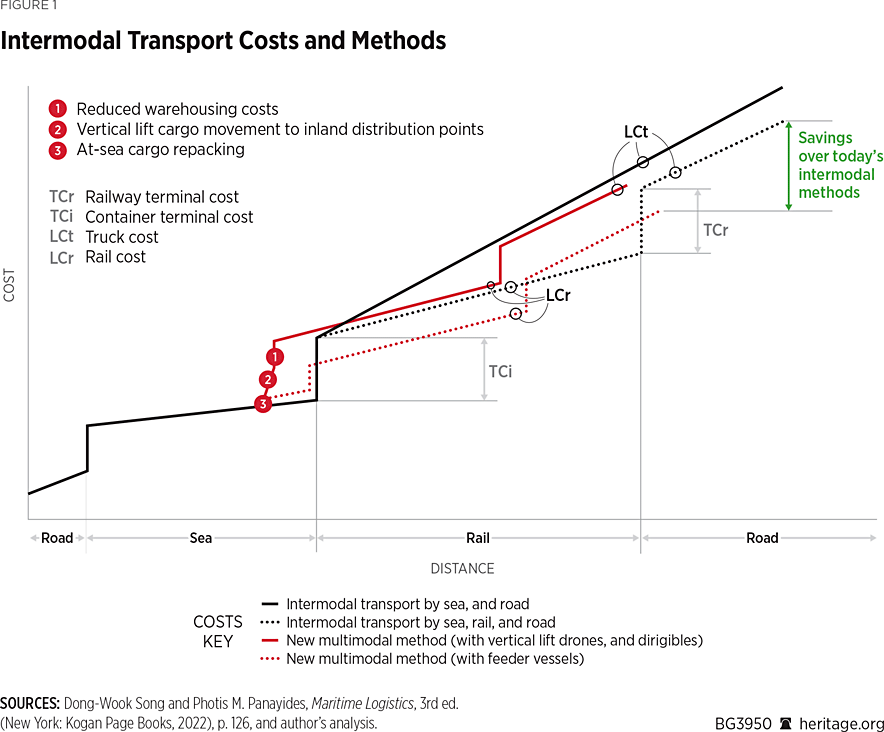
Putting together such a complex logistic system would also mean embracing smart port operations such as those being developed by Scale AI at Ponce, Puerto Rico;[REF] adopting at-sea warehousing management techniques by repurposing expeditionary warehousing techniques being developed by Amazon for disaster relief;[REF] and employing massive data analytics and supply chain predictive analysis being explored by Gnosis[REF] and Govini[REF] that can ease decision-making backed by new artificial intelligence technologies.
Getting investors and shipping operators committed to a new form of logistics requires demonstrating the technologies’ viability and refining business models. This requires “proof-of-concept” evolutions that can chip away at what Clayton Christensen called the innovator’s dilemma that holds back investment in promising disruptive technologies.[REF] Today, several ports, technology companies, and local governments are experimenting with new shipping innovations. A well-planned demonstration would show how to link their efforts. For this reason, the location of an initial demonstration is important. Some good candidates are on the Great Lakes near current efforts to use drones for cargo movement; along the U.S. East Coast, where efforts are underway to reduce road and rail traffic; and Puerto Rico, where smart ports technology is being tested.[REF] A successful demonstration of the new multi-modalism would provide key insights into engineering challenges, inform the operational costs of such a novel approach to shipping, and accelerate investment in and development of a new American maritime comparative advantage.
Innovation is critical, but more is needed. As already discussed, the threat to the nation is more urgent than innovation timelines would allow: We need action to secure needed shipping capacity now. New orders for ships, however, must be informed by a long-term strategy that uses these orders for new ships to focus investments and industrial activity on expansion of national shipbuilding capacity. Glimmers of this can be seen in the approach taken with the November 13, 2024, trilateral U.S.–Canada–Finland Ice Pact initiative to build icebreakers initially in Finland while shifting future production to the U.S.[REF] A tangible sign of progress under this plan is a $1 billion investment begun at Gulf Copper Shipyard in Galveston, Texas, informed by production processes in Finland as the Texas shipyard is prepared to build icebreakers.[REF]
Step Three: Place the orders. Considerable capital is flowing into the American waterfront. This is informed in part by a vision of what can be a new global maritime industrial comparative advantage, but without orders for ships, the endeavor will falter. American shipbuilding is limited in its capacity and burdened by excessive costs such as those imposed by feckless environmental regulations. The result is critical shipping deficiencies that affect military operations overseas. An example is the impact on naval combat operations in the Red Sea against the Houthis that was caused when the tanker Big Horn was grounded, removing the carrier strike group’s source of fuel to sustain flight operations.[REF] Today, American shipbuilding is too expensive and time consuming, and this leads to a search for overseas solutions.
At the request of military leaders at Transportation Command, Congress has authorized the buying of ships on the open market.[REF] This is a stopgap measure that by itself does not serve the larger goal of an American maritime revival.[REF] Instead, adequate demand for domestic ship orders is needed to sustain necessary capital investments and workforce development that over time will drive down prices and speed deliveries. The SHIPS for America Act addresses this need by including a demand signal for a strategic commercial fleet that would grow to 250 ships over a decade and be involved in international trade—the type of ships the military and the nation’s industry need in a war.
As noted, to mitigate overreliance on hostile shipping, the nation needs approximately 1,315 ships—a goal that the strategic commercial fleet alone would not meet. The deficit in American shipping would be addressed initially by a combination of allied shipping and U.S.-owned but foreign-flagged ships procured on the open market. The need for these non-U.S. ships will shrink as American shipbuilding grows, and the strategic commercial fleet can be understood as providing a demand to American shipyards to increase backlog orders and attract investment for new designs that incorporate the advances enabled by maritime innovation incubators.
By some accounts, there are 154 operating shipyards in America, but the vast majority of them are engaged in building craft that are not suitable for transoceanic trade. These shipyards are therefore not able to repair military sealift or build the ships needed to sustain a wartime economy. But by placing orders for ships to build a strategic commercial fleet in an iterative approach, initial medium-size shipyards will grow to handle militarily useful ships as today’s larger shipyards expand their facilities to build globally competitive commercial shipping. This is a decade-long endeavor and long overdue. Initially, it is important that the shipyard be matched not only with its capacity to build ships today, but also with the capacity to make capital investments to build the ships the nation needs later.
Delivering the 250-ship strategic commercial fleet is a generational effort, but it serves to provide initial orders to kickstart a wider maritime industrial recapitalization. To do this, new designs that can be built today at American shipyards are needed, such as tankers (MR); container ships (1,000–3,500 TEU capacity); tankers for LNG (45k cubic-meters capacity); and bulk carriers (handysize up to 50,000 tons displacement). These designs would incorporate military-use requirements, such as installation of CONSOL stations on commercial tankers that enable refueling warships at sea. Critically, these designs would be based on limitations of shipyards’ build capacity today and what parts and materials can be majority American sourced: Today, 100 percent is an impossibility and too cost-ineffective; a more reasonable ship design goal is 80 percent domestically sourced.[REF] Such ships can be built at American shipyards today, and in time, with investments from trusted allies and more Americans, these yards will be able to build ultra-large container ships (more than 14,000 TEU capacity); massive Very Large Crude Carriers (VLCC) tankers; and large (greater than 120,000 cubic meter) LNG carriers that would be economically viable and competitive in the global maritime marketplace.
Reviving shipbuilding and shipping in the U.S. will not be cheap or without risk. The U.S. government, allies, industry, and financial leaders will need to suspend any expectation of quick results or fast returns on investment beyond typical one-year to three-year timeframes. Initial orders will be expensive, cost overruns will be frequent, and as American shipyards restart production, there will be delays as new workers are trained and suppliers come online. Accepting this risk is necessary for the strategic payoff of a viable and strong American maritime industry, and mitigating this risk to entry is where the government has a role, to include holding underperformers to account for the taxpayer. Mitigating this risk means placing government orders (Navy, Coast Guard, Merchant Marine, etc.) with multiple shipbuilders, for several ships at each, to make good business sense to the builder and incentivize capital investments.
As the initial orders for these ships are filled, assessing shipyard performance will be essential in determining follow-on orders. These follow-on orders for new designs would be a function of the shipyard’s ability to take on the work and a demonstrated pattern of reinvesting in its workforce and waterfront. This can be enabled by shifting the incentive structures for capital reinvestment, using methods and tax incentives that reward capital investments over Wall Street. Estonia used this tax structure to incentivize startups and small and medium-size enterprises to reinvest profits in workforce and infrastructure, growing their market share and competitiveness.[REF] Because each shipyard operates in unique circumstances, specialization will be inevitable; some yards, for example, will become expert at building LNG carriers, while others focus on large, unmanned ships for a range of military and commercial uses. However, success is never guaranteed, and tools to ensure that key shipyards remain viable will be needed.
For shipyards that are not ready to move up the value chain of shipbuilding, there will still be demand for ships of the initial design, but continued failure to invest and improve shipyard performance would cause orders to be cancelled and, in rare cases of mismanagement, strategically important shipyards to be taken over for remediation as happened during World War II. Such a course is reasonable given the significant taxpayer investment it would take to begin the revitalization of our strategic maritime industry at a time of sharpening national threat from China.
Conservatorship of Underperforming Shipyards. Several American shipyards with Navy contracts for warship construction are severely underperforming. This situation has national security implications and therefore cannot be allowed to continue. In extreme cases, the Navy has temporarily taken control of shipyards to direct additional assets more effectively, resolve labor issues, and deliver needed warships more expeditiously.
The Selective Service Act of 1940 provides a legal process by which the President can seize industry for national security reasons. Supporting legislation includes the Defense Production Act (DPA), which affords the President broad powers to direct commercial industry to accept and prioritize contracts. Additionally, the Trading with the Enemy Act of 1917 has been amended to apply in peacetime and allows the President to restrict trade with identified entities. The Supreme Court of the United States has ruled that Congress must give consent before the President can seize an industry, overruling President Harry Truman’s seizure of steel mills during the Korean War in the Youngstown Sheet & Tube Company v. Sawyer (1952).[REF]
The Navy has seized underperforming industrial assets before for reasons of incompetence or to settle labor disputes:
- Los Angeles Shipbuilding & Dry Dock, San Pedro, California (1943);
- Howarth Pivoted Bearings, Philadelphia, Pennsylvania (1943);
- Brewster Aeronautics building fighter aircraft, Long Island, New York (1942); and
- York Safe & Lock producing ordnance, York, Pennsylvania (1944).
Step Four: Secure shipping of strategic materials and defend critical shipping routes. The U.S. is the world’s largest economy, but it relies on a range of critical materials to ensure that its industry functions and its people are secure. This lesson was made painfully apparent during the 2021 supply chain crises during COVID recovery and the Suez Canal blockage when a container ship grounded in the canal, all subsequently made worse by the wars in Ukraine (2022) and the Red Sea (2023). In a conflict with China, keeping American allies in Asia on-side will require assured access to energy, military hardware, and other key materials. On balance, it is critical that U.S. and allied national leaders understand what cargo matters, which sea routes it transits, and the types of ships in which it is conveyed.
A short list of strategically important materials for the U.S. and its important military allies includes microelectronics, precision machinery tools, tungsten, titanium, aluminum, refined rare earth minerals, and petroleum.[REF] From this list, it is clear that shipping routes connecting northeast Asian Japanese and South Korean markets, as well as routes with Europe for precision machining equipment and large marine engines, are critical. But China still dominates America’s needs in refined rare earth minerals and tungsten, although alternatives for refining rare earths are evolving in Australia.[REF] In a war with China, these alternative sources would become strategically important as are microelectronics that come overwhelmingly from Taiwan—the most likely target of a global war instigated by the Chinese Communist Party.
Taking a broader global view of key allies and American industrial and supply chain reliance, several key shipping routes emerge. Energy flows to Asia from American sources across the Pacific are top of the list. Sustaining a wartime American economy requires access to European finished products like large ship engines (Poland) and precision machinery critical for retooling factories (Italy and Germany). Access to unrefined rare earth minerals (Africa and Western Australia) will elevate the strategic value of shipping from Africa and from the seafloor in the South Pacific; access to refined rare earth minerals will similarly elevate the strategic importance of shipping from new plants in Western Australia.
In the event of a major war with China, these would be the sea lanes worth fighting for to prevail over the Chinese Communist Party. Knowing this also defines the priority for the types of ships to be bought or built now, obligations sought for access to these materials, and secure sealift across these sea routes.
Recommendations for Action
Step one above was well underway as of January 2026, but without renewed national leadership, momentum will completely stall. Step two needs to be kickstarted as soon as possible with the establishment of maritime prosperity zones and innovation incubators. No action has yet been taken on steps three and four. Operationalizing the necessary actions will require several actions. Specifically:
- Place initial orders for ships at domestic shipyards. The Maritime Administrator should select no fewer than two shipyards per class of ship with a minimum order at each shipyard of three ships of the following classes: MR tanker and 3,500 TEU container ships. The design for these ships should be contracted and owned by the Maritime Administration and based on sourcing no less than 80 percent of its materials from within the U.S. with construction at domestic shipyards. Preliminary design work and supply chain analysis have been completed, and once directed and budgeted, the final designs and shipyard selections can inform shipbuilding contracts.
- The initial order for commercial ships should be informed by the preliminary findings of TIDALWAVE, which indicates an order for 15 dry stores ships capable of handling ammunition and orders for 15 to 20 tankers modified for port and starboard CONSOL fittings to refuel naval ships at sea.[REF] This initial order would address the military needs only for a prolonged regionally limited war in the Pacific. Congress therefore should direct and appropriate funds so that the Secretary of Transportation can:
- Contract for 20 50,000 dwt MR tankers with port and starboard CONSOL modifications at two shipyards. If the contract includes initial overseas production (est. $57 million per ship), the final ship of the order must be produced at a U.S. shipyard (est. $240 million per ship). Total estimated maximum cost: $4.840 billion.
- Contract for 15 3,500 TEU container ships at no fewer than two shipyards with a minimum order of three ships at any one shipyard to allow for economy of scale and business viability. These ships should have allowance for a helicopter deck to allow for transfer of cargo at sea and certifications to handle ordnance for the U.S. military. If the contract includes initial overseas production ($55 million per ship), the final ship of the order must be produced at a U.S. shipyard ($320 million per ship). Total estimated maximum cost: $4.830 billion.
- The total recommended budget for this initial procurement must include expected engineering and design contract work as well as shipyard assessments and oversight of the project at various shipyards. Disposition of ships and crews would be handled by MARAD and contracted to Military Sealift Command (MSC) to support military activities. Total initial program cost: $10 billion.
- Revive the dormant U.S. Maritime Service and make it responsible for all non-combat federal shipping. The Maritime Administrator should seek from Congress budgets to restore the U.S. Maritime Service (USMS) to manage and crew the Navy’s needed sealift. Authorized by Title 46 of the U.S. Code, the U.S. Maritime Service was established in 1938 to crew American commercial ships that sustained our allies and America in World War II.[REF] The service was dissolved in 1954 but remains in law today.
- Led by senior commissioned Merchant Marine officers who are familiar with the commercial and military aspects of shipping, the Service could lead the acquisition of needed shipping and crews for peacetime operations and commercial activity while being ready to provide full support of a wartime effort. Without such a uniformed service option, a third of graduates from the U.S. Merchant Marine Academy opt for commissions in other active-duty services.[REF] Resurrection of the U.S. Maritime Service would start by addressing the Navy’s need to fully crew its troubled MSC.
- Initially, current merchant mariner officers serving at MSC should be activated as USMS officers, and those billets should be dedicated to be filled by future USMS officers. Eventually, more billets would be filled by USMS officers to include the Commander of MSC. Cost will be minimal but represents a transfer of funding from the Department of the Navy to MARAD. Estimated cost: $10 million per year.
- The initial focus will be on filling gaps in existing MSC ships with USMS crews. Estimated cost: $50 million per year.
- Survey and identify centers of maritime activity and innovation. The President’s April executive order on “Restoring America’s Maritime Dominance” directs the establishment of maritime prosperity zones in language that is echoed in the proposed SHIPS for America Act.[REF] These prosperity zones would create favorable maritime investment zones with tax incentives and should include tailored regulatory relief as well. To this end:
- Governors should engage their constituents and propose to the President and Congress candidates for Maritime Prosperity Zones. A coalition called California Forever has already publicly called for a Maritime Prosperity Zone in Solano County.[REF]
- The Maritime Administrator must conduct a survey of all existing and potential ports and shipyards to determine their suitability for future maritime industrial activity, inform prioritization of federal grants, and develop plans for rapid industrial growth in a crisis.
- The Environmental Protection Agency Administrator should propose tailored responsible reliefs for proposed Maritime Prosperity Zones and sites that the Maritime Administrator recommends be used to develop expanded maritime industrial activity. Commonsense regulations should be sought while considering relief from National Environmental Policy Act of 1969 (NEPA) requirements and state environmental regulations using a “do no net harm” standard.[REF]
- Develop a shipyard conservatorship program to remediate underperforming shipyards. The Secretary of the Navy should develop with the Chief of Naval Operations a remediation program for underperforming shipyards. The Deputy Assistant Secretary of the Navy for Ships should conduct a review of shipbuilding programs, identifying candidate shipyards for corrective action. Within 30 days of this report, recommendations for remediation and potential shipyards should be submitted to the President for transmittal to Congress and concurrence for action.
- Establish a Maritime Group of Nations (MGN). The President should establish an MGN modeled on the G7 to coordinate regulatory and commerce policies informally with key partner nations. The initial meeting of the MGN should be held in the United States with invitations for representatives from like-minded maritime nations. Potential agenda items for the initial meeting could include assurances of access to shipping in crisis and regulation of small nuclear reactors in commercial shipping. Administratively, this effort would be led by the Secretary of Transportation and supported by interagency subject-matter experts. Initial membership should include South Korea and Japan given their treaty alliances with the United States and large competitive shipbuilding industries. The Philippines and Vietnam—with their tens of thousands of experienced mariners—should also be included as should Germany, Greece, the Netherlands, Norway, and Singapore with their thousands of large commercial ships.
- Consolidate maritime-related agencies in a single Maritime Department. Currently, the principal agencies (U.S. Coast Guard, Maritime Administration, National Oceanic and Atmospheric Administration, and Federal Maritime Commission) responsible for the nation’s non-defense maritime sector are scattered across several departments.[REF] Structurally, this has not fostered coherent sustained or well-resourced maritime initiatives. Both reorganizing for task and increased investment in the nation’s maritime sector are past due.
- Provide further incentives for investment in maritime industrial capacity. Attracting and sustaining the scale of private capital needed for shipyards, ports, and fleet expansion will require structural reforms that favor large, long-term capital investments in the maritime industry. The One Big Beautiful Bill Act made permanent 100 percent full expensing for equipment but allowed only for temporary full expensing of manufacturing structures.[REF] Given the long lead time needed to develop major shipbuilding facilities, Congress and the President should change 26 USC 168 to make expensing for structures permanent as well.[REF] This would fully implement the major insight of our earlier recommendation to move to a distributed profits tax for shipbuilders. Providing certainty with respect to the continuing availability of bonus depreciation would enhance the ability of firms to plan private maritime industrial investment.
- Expand the education and certification capacity of merchant mariners, civilian maritime nuclear power users, and naval architects. To this end, the Maritime Administrator should direct the creation of a mariner and naval architecture panel to propose and oversee the revival of associated training and make legislative recommendations. The need for mariners just to sustain today’s too-small Navy is dire. In 2024, the MSC announced that it was sidelining 17 ships because too few merchant mariners were available.[REF] If the nation is to regain global maritime market share and a healthy maritime industrial base, it must expand existing merchant marine academies such as the U.S. Merchant Marine Academy. This should include state institutions that also train unlicensed crew, such as Calhoon College in Maryland, which was established in 1966 as part of the Licensed Engineers Apprentice Program (LEAP) to address a critical shortage of marine engineers during the Vietnam War.[REF]
- In tandem with this, to bolster our own maritime education, which produces about a dozen American naval architects a year, options for allied nations to send instructors to American institutions and federal academies (the U.S. Merchant Marine Academy and U.S. Naval Academy) should be pursued. Institutions like the U.S. Merchant Marine Academy must again lead the world in commercial maritime innovation as was the case with commercial nuclear propulsion in the 1950s.[REF] At the same time, there is a need to infuse American maritime education and industry with the best practices and engineering processes from around the world. Already included in draft legislation is the establishment of a new International Scholarship for Mariner and Naval Architecture focusing on graduate-level education.[REF]
- Name an interagency maritime coordinator responsible to the President. The President should not wait for the SHIPS for America Act to reach his desk to name a Maritime Security Advisor. Given the intertwined equities of economic and national security in a national maritime effort, the maritime coordinator should be co-equal with the National Security Advisor and the Director of the National Economic Council. This would include formally reviving a reformulated maritime industrial team in the National Security Council.[REF]
What Success Looks Like
Addressing the nation’s strategic maritime vulnerability will not be done successfully overnight, but working with allies can rapidly plug the holes. However, plugging these supply chain and shipbuilding gaps is not by itself sustainable: Fundamental reinvestment and rebuilding are national necessities. Success would see a sustained inward flow of investment into America’s shipyards, new orders for American-built ships, and securing of deals that assure shipping where it is needed. If approached with vigor, success is assured and will signal to Beijing that a war with the U.S. would not be winnable either in the short term or in the long term.
Brent D. Sadler is a Senior Research Fellow for Naval Warfare and Advanced Technology in the Douglas and Sarah Allison Center for National Security at The Heritage Foundation.