Editorial note: this essay originally appeared at The Giving Review.
***
Nonprofit public-policy research organizations—“think tanks,” in common parlance—have become much more politicized, partisan even, than when their creation and financial support were first legislatively incentivized by tax-code provisions. The incentivization was to encourage charity in general—including, relevant to this context in particular, furthering scholarly research to better inform policy debates and formulation.
Institutional and individual donors who fund these think tanks, who almost always benefit from the same or related tax-code provisions in the process, have played and continue to play a large role in creating and maintaining tension with, if not outright divergence from, this original legislative intent.
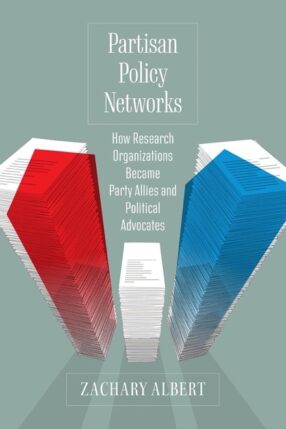
Zachary Albert‘s first book, Partisan Policy Networks: How Research Organizations Became Party Allies and Political Advocates, sheds much helpfully refulgent light, including in the form of facts and figures, on these phenomena.
Indicative data
Before a prime example, some necessary boilerplate tax-policy background. Policy-research organizations that seek and achieve the status of a public charity under Internal Revenue Code (IRC) § 501(c)(3), of course, are subject to limits or outright prohibitions on their lobbying or electioneering efforts in order to get and keep that status. They are tax-exempt, and contributions to them are tax-deductible.
A growing number of these (c)(3) think tanks have created an affiliated entity for which they’ve sought and achieved the status of a social-welfare group under IRC § 501(c)(4). These (c)(4) groups, according to Internal Revenue Service language that Albert quotes, “may engage in some political activities”—including “direct or indirect participation or intervention in political campaigns”—if such efforts are not their “primary activity.” They are tax-exempt too, recall, but contributions to them are not tax-deductible.
“The ability to engage in direct advocacy and activism while still retaining the legal and popular patina of a think tank is highly desirable for policy-demanding groups,” Albert writes in Partisan Policy Networks, available at a discount from Penn Press by following these instructions. “For this reason, the tendency to form (or transform into) a politically active do-tank is increasingly pervasive ….”
The below chart, from a sample of 65 influential think tanks he compiled for the book, “shows the share of think tanks founded in each decade that can be considered ‘politically active,’ meaning they have engaged in lobbying or have an affiliated 501(c)(4),” as described by Albert, an assistant professor of politics at Brandeis University.
Politically active think tanks by founding decade
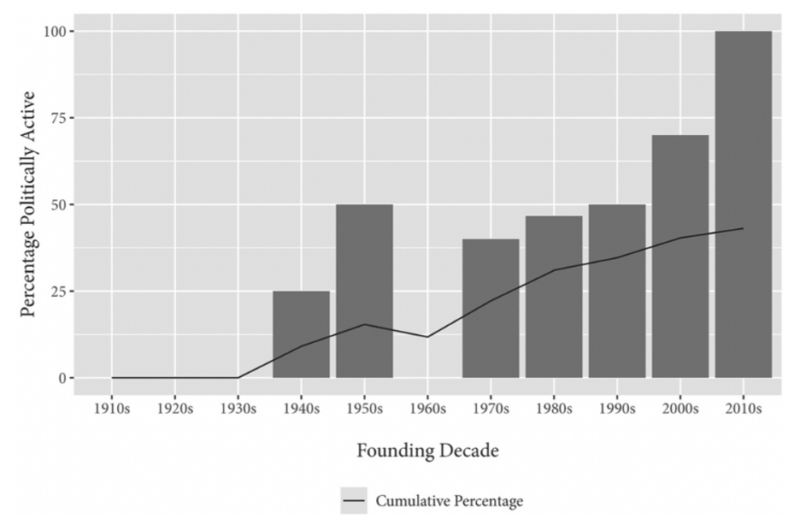
“The solid line tracks the cumulative percentage of all think tanks considered politically active over time,” he continues. “The chart shows that the majority of think tanks founded prior to 1990 did not go on to engage directly in politics, with only two think tanks … eventually becoming politically active. The vast majority of early think tanks started as and continue to be politically disinterested.”
Then, nonprofit “think tanks founded since the 1990s are more likely than not to engage in direct political activism, often but not always through an affiliated advocacy organization,” according to Albert.
These organizations are largely ideological and often have partisan policy preferences. There are some notable exceptions … but in general those that seek to influence the political process in more direct ways also seek to move policy in a specific ideological direction and work through a single political party to do so. The ability to employ advocacy tactics through their affiliated 501(c)(4)s, or just engage in lobbying through their think tanks, allows them to provide direct and indirect subsidies to their preferred party, aid it in their joint policymaking efforts, and act as allies in the partisan policy network.
Later in the work, he also presents and explains data supporting the idea that partisan research organizations “rely far more on ideologically extreme donors, especially individuals.”
Albert’s next book—Small Donors in the US: Myths & Reality, co-authored with Raymond J. La Raja—will be released later this Spring by The University of Chicago Press.
He was kind enough to join me for a recorded conversation earlier this month. In the first part of our discussion, which is here, we talk about how so many think tanks have become partisan political organizations, including the role of their funding.
The just more than 15-and-a-half-minute video below is the second part, during which we discuss differences in the two parties’ policy networks, corporate support of both networks, and how to consider improving the research product available to policymakers and the public, including by strengthening parties.
Asymmetry and avoiding the muck, and massaging and ensuring
The two parties’ policy networks “are not symmetrical networks,” Albert tells me. “The liberal Democratic-leaning network is more diffuse. It’s a bit more scattered.” There are “more organizations that fall under that side, and none of them” is “super-dominant. Whereas on the Republican side, the conservative side,” there are “fewer organizations, but they have generally more power and more influence. … There’s an asymmetry, even if they’re kind of evenly matched in terms of number and to some degree even resources. The nature of these networks looks very different.”
On the conservative side, Albert again cites The Heritage Foundation as noteworthily influential, historically and currently. “Generally, I think they’ve affiliated themselves with the Trump kind of MAGA wing of the party and oriented themselves around that agenda,” he says,
so I think I would say their future and their success to some degree hinges on the success of the MAGA movement in the party and how central that faction remains. But on the other hand, we’ve seen Heritage adapt and pivot before, so I think they are going to remain an important player moving forward regardless.
On corporate support of think tanks, “corporations to some degree are loath to give to some of these organizations that have” political “reputations and get more in the muck” of partisanship, according to Albert. “At the same time, I was also kind of surprised when I looked at the donors to these organizations, the corporate donors” to think tanks,
that they are giving fairly widely, right? So, the Center for American Progress and the Center on Budget and Policy Priorities on the left both have a good number of corporate sponsors. The same is true of organizations on the right and in the center. … There’s a good deal of corporate money that’s being spread out across the ideological spectrum in a way where individual money is not. It’s much more concentrated on one side or the other.
More largely, he says, “I don’t want to oversell how intellectually dishonest this process is, because” there are “plenty of organizations, even with ideological viewpoints and partisan viewpoints even, that are doing good research.” In Partisan Policy Networks, he continues, he addresses
What does it mean to produce biased research? It’s not fabricating the numbers and lying. It’s something much less sinister than that. It’s agenda-setting; you don’t focus on topics, you don’t publish research that challenges some of the central goals of your organization. It is also adopting particular assumptions, using particular data, defining concepts in particular ways that are going to support your conclusion, [your] vision.
… I don’t want to go too far in saying that these are all liars. By and large, most of these people are doing halfway-decent research, if not better. But it’s massaging the research in ways that are going to ensure that they support the general outlook of the organization.
Stronger parties, and supply and demand
In terms of what to do about any of this, if anything, “stronger parties would help solve some of the issues we have going on,” Albert says. “I would actually turn attention, though, to stronger parties inside of political institutions, so mainly Congress and stronger nonpartisan institutions within there, as well.” This would include, for example, “more support for something like the Congressional Research Service and nonpartisan research organizations inside the institution, which would make members less reliant on outside sources of information, which come with all this baggage we’ve described.”
He thinks “stronger political-party organizations, as well, inside Congress”—like “stronger policy committees, stronger committees in general—might help again make members of Congress less reliant on these highly motivated outside sources of information,” too.
“A big part of why there’s been this increase in partisan and political research organizations is that elected officials have a demand for this,” Albert notes, “and these organizations are meeting that. … It’s very much a marketplace dynamic where” what they supply “is just a rational reaction to broader partisan polarization.
“Another, more-punitive approach might be to have more enforcement of these separations” between legal categories, he says, but “I think that’s kind of a dead letter,” as we talked about in Part 1. “I don’t see that being a realistic solution and I really think that raises all sorts of thorny questions. …
“I like to focus on private think tanks that I think are living up more to the vision of what a think tank is and should be,” Albert concludes, citing the Brookings Institution, the American Enterprise Institute, and the Cato Institute as examples.
They have kind of a principled opposition to that politicization. Even if they have ideological viewpoints, I think it’s very valuable to have people researching in … different areas from particular perspectives, and those perspectives are pretty well-known. What’s less well-known a lot of the times is these groups that combine an ideological and even partisan perspective with aggressive political advocacy and doing these interest-group type of things under the guise of a think tank and kind of benefiting from that inherited reputation as just being researchers, when really they’re doing far more than that.