On the morning of December 5, 1955, the black residents of Montgomery, Alabama, initiated one of the most profound acts of civil disobedience in American history: the Montgomery Bus Boycott. Planned to compel fair treatment from the city’s white-operated buses, the boycott’s first day exceeded its organizers’ expectations, as bus after bus rolled by with almost no black passengers. That evening, sensing that they stood at the threshold of something momentous, thousands of black Montgomerians descended on Holt Street Baptist Church. They had come to celebrate their unity of purpose. They had come seeking guidance on what would happen next. Above all, they had come in search of someone who could give voice to their hopes and fears and provide a moral framework strong enough to justify their sacrifices in the coming struggle.
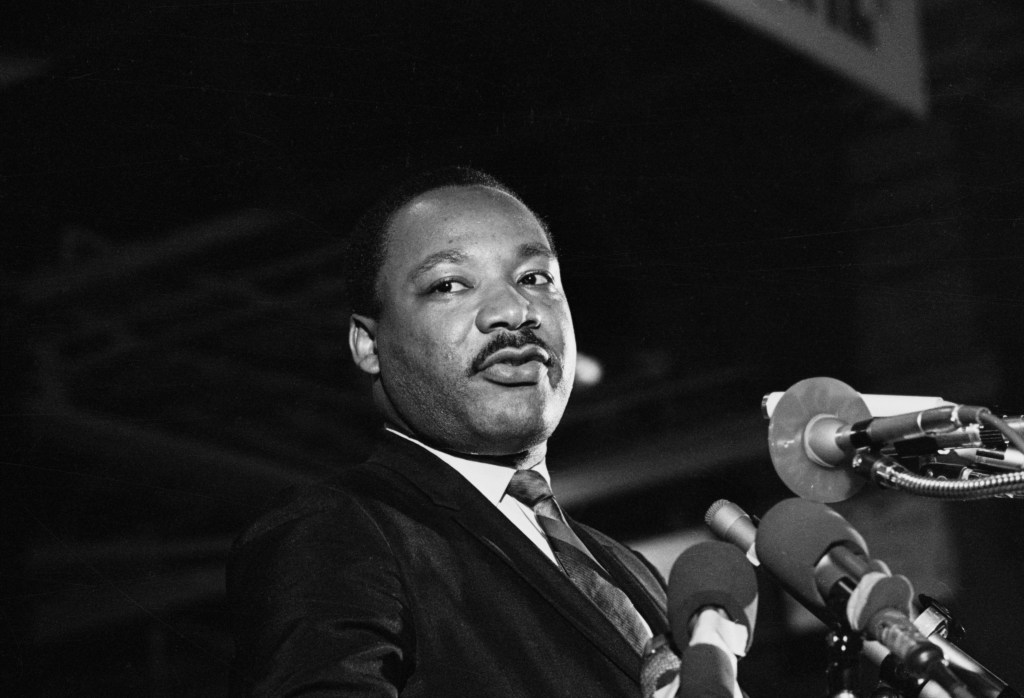
In this decisive moment, one of the boycott’s organizing ministers—the 26-year-old Martin Luther King Jr.—pushed his way through the crowd to deliver an impromptu address. With his words that night, the boycott transformed from a local protest against segregated buses into a national movement to redeem the soul of America.
“First and foremost we are American citizens,” King told the expectant crowd. “We are not here advocating violence. … The only weapon that we have in our hands this evening is the weapon of protest.” This burgeoning mass movement, he insisted, was not merely a stand against segregation, but a challenge to the nation, a test of whether the principles of freedom and equality enshrined in America’s founding documents would finally be realized for black Americans. By refusing to cooperate with an unjust system, black Montgomerians were not radicals attempting to undermine democracy, but citizens seeking to purify it.
In framing racial equality as the logical fulfillment of shared American values, King embodied the ideal of the statesman: a leader who marshals public sentiment behind a principled moral end through a unifying message grounded in history. “If we are wrong, the Constitution of the United States is wrong,” he told the crowd in Montgomery.
King invoked the founding because he viewed himself as an interpreter of the moral core of American democracy, in a lineage of statesmen from Thomas Jefferson to Abraham Lincoln. Like Jefferson’s assertion that all men are created equal, and Lincoln’s recognition that a nation dedicated to that proposition could not endure half-slave and half-free, King infused the civil rights struggle with a transcendent claim: The realization of moral absolutes in America’s past provided the basis for collective action in the present, and made the nation and its people worthy of redemption.
King understood American history not as a story of inevitable progress, but as a moral inheritance—one that bestowed a responsibility upon subsequent generations to strive toward their own moral horizons and to address the challenges of their time with clarity and purpose.
In a commencement address at Lincoln University in Pennsylvania six years later, King made this philosophy explicit: “The American Dream,” he stated simply, “reminds us that every man is heir to [a] legacy of worthiness.” What separated the United States from other nations throughout history, King argued, was not power or prosperity but the Declaration of Independence’s “sublime words”: All men possessed natural rights to life, liberty, and the pursuit of happiness, and although government was created to protect these rights, it was not their source. As a student of history, King understood that “seldom if ever in the history of the world” had the founding documents of a nation contained such a radical idea—one that, as black Americans had long argued, expressed an “amazing universalism,” without regard to race, nationality, or creed.
Understanding King as a historical thinker and statesman helps frame the climactic August 28, 1963, March on Washington not as an exercise in utopian pageantry but as a deliberate test of one of the central questions of his life: Could moral ends be achieved through moral means? When more than 200,000 Americans converged on the National Mall, they came to reaffirm their conviction that a nonviolent mass movement of ordinary citizens could change history.
Delivered in the shadow of Lincoln’s towering statue, King’s “I Have a Dream” speech captured the essence of democratic statesmanship. In a sweeping narrative that fused biblical language with faith in the redemptive power of historical progress, King identified hope for racial reconciliation in America’s past and called on those in attendance to commit to realizing this goal. America could finally live out the “true meaning of its creed,” he insisted, but only if its citizens embraced equality before the law and genuine integration as the indispensable means of renewing American democracy by extending its blessings to all its people.
The March on Washington is widely remembered for King’s soaring rhetoric. Yet it was his guidance of the younger, more outspoken John Lewis that best reflected his vital role in preserving the moral authority and strategic discipline of the civil rights movement. When Lewis insisted on delivering a fiery address ahead of King—one that called for marching through the South in a “revolution,” likened to Sherman’s destructive March to the Sea—King huddled with him by the Lincoln monument, not to chastise him for his anger, but to appeal to the better angels of his nature. “‘John, that doesn’t sound like you.’ That’s what Dr. King said,” Lewis later recalled. In counseling restraint, King was not dismissive of Lewis’ anger, nor compromising black Americans’ legitimate grievances to preserve a harmonious photo-op. Rather, he was ensuring that black citizens’ full integration into American life remained the march’s enduring image in the national consciousness.
One of the most remarkable things about Martin Luther King Jr. is that he never stopped moving. Even as the triumphant days of 1963 faded, the civil rights movement fractured, and the acclaim King had enjoyed dissolved into criticism, he continued to deliver hundreds of speeches a year—crisscrossing the nation and often sleeping only four hours a night. Why did he keep going? As a statesman, King believed that confronting injustice in America was a duty he owed to God, his fellow man, and his country. “I love this country too much to see the drift that it has taken,” he said during one sermon in 1968.
From the moment he arrived in Montgomery to the end of his life, King’s work reflected his commitment to serving others by helping them see the best qualities in themselves and in their nation. If he could just reach one more gang member mired in poverty, one more white moderate, one more disillusioned black leader with his message of persistence, faith, and democratic renewal, then the promise of America—a nation founded on the principle of individual human dignity—might yet be redeemed. “I can’t lose hope,” King once said, “because when you lose hope, you die.” It was this hope, this stubborn faith, that America’s “jangling discords” of racism and inequality could be transformed into a “beautiful symphony of brotherhood,” which carried him to Memphis.
The theme of King’s final address in Memphis on April 3, 1968, was acceptance, not only of his own mortality, but of his place in history. Indeed, despite the setbacks of recent years, he appeared more confident than ever as the leader of a movement whose aspirations for moral reform transcended any one man or lifetime. Rather than giving in to cynicism over the long struggle to advance the cause of human freedom, King expressed gratitude for being alive at this “great period of history,” and for the opportunity to lead America toward the promised land of an integrated society. Tracing human development from ancient Rome to the 20th century, King explained that what he learned from history—and what his opponents did not understand—was that history is not a static record of things that somehow happened; it is shaped by human beings and contains a discernible record of progress toward eternal truths.
Consequently, on that final night in Memphis, King reiterated that it was the gap between America’s professed values and the lived reality of many of its people, not the values themselves, that required adjustment. “All we say to America,” he declared, “is ‘Be true to what you said on paper.’” It was a line that defined his philosophy, the movement he led, and one that connected him to generations of black Americans who viewed the Declaration of Independence and the Constitution not as compromised relics of the past, but as commitments to be fulfilled in the present. In King’s words, these documents were America’s “great wells of democracy … dug deep by the Founding Fathers.” And like water from a well, their assertion of the God-given principle that human beings possess intrinsic value, from which equality in a free society flowed, could always be drawn upon for civic renewal in trying times.
King never lost faith that the idea of America itself was worthy of redemption. In his determination to make America the “truly great nation it is called to be,” King insisted on a moral accounting for all Americans—white and black—not merely another protest or change to the law. From 1776 to the 1960s, he understood American history not as a story of inevitable progress, but as a moral inheritance—one that bestowed a responsibility upon subsequent generations to strive toward their own moral horizons and to address the challenges of their time with clarity and purpose.
To be sure, the obstacles King faced were immense. From racial prejudice to the pressures of leading a movement whose scope far surpassed his own life, King was often dismissed as naïve or written off as incapable of producing meaningful change.
And yet, he never abdicated the burden history had placed upon him. As a statesman, King believed enduring change required engaging in dialogue, building consensus, and compromise without surrendering principle. Building consensus in a democracy is a frustrating, uncertain, and typically thankless process, but King persisted because he believed in a profound synergy between universal morality and the self-evident truths that formed the basis of the American experiment in self-government. “Let us not lose faith in democracy,” he urged black Montgomerians back in 1955. “For with all of its weaknesses, there is a basis of hope in our democratic creed.”