This is Year 250, as most people know by now—the 250th anniversary of the Declaration of Independence. It is also Year 250 for The Wealth of Nations, by Adam Smith, that apostle of the Scottish Enlightenment. Smith published his book on March 9, 1776. The Declaration was issued—sometime in July, I think.
The Wealth of Nations and the American Founding go together like peanut butter and jelly, or whatever your favorite combo is.
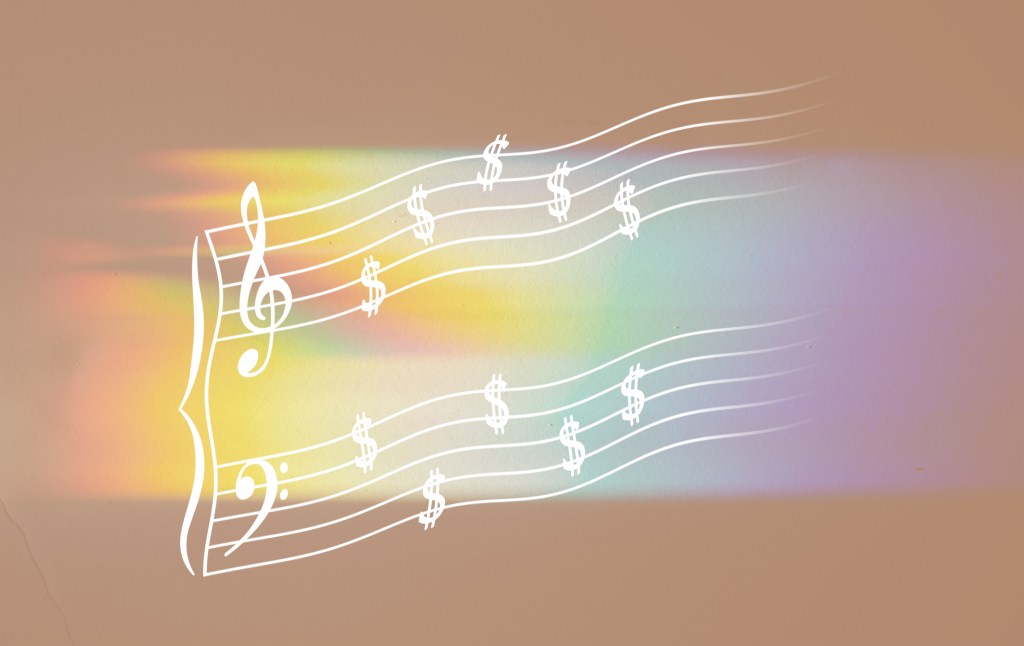
David Lang, an American composer born in 1957, has written a piece based on The Wealth of Nations. He calls his piece the wealth of nations. Why the small letters? I don’t know, but I can tell you this has been the fashion in music for about 20 years now, and I look forward to its passing.
Lang’s wealth of nations was premiered by the New York Philharmonic on March 19. Serving as conductor was Gustavo Dudamel, the Venezuelan maestro, who will become the Philharmonic’s music director next season.
David Lang has a taste for music with political or social connections. In 2019, the Philharmonic premiered his prisoner of the state, which is a “response” to Beethoven’s opera, Fidelio.
Our program notes earlier this month said that Lang “has returned repeatedly to large-scale, text-driven works that place individual voices within a wider civic frame, exploring moral, social, and political questions without prescribing answers.”
His wealth of nations is an oratorio—a secular oratorio—for orchestra, chorus, and two vocal soloists. (At its premiere, the soloists were a mezzo-soprano and a bass-baritone.) The work is in 18 movements, beginning with a purely orchestral one called “sinfony.” There is another, later on, called “pifa.”
Handelians will recognize that these terms come from Messiah, and Lang indeed modeled the wealth of nations on that oratorio. Handel took his texts from—well, the Bible, primarily (King James Version). Our program notes quoted Lang as saying that Adam Smith’s book is “a little bit like the Bible of economics, and, like the Bible, it has been read and misread, quoted and misquoted, understood and misunderstood.”
Lang uses passages from Smith’s book, and also some of his own words. Moreover, he uses texts from Americans who lived in the 19th and early 20th centuries: Ralph Waldo Emerson, Franklin Delano Roosevelt, Eugene V. Debs, et al.
Is the deck stacked against Smith? Does Lang enlist these others to contradict or refute the Scotsman? One could be forgiven for expecting so. The arts world is not exactly a hotbed of free-marketeers and classical liberals.
Here is a statement from Lang: “This piece isn’t about saying Adam Smith is wrong and Eugene Debs is right. I’m not interested in declaring good guys and bad guys.” Instead, he is presenting ideas, in juxtaposition, for a listener to consider.
There are two ways of discussing his work: as an exercise in economics, political theory, and moral philosophy, or as an exercise in music—in short, an oratorio. In singing, there is an old debate: “Prima la musica o prima la parola?” (“First the music or first the word, or words?”) In the 1780s, Antonio Salieri wrote an opera called Prima la musica e poi le parole (“First the Music and Then the Words”).
As a prima la musica guy myself, I will begin with the music.
Lang’s oratorio involves a pastiche of styles, chiefly minimalism, I would say. Words, notes, and phrases are repeated. Sometimes the repetition is choppy or declamatory, sometimes it is lulling. One section of the oratorio—“what is money”—is playful, almost jokey. Another section—“everyone lives”—is syncopated and jazzy.
The FDR section—in which our New Deal president inveighs against monopolies—is, I swear, bluesy. And gospel-inflected. On the night of the premiere, it was sung by the female soloist, not the male.
And need it be said that no one has ever outdone Adam Smith in anti-monopoly?
I smiled when a section began with a sad trombone—because “sad trombone” is an expression that has entered our language. It means, roughly speaking, “Too bad.” Another section is a duet between the soloists accompanied only by snare drum and cymbals.
Though the wealth of nations is an oratorio, it is not heavy. It is light-textured. There is a feeling of chamber music about it.
You might say that passages from books, essays, and speeches don’t make for a promising libretto. You would be right. Commenting on the libretto of a contemporary opera, a conductor friend of mine quipped, “It ain’t Boito.” (Arrigo Boito was the great librettist who worked with Verdi on Falstaff, for example.) David Lang’s authors are not Boito. But he works effectively with them.
It was a pleasure, sitting in the concert hall, to get a little reacquainted with Adam Smith. His intelligence and humanity are evident. Many people know “I, Pencil,” the essay by Leonard E. Read from 1958. It illustrates the extensive cooperation necessary to manufacture a pencil. Back in 1776, Smith’s “pencil” was a woolen coat—“the produce of the joint labour of a great multitude of workmen.”
Smith writes, “The shepherd, the sorter of the wool, the wool-comber or carder, the dyer, the scribbler, the spinner, the weaver, the fuller, the dresser, with many others, must all join their different arts in order to complete even this homely production.”
Emerson appears in an extract from his essay “Wealth.” “The farmer is covetous of his dollar, and with reason,” he writes. “It is no waif to him.” Lang takes it upon himself to switch the pronouns to “her.” Was this necessary? To be honest, I have given up asking such questions.
Maria W. Stewart was an African American writer and activist who lived from 1803 to 1879. In 1833, she delivered an address in Boston, saying, “… we have performed the labor, they have received the profits; we have planted the vines, they have eaten the fruits.” She was talking about slavery, of course, and Lang quotes her (or sets her).
I found myself hoping that everyone in the hall realized: Adam Smith was as anti-slavery as they came. So was his English contemporary Samuel Johnson. For my money, Johnson was responsible for the most stinging criticism of the American patriots ever uttered: “… how is it that we hear the loudest yelps for liberty among the drivers of negroes?”
Eugene V. Debs was America’s leading socialist, and he was convicted of sedition in 1918. (President Warren Harding would commute his sentence in 1921.) Debs made a statement to the court, and Lang sets almost the entirety of it. It is an eloquent statement, whatever we think of its ideas. Toward the end, Debs pleads for “social justice.”
Sitting there, I thought, “You want social justice? Give the people what Adam Smith was advocating.” I also thought of Phil Gramm, the Texas politician and onetime economics professor. In 2000, Gov. George W. Bush was campaigning on “compassionate conservatism.” Gramm balked at the phrase. “Freedom is compassionate,” he said.
I further thought of successors to Smith and The Wealth of Nations—in particular, Friedrich Hayek and The Constitution of Liberty, and Milton Friedman and Capitalism and Freedom. These books—all three—are interesting and brilliant. But they are also … true, aren’t they?
Men and women have rights regardless of material prosperity. Smith, Hayek, and Friedman knew that, and so do you and I. But in the field of material prosperity alone—is there any debate? What is the record of an open economy versus a closed one? What is the record of free enterprise versus central planning?
Consider West Germany and East Germany. Consider the two Koreas. Consider Venezuela, which I did in the concert hall, in part because Maestro Dudamel was on the podium. (He conducted at Hugo Chávez’s funeral in 2013. Since then, he has distanced himself from chavismo.) Venezuela was once a model for democracy and prosperity in South America. Chávez drove the country into dictatorship and starvation.
But we can talk about these issues on any other day—back to David Lang’s wealth of nations as a work of art.
I found it sincere, earnest, and admirable. I must say, too, that it did not quite hold my attention. I found it a little tedious, as the work proceeded. But I would like to hear it again, which may sound like faint praise but instead is rather high—especially for a new work.
And calling attention to The Wealth of Nations at 250 is a service by itself.