from the making-being-awful-more-efficient dept
All the people who have always brushed off concerns about surveillance tech, please come get your kids. And then let someone else raise them.
Lots of people are fine with mass surveillance because they believe the horseshit spewed by the immediate beneficiaries of this tech: law enforcement agencies that claim every encroachment on your rights might (MIGHT!) lead to the arrest of a dangerous criminal.
Running neck and neck with government surveillance state enthusiasts are extremely wealthy Americans. When they’re not adding new levels of surveillance to the businesses they own, they’re scattering cameras all around their gated communities and giving cops unfettered access to any images these cameras record.
Here’s how it plays out at the ground level: parents can’t get their kids enrolled in the nearest school because of surveillance tech. In one recent case, license plate reader data was used to deny enrollment because the data collected claimed the parent didn’t actually reside in the school district.
Just over a year ago, Thalía Sánchez became the proud owner of a home in Alsip. She decided to leave the bustle of the city for a quiet neighborhood setting and the best possible education for her daughter.
However, to this day, despite providing all required paperwork including her driver’s license, utility bills, vehicle registration, and mortgage statement, the Alsip Hazelgreen Oak Lawn School District 126 has repeatedly denied her daughter’s enrollment.
Why would the district do this? Well, it’s apparently because it has decided to trust the determinations made by its surveillance tech partner, rather than documents actually seen in person by the people making these determinations.
According to the school district, her daughter’s new student enrollment form was denied due to “license plate recognition software showing only Chicago addresses overnight” in July and August. In an email sent to Sánchez in August, the school district told her, “Although you are the owner on record of a house in our district boundaries, your license plate recognition shows that is not the place where you reside.”
But that’s obviously not true. Sanchez says the only reason plate reader data would have shown her car as “staying” in Chicago was because she lent it to a relative during that time period. The school insists this data is enough to overturn the documents she’s provided because… well, it doesn’t really say. It just claims it “relies” on this information gathering to determine residency for students.
All of this can be traced back to Thompson Reuters, which apparently has branched out into the AI-assisted, ALPR-enabled business of denying enrollment to students based on assumptions made by its software.
Here’s what little there is of additional information, as obtained by The Register while reporting on this case:
Thomson Reuters Clear, which more broadly is an AI-assisted records investigation tool, has a page dedicated to its application for school districts. It sells Clear as a tool for residency verification, claiming that it can “automate” such tasks with “enhanced reliability,” and can take care of them “in minutes, not months.”
One of the particular things the Clear page notes is its ability to access license plate data “and develop pattern of life information” that helps identify whether those who are claiming they’re residents for the sake of getting a kid enrolled in school are lying or not.
Thomson Reuters does not specify where it gets its license plate reader data and did not respond to questions.
We’ll get to the highlighted sentence in a moment, but let’s just take a beat and consider how creepy and weird this Thomson Reuters promotional pitch is:
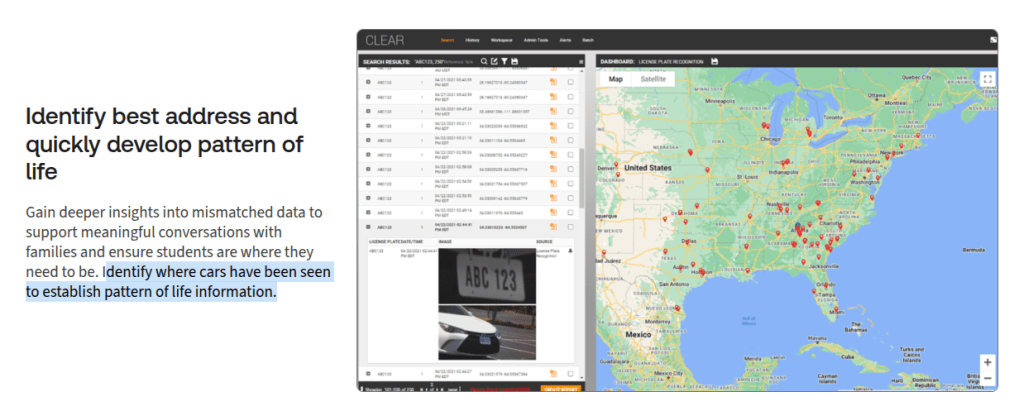
The text reads:
Gain deeper insights into mismatched data to support meaningful conversations with families and ensure students are where they need to be. Identify where cars have been seen to establish pattern of life information.
No one expects a law enforcement agency to do this (at least without a warrant or reasonable suspicion), much less a school district. Government agencies shouldn’t have unfettered access to “pattern of life” information just because. It’s not like the people being surveilled here are engaged in criminal activity. They’re just trying to make sure their kids receive an education. And while there will always be people who game the system to get their kids into better schools, that’s hardly justification for subjecting every enrolling student’s family to expansive surveillance-enabled background checks.
And while Thomson Reuters (and the district itself) has refused to comment on the source of its plate reader data, it can safely be assumed that it’s Flock Safety. Flock Safety has never shown any concern about who accesses the data it compiles, much less why they choose to do it. Flock is swiftly becoming the leading provider of ALPR cameras and given its complete lack of internal or external oversight, it’s more than likely the case that its feeding this data to third parties like Thomson Reuters that are willing to pay a premium for data that simply can’t be had elsewhere.
We’re not catching criminals with this tech. Sure, it may happen now and then. But the real value is repeated resale of “pattern of life” data to whoever is willing to purchase it. That’s a massive problem that’s only going to get worse… full stop.
Filed Under: alpr, chicago, license plate readers, surveillance, wtaf
Companies: flock, flock safety, thomson reuters