Editorial note: this essay originally appeared at The Giving Review.
***
A number of conservatives have issued warnings about any aggressive populist reaction against establishment progressive philanthropy and its activities, including those of almost all the largest private foundations and nonprofits in America, because of that which such a reaction might in turn mean for conservative foundations and nonprofit groups if and when liberals and progressives inevitably return to positions of political, policymaking, and prosecutorial power themselves.
This might strike some as a little historically uninformed—specifically, about that which those progressives have actually done when they previously possessed such power. In just recent history, think of the Federal Bureau of Investigation’s (FBI’s) Arctic Frost investigation of conservative nonprofits starting in 2022—about which we’re still learning much that should be of concern, as well as cause for pause among those “let’s-tone-it-downers” fretful about a new future. It sure appears as if the feared future has happened already.
In fact, this supposed future is about 90 years old, at least. One needn’t wait to learn much more about the Black, Minton, Anderson, and Buchanan Committee, for instance. We do know about them.
Or at least should.
Frontal assault on enemies
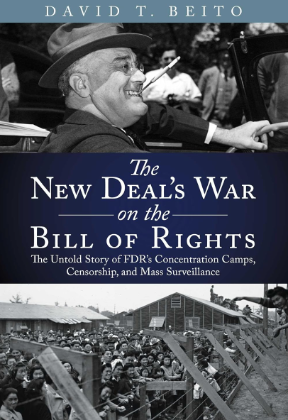
As President Franklin D. Roosevelt’s first term was ending and there were great concerns among progressives and Democrats about his re-election prospects in 1936, the Senate Special Committee to Investigate Lobbying Activities—established the prior year and chaired by Alabama Democrat Hugo Black—“mounted a more frontal assault on the New Deal’s enemies,” according to University of Alabama historian David T. Beito’s 2023 book The New Deal’s War on the Bill of Rights.
During his tenure as this committee’s chair, Black had deployed highly controversial methods such as dragnet subpoenas of telegrams (with the assistance of the Federal Communications Commission) and of tax records (with the assistance of the Internal Revenue Service [IRS]) when probing anti–New Deal business interests and political organizations,” according to Beito and Marcus M. Witcher in a 2016 Independent Review article. (All parentheses in original.) This was far prior to better-known, later abuses of the IRS by Presidents Lyndon B. Johnson and Richard M. Nixon, of course.
“Dragnet subpoenas” are, more formalistically, blanket duces tecum subpoenas; duces tecum means “under penalty bring with you,” and they include all potentially relevant documentation, covering correspondence, financial information, and whatever else. Arctic Frost-like, it might seem.
Or, I guess, the future.
While the Internal Revenue Code § 501(c)’s categorization of different types of nonprofit groups wasn’t created until 1954, well after the Black Committee’s existence, the committee’s investigations also blanketly covered what would now be considered (c)(3) charitable and (c)(4) social-welfare ones. In January 1936, for example, “as former Democratic standard-bearer Al Smith was speaking at a highly publicized American Liberty League dinner, the committee was mailing out questionnaires to hundreds of individuals,” Beito writes in the book.
These asked under oath for itemized answers for any contributions over the previous two years to the American Liberty League as well as to the following other anti-New Deal groups: the Crusaders, the New York State Economic Council, the American Taxpayers League, and the Sentinels of the Republic. The mailings warned the recipients to be prepared to testify. Not without reason, many critics suggested that a key goal of the probe was to help Roosevelt’s campaign by scaring away potential donors fearful of being hauled before a congressional committee or subjected to tax audits. In a predictable response, the American Liberty League said it was being singled out for advocating “constitutional principles” and did not intend to comply because it was not a lobby.
Heavy-handed retaliation
Then, FDR’s second term began in 1937 “with three months of uninterrupted triumph followed by interludes of confusion, embattlement, false starts, several high-profile setbacks, an economic dip, and finally a determination to retaliate” against New Deal opponents, Beito recounts in The New Deal’s War on the Bill of Rights. The Senate’s Special Committee to Investigate Lobbying Activities “was a leading component of this strategy of retaliation.”
Indiana Democrat Sherman Minton had just become chairman of the committee, after FDR appointed Black, Minton’s mentor, to the Supreme Court. Minton himself was later nominated by FDR to a federal appeals-court judgeship in 1941 and by Harry S Truman to the Supreme Court in 1949. Black and Minton were men favored by the progressive establishment, intellectually and politically enamored of its New Deal, and aggressive in targeting its enemies with whatever investigative powers of the state over which they could coldly—perhaps frostily?—and calculatedly wield any influence.
“Minton, who had been Roosevelt’s preferred choice for the first open Supreme Court slot but had turned him down, was even more zealous than his predecessor in fealty to the New Deal,” Beito and Witcher write in their Independent Review piece. “The Minton Committee’s heavy-handed methods, however, produced widespread anger, thanks, in part, to the machinations of an all-too-obviously partisan chair. Rather than protecting and advancing the New Deal as intended, its actions had the opposite effect.”
Under Minton’s leadership, the committee additionally targeted a new entity formed just after FDR’s February 1937 announcement of his intent to pack the Supreme Court—the Committee to Uphold Constitutional Government, which would be more fairly characterized as an outright political committee that didn’t engage in charitable or social-welfare activities. It also focused deeply on the American Liberty League, as well, and the Famers Independence Council of America. Black Committee- and Arctic Frost-like.
Or the future. Again.
More probing questionnaires
In 1944, the House Committee on Campaign Expenditures—chaired by Rep. Clinton Anderson, Democrat of New Mexico, so known as the Anderson Committee—launched yet another investigation, targeting the Committee for Constitutional Government, which had shortened its name three years earlier from the old Committee to Uphold Constitutional Government, as Beito overviews in The New Deal’s War on the Bill of Rights. The Anderson Committee “represented continuity” with the Black and Minton Committees, Beito writes.
The Anderson Committee’s work helped generate the evidentiary and political foundation for the failed “Great Sedition Trial” in ’44, after many far‑right, pro‑Nazi, or Nazi‑sympathetic propagandists previously scrutinized by the Black and Minton Committees were indicted under the Smith Act. It ended in a mistrial. The committee’s work also helped lay the predicate for the Lobbying Act of 1946, requiring disclosure of all those contributing $500 or more to an organization, and “indirectly spawned” the House Select Committee on Lobbying, by Beito’s telling.
“After Truman’s upset victory in 1948, bringing Democratic majorities in the House and Senate, the victors promised again to scrutinize lobbies widely blamed for the previous Republican triumph” in the November 1946 mid-term elections, according to Beito’s book. The House Select Committee on Lobbying—chaired by Rep. Frank Buchanan, Democrat of Pennsylvania, so known as the Buchanan Committee—was authorized in 1949.
In 1950, the Buchanan Committee began its investigation with “a probing questionnaire sent to more than 170 businesses and organizations,” Beito writes.
The wording defined lobbying in the broadest possible terms to also include groups responsible for the indirect formation of political ideas. Buchanan vowed to play no favorites and pledged that his goals were only information and transparency, but few of the questionnaires went out to businesses or groups led by New Dealers or Fair Dealers. Especially revealing was the question asking to “include all expenditures in connection with” eight, and only eight, named organizations. All but one of these organizations were either right-wing or libertarian in orientation: the CCG, the American Enterprise Association (predecessor of the American Enterprise Institute), America’s Future, Inc. (a conservative outlet for Robert McCormick of the Chicago Daily Tribune), the Constitution and Free Enterprise Foundation, the Economists National Committee for Monetary Policy (pro–gold standard), the libertarian Foundation for Economic Education, and the Constitutional Educational League. The lone exception to this pattern was the Public Affairs Institute, a left-of- center group that promoted an even larger welfare state.
(All footnotes omitted.)
Beito notes what he calls the “glaring omissions” from the list of “the CIO-PAC as well as businesses allied with the administration … Buchanan himself revealed some explicit bias early on when he said that three out of the eight organizations under fire advocated ‘a brand of American Fascism; they are against those who believe in a free, progressive America.’”
Those concerned about aggressive governmental treatment by liberals and progressives of conservative nonprofits in particular cannot nesciently look only to a new, retaliatory future. Evidence of such treatment is also elsewhere.
The past—which, in fact, may actually serve to many populist conservatives as at least some basis for aggressive governmental reaction to liberal and progressive nonprofitdom.