U.S. automakers had built their EV plans with a network of subsidies and mandates meant to nudge U.S. manufacturers into the electric energy transition. From Obama-era regulations on vehicle mileage, to subsidies in 2022’s Inflation Reduction Act that paid consumers up to $7,500 per new electric vehicle, to even stiffer rules in California (whose base of consumers is so large that its decisions affect the entire U.S. auto industry), car companies had reason to believe that government winds were at their back.
But in May, the Senate blocked special waivers granted by the Biden administration that allowed California to impose an electric-vehicle mandate. And in July, the congressional GOP’s One Big Beautiful Bill Act ended subsidies for the purchase of new electric vehicles, which expired on September 30.
“The market (for EVs) is still in its pretty early stages,” Joshua Linn, a professor of economics at the University of Maryland, who studies the effects of government policies on the market for green technologies, told TMD. “ It’s not a surprise that you would see those consumers less interested in buying them than they were, as well as companies pulling back.”
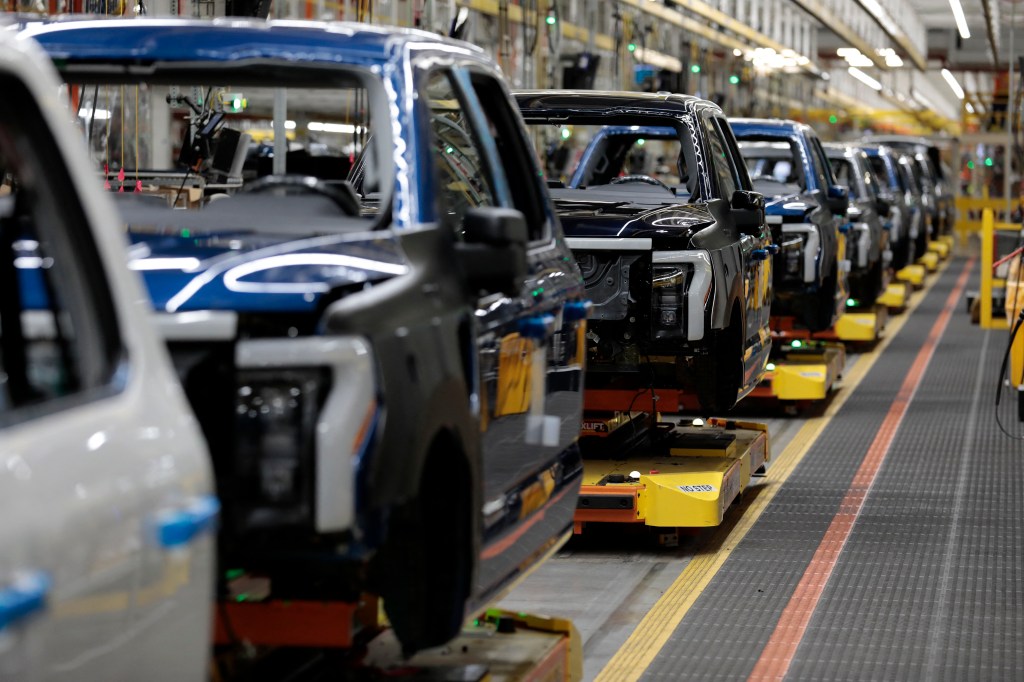
There’s also been a product-fit problem for the U.S. car buyer. Trucks are traditionally the most profitable segment of the U.S. auto market, but they haven’t worked well with EV power. Their range plummets when hauling or operating in cold weather, and these trucks cost considerably more than their ICE equivalents. There are six all-electric pickup trucks available to U.S. consumers, and the top seller by far is the newly canceled F-150 Lightning. Ford sold more than 10,000 units in the third quarter of 2025, an increase over previous quarters but still less than 5 percent of all F-150 sales.
But to say the EV market has failed would be a shallow view. The Tesla Model Y, a midsize SUV, was the bestselling car in the world in 2023, moving more than 1.2 million units, and in 2024 was still the fourth bestselling car in the U.S. “Lots of people are willing to pay a little bit more for an electric vehicle,” David Rapson, an economist at the University of California, Davis, told TMD.
For urban commuters, being unable to drive 500 miles on a single charge isn’t a meaningful problem, and EVs have lower operating costs, faster acceleration, quieter driving, and generally better in-car technology, including advanced driver-assistance systems. You also never have to stop at a gas station, and if you plug your car in overnight and at work, you never have to wait at a charging station. There’s also a particular class of wealthy consumers who like having the clean, futuristic thing: The Bay Area boasts the greatest concentration of electric cars in the U.S. But high-end electric sedans—which Porsche, Audi, and Lucid all started with—are among the fastest-depreciating cars on sale.
Combined with increases in the number of charging stations and continuing improvements in battery technology, EVs will continue to attract consumer demand. “There’s going to be organic growth in that market,” said Rapson. “It just will be smaller than if there were major policy forces pushing EVs forward.” Many U.S.-made electric cars (often made by foreign companies) continue to roll off production lines, such as the Hyundai Ioniq 5 and the Kia EV9.
Globally, the EV market tells a different story. Sales of midsize EVs continue to grow in Europe; developing countries are increasingly adopting the technology; and nobody builds or buys as many electric cars as China. In 2024, the People’s Republic accounted for better than 70 percent of global EV production—12.4 million units in total. But contrary to stereotypes about Chinese-made goods, many of these models surpass the quality of Western rivals, at a fraction of the price.
Chinese EVs aren’t available in the U.S.—at least not without privately importing them and paying a 100 percent tariff. But that isn’t true elsewhere. Chinese EV exports have increased by more than 600 percent since 2020, with EV sales accounting for rapidly rising shares of new vehicle purchases in developing markets. In Indonesia, for example, 12 percent of new vehicle purchases are EVs, up from zero percent five years ago. And across Indonesia, Brazil, Vietnam, Turkey, and Mexico, the developing world has a large base of EV customers.
“There’s entire generations that are going to know EVs before they know internal combustion engine vehicles, and a lot of those EVs are Chinese,” Ilaria Mazzocco, deputy director and senior fellow with the Trustee Chair in Chinese Business and Economics at the Center for Strategic and International Studies, told TMD.
China—as part of its national strategy to dominate high-tech industries—has engaged in a decades-long project to promote its EV sector, beginning after the 2008 financial crisis, Mazzocco said. The Chinese government has required local governments to purchase EVs, doled out consumer subsidies, and allowed EV buyers to bypass the license plate lottery, a process that could take decades under normal conditions. It’s also targeted “upstream” technologies, investing heavily in battery technology and securing supplies of rare earths and critical minerals. This has involved government investment, but the Chinese Communist Party hasn’t bailed out and supported weak automakers. Much of their effort has been to cut red tape and create a savagely competitive local EV market, forcing each company to rapidly improve and innovate, or die.
In his book Breakneck, Dan Wang recounts how, in 2018, Tesla became the first foreign carmaker invited to set up a wholly owned factory in China. Local automakers opposed the move, but the CCP approved it anyway, with Industry Minister Miao Wei saying that Tesla would be a “catfish” in the domestic market—a strong competitor that would force Chinese EV makers to innovate and improve. And today, Chinese EV manufacturers like BYD, NIO, and even the phone manufacturer Xiaomi produce cars that handily compete with the best from Musk. And because of the Chinese EV manufacturing talent market, Teslas built in its Shanghai factory have a reputation for being better made than those made in the West.
“The problem for the U.S. and Europe is that their companies really haven’t put the same level of effort over the past 15 years,” Mazzocco noted. American and European lawmakers have been less consistent and comprehensive than those in China, pairing temporary demand-side subsidies with aggressive tariffs on foreign competitors, and doing little to support the battery innovations and supply chain investments that underpin competitive EV production. Since 2012, California has required all car companies that sell in the state to offer a zero-emission vehicle. But without accompanying industrial policy, manufacturers like Mazda have responded with subpar, overpriced “compliance cars”—produced in limited quantities solely to satisfy regulations—that few consumers want to buy.
And even so, much of this week’s news has been overstated. The EU’s proposed new rules, while pared back, still set stringent requirements for electric vehicles, mandating that manufacturers reduce their fleet-wide tailpipe emissions by 90 percent by 2035.
Ford is backing down from its current EV platform but in August announced plans to invest $5 billion in its new Universal EV Platform, which it hopes will help it manufacture smaller, cheaper, and better electric vehicles. Farley called it Ford’s “Next Model T Moment,” and the first vehicle using it—a mid-sized pickup—is scheduled for release in 2027.
Last year, Farley told a British podcaster that he had driven a Xiaomi SU7 for six months as part of research into his competitors.
“We flew one from Shanghai to Chicago, and I’ve been driving it for six months now, and I don’t want to give it up,” he said.