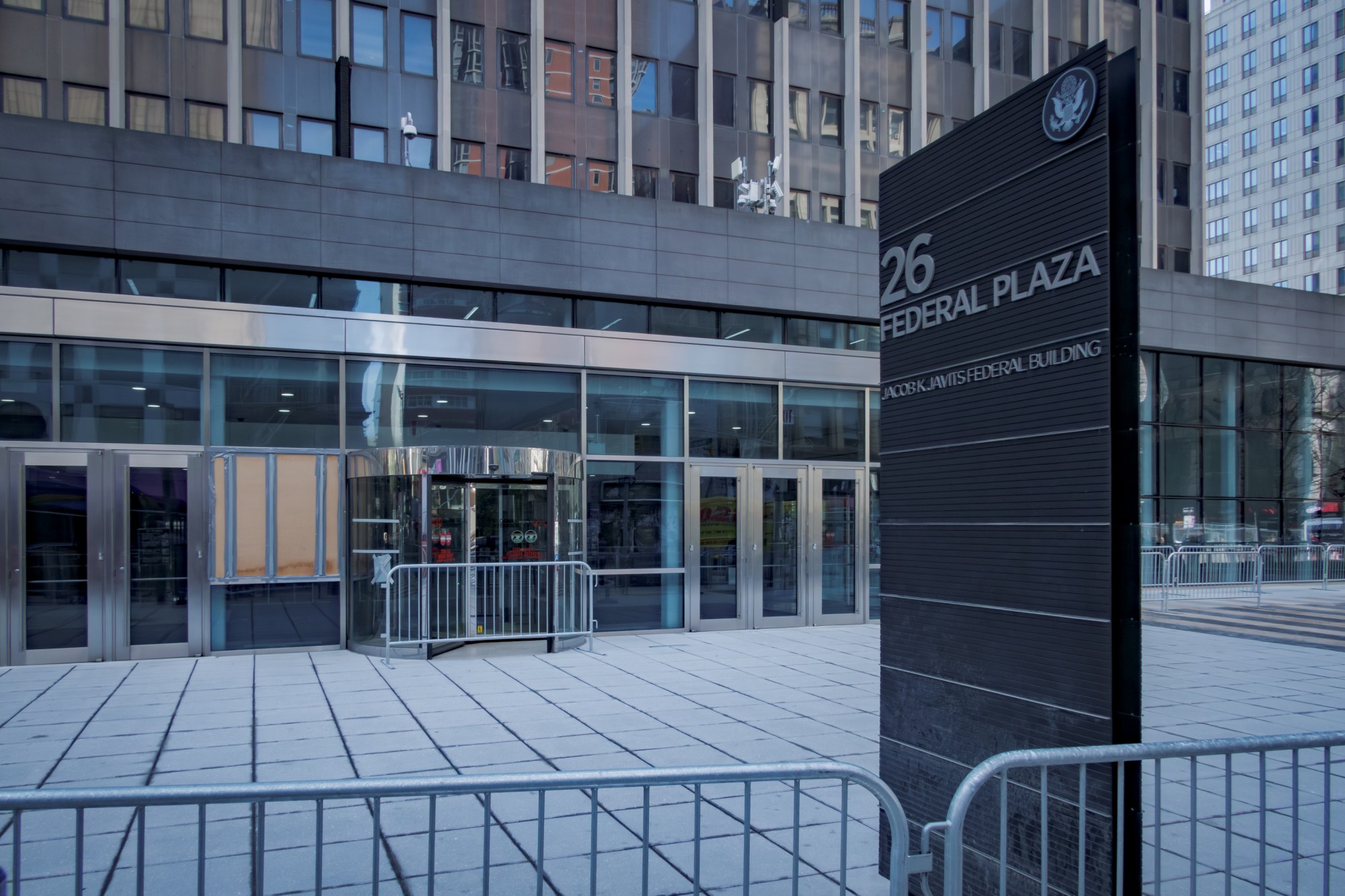
There are no windows on the 12th floor of 26 Federal Plaza in New York City. Once inside, the city disappears. Gray hallways open out into gray waiting rooms: like a train station or an airport, a transit hub, a no man’s land, a station between stations. You must take off your belt and remove your shoes before security will let you through the door. When you step inside that means you’ve exited the purview of the city and have entered the jurisdiction of the federal government. You may have lived in New York for years as a resident, a neighbor, a taxpayer, but if summoned for a date with federal immigration court, you report to the 12th floor as an “alien,” and as thousands of immigrants since July can attest, you enter 26 Federal Plaza not knowing when or where you will come out.
I’ve been coming to 26 Federal Plaza once a week since July with a group of other volunteer “legal observers.” I am not a lawyer or a social worker. I’m just a stranger, or as I introduce myself to those waiting to appear before the court, a neighbor, a New Yorker, “who doesn’t want to see my neighbors taken by ICE.” A simple introduction that can be said swiftly in an elevator, say, or waiting in line to get through security, in clumsy, classroom Spanish.
I offer to accompany respondents to and from their hearings. If they accept, I wait with them in windowless waiting rooms. Sometimes I see them out, all the way to the subway. Other times masked ICE agents stop us en route, and I stand there, a silent witness to a disappearance, the outcome of which I rarely know. I do not intervene. When a detention is underway, I do not obstruct, record, or even speak. I’m just an observer.
What else do I see? Children, mostly. ICE primarily targets adult men (who make up roughly 70 to 80 percent of those in the agency’s custody) for detention and deportation, but the waiting rooms outside of immigration court are full of kids. On a chilly Friday in January, for instance, I see families from Colombia, El Salvador, Ecuador, and Haiti; families whose countries of origin are posted outside of the courtroom along with their “Alien” numbers and names. Mothers, grandmothers, fathers, and kids in their Sunday best, waiting to appear before a federal judge who will evaluate their applications for asylum. Almost nobody has a lawyer. Almost nobody is fluent in English. Little girls in red velvet with white buckles on their shoes. Little boys in three-piece suits. An infant, 15 days old, nursing at his mother’s breast.
What do the children see?
I am not the first person to observe how masking degrades the public’s faith in ICE. The mask offers immunity and anonymity. It gives the wearer the freedom to disappear from public view. This was precisely what ICE’s most fervent supporters said only a few years ago, about different men and women in masks, in what now feels like a different century. It is what the Georgia state legislature cited when it passed an anti-masking bill in 1951 to deter the Ku Klux Klan from donning hoods.
But I wonder whether the mask obscures their vision as well as ours—whether the freedom of being unseen also frees the agent from seeing, really, what they do and to whom.
In July, I heard two ICE agents ranking Mission: Impossible movies from worst to best. The first one was obviously the best, the John Woo sequel obviously the worst, but how to weigh Rogue Nation against Ghost Protocol? While they debated, a young man left the courtroom with his mother. Two ICE agents approached. One told him to put his hands behind his back; the other pulled out the handcuffs. The young man almost made it to the elevator before the ICE agents caught him. They wrestled him to the ground while his mother cried out. Then they led him away through an armored door.
Ten minutes later, the agents returned and, as if they’d never stopped, continued ranking films while I listened to that mother, whose son they had taken, weeping in another room. She was moaning “no, no, no,” over and over, but the agents gave no sign that they could hear her. She had no role in their film, in their personal spectacle, in which two action heroes wrestled a man to the ground before he could escape down an elevator and back out into the city. She had been there, but she had been edited out of the final cut.
Even when no one is detained, the presence of masked agents everywhere—in the waiting room, in the hallways, in the elevators—permeates the building with fear. This is in no small part because the post-hearing detentions are, or at least appear to be, random. I have witnessed dozens of respondents appear before the court, receive a follow-up court date, and walk out of the courtroom visibly relieved. Often, that relief is justified: They get out, they go home, and they return to their families. But I have also seen asylum seekers with follow-up court dates stopped on their way to the elevator, handcuffed, and led away. ICE is effective, in part, because they appear to transcend the judicial system and its more predictable rhythms. The judge’s jurisdiction ends at the courtroom door, but ICE moves through the building freely. They appear and disappear through armored doors. When a respondent walks into the gray, windowless room outside the courtroom, they are sometimes taken, sometimes not. Every respondent I have accompanied is afraid, and I can’t, in good faith, tell anyone who reports to the 12th floor as an “alien” that their fear is misplaced.
In December, I sat next to a little girl while a judge evaluated her mother’s asylum application. Some kids on the 12th floor pretend they’re somewhere else—they read books, play games on an iPad, or color with crayons—but this girl was very serious, attentive. She accompanied her mother to the hearing, and she listened to the judge’s every word. When the judge asked a routine question in these proceedings, Do you understand you are removable to your country of origin? the child understood the question before her mother did. Her mother had to wait for the translator to repeat it. But the child knew more English words—the word removable, for instance—And when she heard it, she began to shake.
The success of an asylum application depends on the seeker’s ability to prove that they have a credible reason to fear returning to the country from which they fled. The fear must be one of persecution due to race, persecution due to nationality, persecution due to political opinion, or persecution due to membership within a social group. The seeker must provide credible evidence that the government of her home country cannot or will not protect her, or she must prove that her government is, itself, her persecutor. Years may and often do pass between the time of her crossing the border into the U.S. and her hearing in New York. Her dictator has been deposed and replaced. War has broken out. Earthquakes have wrecked the capital. The archives are burned or lost. A lawless gang has staged a coup. Her country goes by another name. The United States, too, has changed a great deal since she first arrived.
Most asylum applications do not succeed.
Last week, I accompanied an asylum seeker from South America to her court date on the 12th floor. ICE agents aren’t allowed in the courtrooms, but they often hover just outside. While the judge is speaking, you can hear the buzz of their walkie-talkies, hear their footsteps as they pace back and forth.
In this case, the DHS had moved to pretermit the woman’s asylum application, citing Asylum Cooperative Agreements. If the judge granted the motion, she would be removable not to her home country but to two other countries, Honduras and Uganda where, per the ACA, she could seek asylum instead. She had no family in these countries, no friends, and had never so much as visited. The judge asked if the woman had reason to fear such a removal. She said yes. When prompted to clarify the grounds on which she based this fear, she spread out her hands. “I am afraid it would be the same as it is for me here,” she said. Her answer baffled the other legal observers in the room, because, of course, it did not help her case. But as I walked her out, past a line of masked agents in flak jackets, pistols visible on their hips, I thought I understood what she meant. She was afraid to go—an uncertain future in an uncertain place—but she was also afraid to stay.
I don’t always know why I’m here. When ICE takes away an “alien,” wrestles them to the ground or shuffles them through their armored doors, I am helpless. I feel hopeless. I offer a little comfort to the detainee in a language I can barely speak. I suppose I keep coming back because it feels like the right thing to do. And now that I’ve been there, now that I’ve seen it, I feel ashamed when I don’t—when I’m busy, out of town, or simply stay out too late the night before and sleep in when my alarm goes off.
Sometimes the person who is detained has no one with them. I’m haunted by that thought. That the last face you might see before you’re disappeared isn’t that of a friend or a family member, not a face at all, but a mask. A man I escorted out of the courtroom a few weeks ago was in good spirits after he saw the judge. As we walked, I asked him how it went. He gave me a thumbs up and grinned. Then he was taken.
I tried to tell him something with my expression. Something like: I’m here, and I see you. But I don’t know what he saw when he looked at me. I don’t know what came through. I could have said, “I’ll call your wife,” or “I will find you help,” but I did not. Three days before, an ICE agent had shot Renee Good in the head through her car window. I was afraid. The ICE agent barked at me to clear the hallway, and I did what I was told.
I fear that the agent’s way of looking is contagious. The more masks we see, the more normal they become, the more their strangeness begins to fade into the background. Eventually, lawlessness becomes indistinguishable from law, becomes the law. We won’t see the “aliens” they take as people. We will adopt a mask ourselves.
This winter, during a record cold snap in New York,I offered to walk a family with a 15-day-old baby to the train after their court appearance. They had 10 days to appeal the DHS motion to pretermit their asylum application or be found removable to one of four countries, none of which had this family ever visited. They were stopped at the exit of 26 Federal Plaza by a gust of freezing wind. The father handed me the baby’s diaper bag. The mother slowly took the baby’s arms and fitted them into a tiny pink coat. A security guard—who works for the city of New York and not the Department of Homeland Security—yelled at the family to move it along, to stop blocking the exit. I yelled back.
“Okay. So, where can she go and get the baby dressed?”
The security guard shrugged. “Not my problem. She just can’t stay where she’s at.”
What happens on the 12th floor feels like it happens where no one is watching, but this isn’t true. There are no windows to look out of, and no way to see inside, but there are cameras in every corner. Microphones hang from the ceiling. Contact with the outside world is limited, but you are certainly being watched. Signs posted on the walls warn you against cell phone use, and even if you ignore them, service is bad. If you talk to others in the waiting room, you might be hushed by a court assistant or a security guard. Fear is isolating even, and perhaps especially, when collectively felt.
Two weeks ago, a grandmother was waiting for her granddaughter to see the judge when two agents entered the waiting room and began scanning the list of cases on the wall. The list included her granddaughter’s name. The old woman reached for a crucifix hanging from her neck; it was nearly identical to the one hanging from the neck of one of the agents.
I do not see the masked man when he steps outside, when he removes the mask, when he has breakfast with his family, plays with his kids, goes to church. When he puts the mask on, however, he becomes an Agent, and is his own higher power. If this is a delusion, it is one corroborated by the highest office of the land.
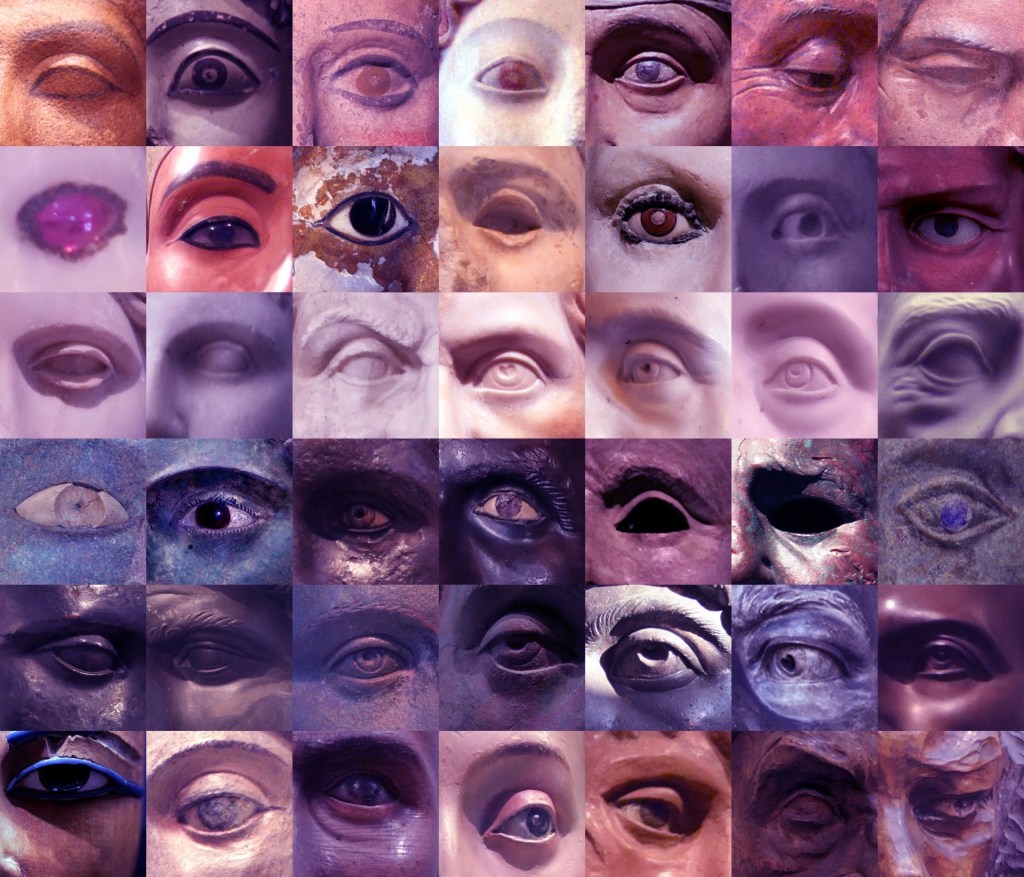
One of the only things to look at, the only interruption to the blankness of the 12th floor’s walls, is a portrait of the president. Its eyes follow me around the room.
Nicholas of Cusa, a 15th-century Catholic monk, asked his brothers to imagine God as a painting on the wall. When you walk around the room, he wrote, the eyes follow you wherever you go. The space is darkened and enclosed, in this hypothetical, and the painting’s gaze appears to look at you alone, but this is an illusion. You puncture that illusion by calling out, and by listening, in turn, to your brother testify that the eyes are following him too. From there you extrapolate that this gaze isn’t just on you but is universal in scope. It “watches with extreme care over the smallest creature as over the largest and over the totality of the universe.” Nicholas terms this exercise “the revelation of the witness.” And this revelation is the basis of his faith in God.
I do not know if God is watching over us, if He’s privy to the comings and goings on the 12th floor of 26 Federal Plaza, but I think it’s important that we believe that someone is watching what we do behind armored doors, in windowless rooms, and that they are looking “with extreme care.” But knowing we are watched is not enough. I believe we transcend the darkness not just by knowing that we are beheld, but by knowing that we are beholden to the other, to the stranger who is with us in the darkness calling out.
In the fall, an ICE agent came in with a piece of paper on which was printed a man’s “Alien Number” and photograph. She scanned the hallway until she found him. He was holding his 3-year-old daughter, asleep on his chest. The ICE agent’s hesitation seemed visible to me, even underneath the mask, but she had a job to do. I watched her approach the man resolutely. He handed the baby over to his wife who started weeping, quietly, so the baby wouldn’t wake. The ICE agent didn’t look at her at all. She took the man aside, until they were both partially hidden behind a wall. She pulled out the handcuffs. And then she flicked her gaze, briefly, at me. We locked eyes.
I don’t know what she read in my expression. But while I watched, her eyes filled with tears. She turned away from the man. She put the handcuffs back on her belt. He picked up his sleeping daughter, took his wife by the hand, and left.
To get to 26 Federal Plaza, I get off the subway at the Chambers Street station. Hearings start early, so when I arrive, I’m often too groggy to take note of my surroundings. When I leave, in the afternoons, I walk more slowly. I feel raw, exposed, undone by the simple freedom I have to come and go. Today I noticed that the mosaic which covers the Chamber Street station is a pattern, repeating: a wall of eyes.