Donald Trump appeared in person for Supreme Court arguments over his executive order ending birthright citizenship on Wednesday, becoming the first sitting president to ever show up in the courthouse. While Trump no doubt has a flair for the dramatic, he must have left disappointed by the careful, reasoned, technical arguments that filled the air: no banging on tables, no surprise witnesses (or witnesses of any kind), no earth-shattering rulings from the judges (those won’t come until June). And the proceedings showed that the outcome will likely also lack drama: The court appears poised to affirm the traditional American rule that anyone born in the United States is automatically a citizen.
While the question sparks fierce debate over immigration policy, it should not be a close call for those who interpret the Constitution based solely on its text and history. The case for birthright citizenship is, at its core, a straightforward one. The text of the 14th Amendment, the historical record of its drafting and ratification, the common-law tradition it incorporated, and 127 years of Supreme Court precedent all support birthright citizenship. No Congress, no president, and no Supreme Court has ever held otherwise. If the current majority of the justices is serious about interpreting the Constitution based on its original meaning, it will follow that history.
We should acknowledge the policy reasons behind the Trump administration’s attempt to overturn the 14th Amendment’s longtime interpretation. Automatic citizenship for children born to illegal immigrants on U.S. territory encourages foreign nationals to cross borders in violation of the law. Research by Pew suggests that 320,000 children were born to illegal immigrants and temporary visa holders in 2023 alone, close to 9 percent of all births in the United States.
However, ending birthright citizenship would do little to solve the immigration crisis. That effort must start at the border. An estimated 750,000 to 2 million immigrants entered the country unlawfully per year under the Biden administration. The problem was not that the children born to these illegal immigrants received citizenship, but that the administration refused to secure the southern border and enforce immigration law. Rewiring a constitutional rule that has governed since Reconstruction would not meaningfully change the conditions that draw people here. It would simply create a class of families, whose members were born on American soil, who can never become Americans—akin to the large communities of foreign workers who live as a second class in some European nations.
Regardless of these policy considerations, the Trump administration’s policy runs smack into the constitutional text. The 14th Amendment simply declares: “All persons born or naturalized in the United States, and subject to the jurisdiction thereof, are citizens of the United States and of the State wherein they reside.” This text sought to codify the traditional American and British rule that the place of birth determined citizenship on the one hand, and on the other to remove the great stain on that principle: the prohibition of slaves from citizenship.
“On birthright citizenship, the law has always led to the same place: To be born in the United States is to be born American.”
John Yoo
“In declaring independence from Great Britain, the founders of this nation rejected the English common law of subjectship in favor of an American law of citizenship.”
Pete Patterson
American history from the time of the founding makes clear that the U.S. and its Constitution adopted the birthright citizenship rule. In antebellum America, states granted citizenship. Upon independence, the states chose to follow the British rule. Known as jus soli, or “right of the soil,” the Anglo-American common law determined citizenship based on the place of birth. This concept was a rejection of the European standard of jus sanguinis, or “right of blood,” which based citizenship on the bloodline of the parents. In the 18th century, the great English legal scholar William Blackstone declared that the British rule held that “the children of aliens, born here in England, are generally speaking, natural-born subjects, and entitled to all the privileges of such.” American courts embraced this rule from the earliest days of the republic. As a Massachusetts court stated in 1806, “a man, born within the jurisdiction of the common law, is a citizen of the country wherein he is born.”
The Reconstruction Congress that met after the Union victory in the Civil War did not seek to change this rule. Instead, the lawmakers transformed birthright citizenship into a foundational constitutional principle and elevated it beyond the reach of elected politicians. They sought to place the principle into the Constitution because of the most grievous travesty in American constitutional history: slavery. In Dred Scott v. Sanford (1857), Chief Justice Roger Taney held that slaves and freedmen—even those born in the United States—could not become American citizens. Taney believed that the founders would have rejected the idea that blacks were equal to whites, and he used this belief to override the constitutional text, which neither excluded them from citizenship nor prevented Congress or the states from granting them that right.
The 14th Amendment overturned Dred Scott, making clear that the government can never base citizenship on any ethnic, religious, or political trait. The 1868 amendment was an affirmation of the existing common-law rule, not a departure from it. There are few records of the 14th Amendment’s ratification debates in the state legislatures, which is why constitutional practice and common law history are of such central importance. But there are a few instances where Congress addressed the issue. When the 14th Amendment came to the floor, some congressional critics recognized the broad sweep of the birthright citizenship language. Pennsylvania Sen. Edgar Cowan asked supporters of the amendment: “Is the child of the Chinese immigrant in California a citizen? Is the child born of a Gypsy born in Pennsylvania a citizen?” California Sen. John Conness responded in the affirmative, and later lost reelection due to anti-Chinese sentiment in California.
Originalist scholars who support Trump’s executive order cite legislative history that they believe supports the end of birthright citizenship. But the Reconstruction Congress was expanding citizenship, not narrowing it. It is difficult to believe that the same Congress that first freed the slaves in the 13th Amendment and then extended citizenship to them in the 14th Amendment would have simultaneously taken citizenship away from the children of immigrants.
The Trump administration, however, argues that the Reconstruction Congress sought to create a wholly new approach to citizenship based on the legal status of the parents, not the birthplace of their child. This argument depends wholly on the phrase “subject to the jurisdiction thereof,” which follows “All persons born or naturalized in the United States” in the 14th Amendment’s text. Because undocumented immigrants owe allegiance to another nation, the argument goes, they are not truly “subject to the jurisdiction” of the United States.
This reading is historically and textually implausible. If an illegal immigrant were not subject to American jurisdiction, he could break American laws and claim the government had no authority to arrest, try, or punish him. That conclusion is untenable. Foreign nationals on American soil, lawful or not, are bound by American law. Indeed, the Supreme Court has long confirmed that an immigrant, “although alleged to be illegally here,” falls within the jurisdiction of our laws.
In response, the Trump administration’s supporters argue that the traditional birthright citizenship phrase would render “subject to the jurisdiction thereof” redundant. But it was not mere surplusage. At the time of ratification, domestic and international law recognized three narrow categories outside American jurisdiction: foreign diplomats, soldiers of an occupying enemy army, and Native Americans on tribal lands. These were defined, well-understood exceptions that did not include ordinary immigrants, illegal or not—indeed, Congress would not enact the first immigration laws for another two decades. These categories contrasted with those of the Civil Rights Act of 1866, which excluded from citizenship individuals “subject to any foreign power” and “Indians not taxed.” If the 14th Amendment’s drafters had wanted “jurisdiction” to exclude the children of immigrants, they would simply have copied that language. They did not.
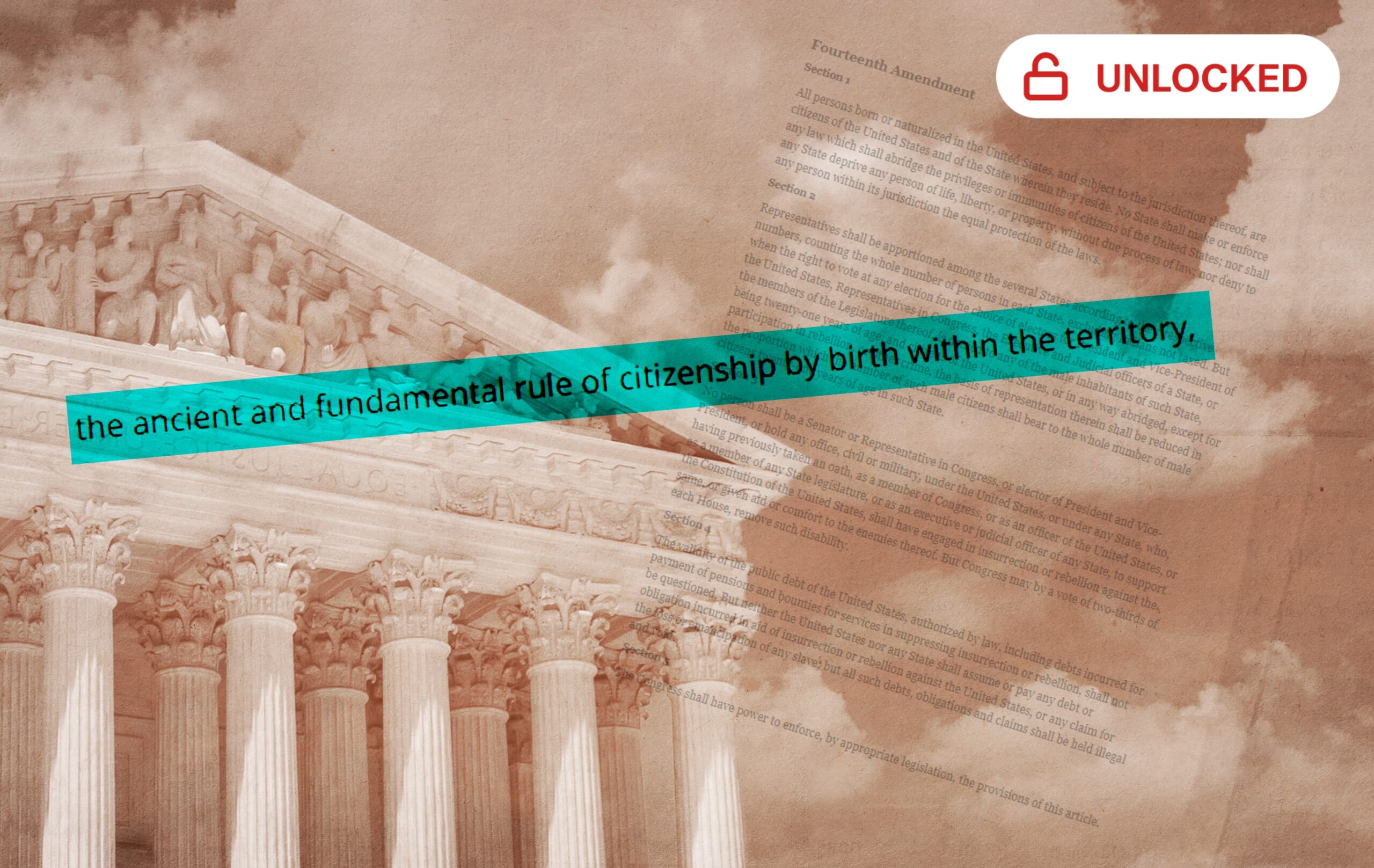
The Supreme Court settled the question in United States v. Wong Kim Ark (1898). It upheld the citizenship of a child born in San Francisco to Chinese parents who were themselves barred from ever becoming citizens under the Chinese Exclusion Acts. The court declared that “the Fourteenth Amendment affirms the ancient and fundamental rule of citizenship by birth within the territory, in the allegiance and under the protection of the country, including all children here born of resident aliens.” The government argued on Wednesday that this ruling does not apply because Wong’s parents were here legally. This distinction is artificial and legally irrelevant: At the time, Congress had not yet enacted comprehensive immigration laws defining legal and illegal entry. No Congress or president has ever followed any rule other than birthright citizenship.
Until Trump came along, that is. The president has the right, as the one whom the Constitution vests the duty to “take Care that the Laws be faithfully executed,” to propose a different interpretation and try to persuade the Supreme Court justices to change their minds. His solicitor general on Wednesday sought to limit citizenship to children born to parents who are citizens or otherwise legally present in the country. He asked the court to overturn a constitutional understanding that has held through war, Reconstruction, and the entirety of American history. The concern driving the order, that our immigration system is in serious disrepair, is one that millions of Americans rightly share. But the remedy must be consistent with the Constitution.
If the American people believe that birthright citizenship threatens our national security or the concept of national citizenship, they have a path forward. Indeed, the Constitution’s amendment process exists precisely for moments like this. What Americans should not support is finding in the 14th Amendment a meaning that it has never held and that the historical record does not support. True conservative jurisprudence follows the law where it leads, even when we disagree with the destination. On birthright citizenship, the law has always led to the same place: To be born in the United States is to be born American.