“One of the biggest effects [isn’t] just in terms of whether people are living in a given place, they’re in terms of who can move to another place,” Issi Romem, an economist and founder of MetroSight, a housing research firm, told TMD. “We’re gradually barring a whole subset of the country from living in certain parts of the country that are more expensive.”
The result is a market where demand in many locales far outpaces supply—and prices reflect it. In a recent New York Times/Siena poll, more than half of respondents ages 18 to 29 said securing housing was their top affordability concern. The next-most-cited expense was “basic needs/cost of living/bills” at 9 percent.
Only 22 percent of Americans ages 45 to 64 say that housing is their biggest affordability concern, and only 7 percent of seniors cite it as the expense that worries them the most—but more than a third of seniors agreed in the Times/Siena poll that housing has become unaffordable.
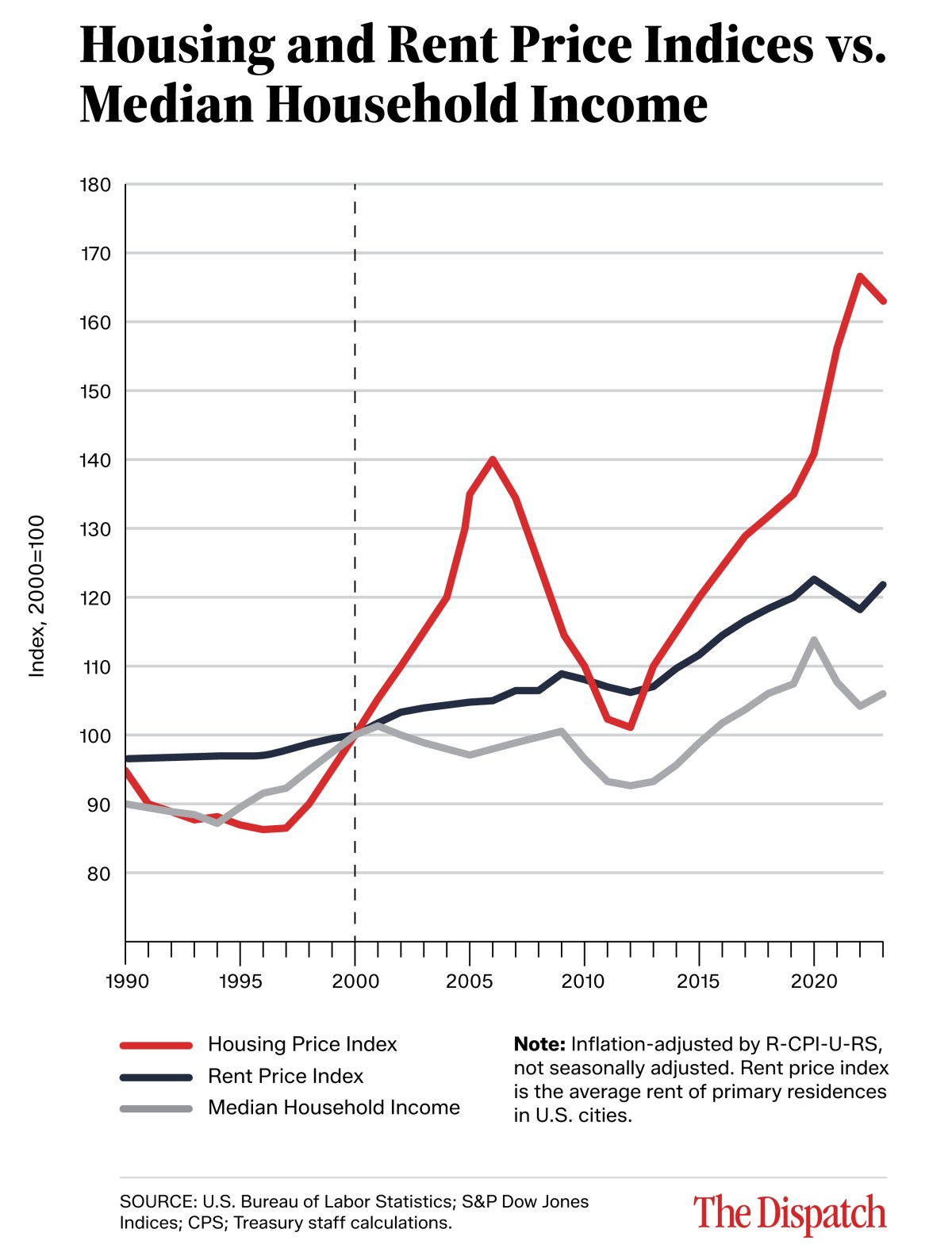
Starting around 2000, housing prices, as measured by the Case-Shiller index, began rising faster than median household income (except for a brief reprieve in the early 2010s). The amount renters pay has also grown faster than wages for almost all of the 21st century.
In 2024—the last year for which quality data is available—43.5 million households, or 33 percent of U.S. households, spent more than 30 percent of their monthly income on housing, meeting the definition of “cost burdened.” Of those, 21.6 million (or 16 percent of all U.S. households) dedicated more than half their income to rent or mortgage payments, plus utilities and other household costs. According to the National Association of Realtors, the median age of first-time home buyers in the U.S. in 2025 was a record high of 40 years old. (The Mortgage Bankers Association disputes NAR’s methodology, and other large-scale data sources—including the National Mortgage Database and Federal Reserve Bank of New York data—put the median first-time buyer age in the low 30s.)
The Causes
There isn’t one single cause of rising housing prices; environmental regulations, a shortage of construction workers, requirements for parking spaces, and rent-control legislation all drive prices upward, to name just a few. (To learn more about the causes of the current housing situation, read the November 11 issue of TMD.) But most economists agree that local zoning and permitting laws play a significant role.
“That’s where the control is; it’s at a very local level,” Joseph Gyourko, an economist at the University of Pennsylvania’s Wharton School who studies the housing market, told TMD. And the excess housing that does exist tends to be located in places with less demand: millions of units sit vacant in depopulating cities and rural areas, while supply remains chronically tight in the high-demand metros where jobs are concentrating.
Because housing rules are set locally, the push for reform has moved from the bottom up. The YIMBY movement (“yes in my backyard”) began with citizens testifying at Bay Area town meetings in the early 2010s, and has since grown into a national effort, with 72 chapters in 28 states, state-level PACs, and a newly formed House caucus.
States like California, Oregon, Washington, and Montana have passed major zoning reforms, such as expanding the number of areas where apartment buildings can be built and banning rules that allow only single-family homes. Increasingly, leaders of pricey cities—notably, Mayors Daniel Lurie in San Francisco and Zohran Mamdani in New York—say they’re committed to building more housing.
The Bill
Most zoning and permitting laws are set at the state or local level—but with the 21st Century ROAD to Housing Act, Washington is trying to prod states and cities into building more.
Should the bill reach President Donald Trump’s desk—and should he sign it, which is uncertain given his recent pledge not to sign any legislation until Congress passes the SAVE America Act—it would reward communities that plan or build more housing with federal grants and loans, streamline certain environmental review requirements, and expand home-repair loan programs.
The bill also aims to revive a collapsed industry: manufactured housing. Factory-built homes, regulated under federal standards from the Department of Housing & Urban Development rather than local codes, once accounted for 600,000 new units a year. Today, after the lending crises in the 1970s and early 2000s gutted the sector, that number is closer to 100,000. But factory production means lower costs—and by eliminating the requirement that all manufactured homes sit on a steel “permanent chassis,” the ROAD to Housing Act could save tens of thousands of dollars per unit.
“We don’t even know what that industry could do if we just let it do its thing,” Laura Foote, the executive director of YIMBY Action, the leading housing advocacy organization in the country, told TMD. Startups like the American Housing Corporation are seeking to apply modern construction methods and design to the sector.
“Manufactured housing is basically the only type of non-subsidized, affordable housing that we bring to market,” Tara Roche, a project director at the Housing Policy Initiative at the Pew Charitable Trusts, told TMD. Modern manufactured homes would shoot for “sometimes, frankly, higher quality than you would have with an aging home that hasn’t been updated in many years,” Roche said.
Freeing companies to build more manufactured housing is a step in the right direction, but several experts cautioned that Americans shouldn’t expect federal legislation to fundamentally alter the housing market.
“I don’t know that I see anything in the bill that makes me expect to see a kink upward in housing completions, that’s going to be visible on a chart,” Kevin Erdmann, a senior affiliated scholar at the Mercatus Center and a housing market expert, told TMD. Tobias Peter, the co-director of the American Enterprise Institute’s Housing Center, agreed: “This role of the federal government is very limited in affecting supply.”
Peter also worried that some of the reforms in the Act could empower the federal government to take less productive actions in the future, such as incentivizing inclusionary zoning, a policy that mandates that each new multifamily building include a certain number of below-market “affordable” units. Many analysts, including Peter, believe that inclusionary zoning increases construction costs and reduces supply, offsetting affordability gains. “The bill doesn’t really spend a whole lot of money on these actions, but it lays the groundwork for a new administration” to do so in the future, he said.
The Senate’s version of the bill was broadly similar to the one passed by the House, but added a new section titled “Homes are for People, not Corporations.” This provision would ban institutional investors—defined as entities owning 350 or more single-family homes—from purchasing more homes, with exceptions for newly built or renovated properties that must be sold to homebuyers within seven years.
And this effort has support on both sides of the aisle—including from Trump himself. “People live in homes, not corporations,” he wrote on Truth Social in January. Later that month, he issued an executive order urging Congress to work with the executive branch to “stop Wall Street from treating America’s neighborhoods like a trading floor.”
But Wall Street does not significantly affect the nation’s stock of single-family homes. A 2023 report from the Urban Institute found that, of the 16 percent of single-family homes rented, only 3 percent were owned by large institutional investors (defined as those owning 1,000 or more units). Gyourko argued that forcing investors to sell rental units would do nothing but slightly increase the number of homes available to buy and slightly decrease the number available to rent.
The ban also threatens the build-to-rent industry, which has grown in recent years, albeit from very modest levels. The National Association of Home Builders, which had previously supported the bill, on Thursday threatened to withdraw its backing due to the provision, declaring that the mandate to sell built-to-rent homes would lead to a “decrease in housing supply.”
Sharon Wilson Géno, the National Multifamily Housing Council president, and Bob Pinnegar, National Apartment Association president and CEO, said in a joint statement that the restrictions would have an “immediate chilling effect on housing supply, affordability and investment.” Almost 80 industry and pro-housing groups have signed an open letter calling for the removal of the provisions.
Some House Republicans—who must vote to ratify the final version of the bill—are concerned. Shortly before the Senate voted, Rep. Andy Harris from Maryland, chair of the House Freedom Caucus, said “We’ll deal with housing in some way—it’s not going to be the way the Senate is going to send it over to the House.” Rep. Scott Perry from Pennsylvania called many of the bill’s provisions “downright socialist, if not outright communist.” But their alarm seems unlikely to stop or fix a bill that passed the Senate with 89 votes.
“It’s Democrats. It’s Republicans. It’s pieces they built out together,” Elizabeth Warren said in an interview Thursday. “That is the strength of this bill.”