You’re reading The Morning Dispatch, our flagship daily newsletter explaining all the news you need to know today in fewer than 15 minutes. To unlock the full version, become a Dispatch member today.
Happy Monday! Saudi Arabia’s Real Estate Future Forum announced appearances by John Kerry, Hillary Clinton, Tucker Carlson, and Piers Morgan. None of them know anything about real estate, or shame apparently—but it’s a beautiful reminder that bipartisan unity is possible for a large enough wire transfer.
Quick Hits: Today’s Top Stories
Border Patrol Agents Kill Minneapolis Protester
U.S. Border Patrol agents on Saturday shot and killed a 37-year-old man, Alex Pretti, in Minneapolis following a confrontation with protesters. Homeland Security Secretary Kristi Noem said Pretti was armed with “weapons and ammunition” and interfered with a law enforcement operation, describing him as a “domestic terrorist.” The Department of Homeland Security (DHS) claimed that Border Patrol agents “attempted to disarm the suspect but the armed suspect violently resisted.” But video footage shows that one agent removed a handgun from Pretti’s waistband moments before a different agent opened fire. No publicly available evidence shows Pretti, who had a concealed carry permit, assaulting the agents. Pretti had previously worked as an ICU nurse at a Veterans Affairs hospital in Minneapolis, and did not have a criminal record. In a statement, Pretti’s family characterized the Trump administration’s description of events as “sickening lies,” writing, “Alex is clearly not holding a gun when attacked.” Democratic Minnesota Gov. Tim Walz also described the DHS’s account as “lies,” pledging to launch a thorough state investigation into the shooting. Minnesota state officials obtained a warrant from a state judge to investigate the crime scene, but federal law enforcement officials refused to recognize the order. At the request of state officials who sued the federal government, a federal district judge temporarily blocked the Trump administration from “destroying or altering” evidence that could be used in a potential investigation.
- In a post shared Sunday, Republican Gov. Phil Scott of Vermont criticized federal immigration enforcement for causing fatal shootings of American citizens “exercising their God-given and constitutional rights,” and urged President Donald Trump to pause immigration raids and return the government’s focus to “truly criminal illegal immigrants.”
- Senate Minority Leader Chuck Schumer said Saturday that Democrats would not vote to support any appropriations bill that includes the DHS funding bill.
- Speaking to the Wall Street Journal, Trump wouldn’t say whether he thought the agent had acted correctly or incorrectly, but said his administration is “reviewing everything and will come out with a determination.”
Xi’s Military Leadership Purge
China’s Ministry of National Defense announced Saturday that Gen. Zhang Youxia, the country’s most senior military officer after Xi Jinping, has been placed under investigation for “grave violations of discipline and the law,” along with the chief of staff of the Central Military Commission (CMC) Joint Staff Department, Liu Zhenli. Zhang is a vice chairman of the commission and was considered Xi’s most trusted military ally; their fathers fought together during the Chinese civil war, and the two men have known each other since childhood. The Wall Street Journal reported Sunday that an internal military briefing accused Zhang of helping leak nuclear weapon information to U.S. officials and granting government promotions in exchange for large cash bribes, including the position of defense minister.
- The announcement marks what one former CIA analyst told the New York Times is a “total annihilation of the high command,” leaving the commission with just one active uniformed officer after Xi removed five of six generals appointed in 2022.
- The only remaining CMC member is Zhang Shengmin—the anti-corruption chief running the purges, not a combat commander—and Zhang and Liu were the only remaining CMC members with combat experience.
- More than 50 Chinese senior officers and defense industry executives have been investigated since summer 2023.
Israel Searches for Last Body in Gaza
The Israel Defense Forces (IDF) on Sunday announced search operations to find the body of the last remaining Israeli hostage—Master Sgt. Ran Gvili, who died while defending a kibbutz from Hamas fighters during the terrorist group’s October 7, 2023, civilian massacre—in the Gaza Strip. The IDF searched a cemetery in the northern Gaza Strip on Israel’s side of the Yellow Line, the border to which Israel agreed to withdraw its forces under the ceasefire, though the IDF said some forces were deployed across it into Hamas’ designated territory for security purposes. While the IDF said that credible intelligence indicates Gvili’s remains may be buried there, the military acknowledged it possessed leads to other potential locations. The Times of Israel reported on Sunday that the search is expected to last several days.
- Israeli Prime Minister Benjamin Netanyahu’s office said in a statement on Sunday that, following completion of the search mission, “Israel will open the Rafah crossing,” the border between the Gaza Strip and Egypt, though his office did not provide a specific date or timeframe.
- The U.S. is pressuring Israel to open the Rafah crossing in order to proceed to the second phase of the U.S.-backed Israel-Hamas ceasefire, but that same deal also required Hamas to return all living and deceased Israeli hostages in the initial phase.
Ukrainian Peace Talks Continue
U.S., Ukrainian, and Russian officials met in the United Arab Emirates’ capital city of Abu Dhabi on Friday to discuss a prospective deal to end the war. Ukrainian President Volodymyr Zelensky on Saturday morning described the trilateral meeting as “constructive” and added that a follow-up meeting could be held as early as this week. Speaking in the Lithuanian capital city of Vilnius on Sunday, Zelensky said a U.S. security guarantee deal for Ukraine “is 100 percent ready” to be signed, adding that both countries are coordinating a place and time to make it official before sending the proposal off to their respective legislatures for approval.
- Russian forces conducted air strikes overnight on Friday and into Saturday morning on the Ukrainian capital city of Kyiv, targeting energy infrastructure. As of Sunday, more than 1,300 properties in Kyiv did not have proper heating.
Ted Cruz Caught on Tape
Republican Sen. Ted Cruz of Texas privately criticized President Donald Trump’s tariff policy and Vice President J.D. Vance during donor meetings last year, warning tariffs could decimate the economy and lead to impeachment, according to recordings obtained by Axios. Cruz recounted a late-night call with Trump in which he pressed the president to back off, warning of a “bloodbath” in the 2026 midterms—to which Trump responded, “F—k you, Ted.” Cruz, who is weighing a 2028 presidential bid, also attacked Vance as Tucker Carlson’s “protégé” and alleged the pair orchestrated former national security adviser Mike Waltz’s ouster. A spokesperson for Cruz said the senator is “the president’s greatest ally in the Senate” and dismissed the recordings as “attempts at sowing division.”

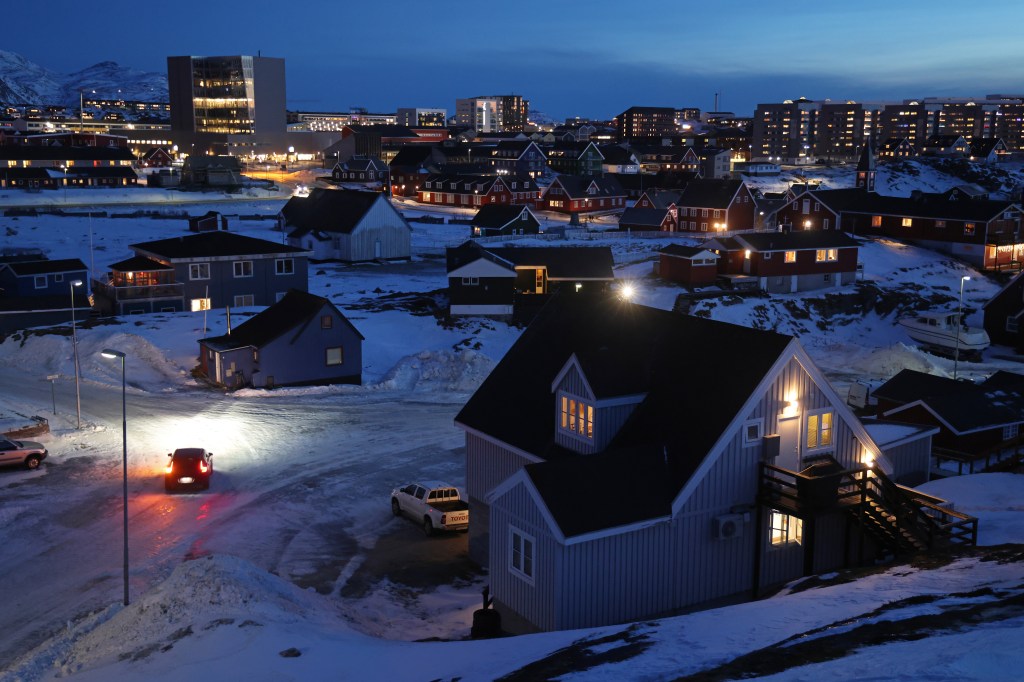
For weeks, President Donald Trump had been telling the world that he wanted Greenland, and when asked, repeatedly no-commented on whether he would use force to get it. But after a few days in the Swiss Alps, the president had changed his approach.
“I won’t use force” to take Greenland, he declared in a Wednesday speech at the World Economic Forum in Davos. And, a few hours later, he seemed to drop the idea of outright owning Greenland, too. Trump emerged from a meeting with NATO Secretary General Mark Rutte declaring that they had reached a “framework of a future deal” over Greenland, and canceled 10 percent tariffs he had threatened to levy on multiple European countries starting February 1. The details weren’t clear, but the crisis would end with Denmark remaining sovereign over Greenland and Trump expressing satisfaction. “It is the ultimate long-term deal. It’s an infinite deal. It is a deal forever,” he told reporters. He told Fox Business on Thursday that the deal “gets everything we want.”
The immediate diplomatic crisis over Greenland is over. But for European leaders and policymakers, the tricky balancing act of whether to confront Trump or appease him remains.
TMD has covered the president’s interest in acquiring Greenland before, explaining his reasoning—and, from the details that have emerged, the framework seems to address the core concerns. The plan is reportedly modeled on Britain’s arrangement with Cyprus—under which U.K. military bases there are considered British territory—and would see parts of Greenland designated as American “sovereign base areas” where the U.S. could conduct military and intelligence operations, station missiles, and develop infrastructure without needing Danish permits. There’s also a mining component: Greenland has large, untapped reserves of rare earth minerals, and Bloomberg reports that the framework includes granting American mining rights, explicitly aimed at keeping Chinese interests out. The deal would reportedly also increase NATO deployments to the Arctic.
The details are still sparse, with no official documents released; what, if anything, will change in practice remains to be seen. The 1951 Defense of Greenland Agreement already grants the U.S. military broad latitude to expand its presence on the island. “Things could be achieved as-is,” Troy Bouffard, the director of the Center for Arctic Security and Resilience at the University of Alaska, Fairbanks, told TMD—though he acknowledged that revisiting a Cold War-era framework could provide clearer guidelines for 21st-century operations.
When asked by ABC News on Sunday whether the deal would be similar to the 1951 deal, Treasury Secretary Scott Bessent said, “I promise you, the deal is not what we had before. It is much more fulsome for the United States.”
You are receiving the free, truncated version of The Morning Dispatch. To read the full newsletter—and unlock all of our stories, podcasts, community benefits, and our newest feature, Dispatch Voiced, which allows you to listen to our written stories in your own podcast feed—join The Dispatch as a paying member.

The immediate pressure on European leaders has eased, Rebeccah Heinrichs, the director of the Keystone Defense Initiative at the Hudson Institute, told TMD. Trump’s climbdown “provides a lot more diplomatic space now for the allies to come in and see very specifically what the United States is looking for” in the Arctic, she said. “If I were the European allies right now, I would be eagerly putting together suggestions for the Danes, but also from their own countries, about what they can do to meet the security needs that the U.S. has found.”
The reversal followed weeks of coordinated European pushback. France, Germany, the Netherlands, Britain, and all the Nordic countries deployed token forces to Greenland in addition to roughly 200 Danish troops under Operation Arctic Endurance—a mission meant to signal Europe’s commitment to Arctic security. “The Danes actually felt that they had to send troops to Greenland,” Daniel Fried, a distinguished fellow at the Atlantic Council and former assistant secretary of state for Europe, told TMD. “If Trump doesn’t like that, and if people say that the Europeans are hysterical, they need only look at what Trump actually said. You cannot, if you’re Denmark, simply ignore that.”
While the military moves may have been largely symbolic, the economic actions were not. On Wednesday, members of the European Parliament indefinitely suspended a U.S. trade agreement made last summer, which would be held “until we see the willingness of the U.S. to re-engage seriously with us and to stop the tariff threats,” according to Željana Zovko, a Croatian representative who is one of the lead legislators on the treaty. The European Commission had also readied a $109 billion package of retaliatory tariffs, initially prepared during trade negotiations last year, targeting U.S. exports—Harley-Davidson, Levi’s, and American whiskey. On top of this, French President Emmanuel Macron supported activating the Anti-Coercion Instrument—a package of financial measures including tariffs, bans on certain goods, and restrictions on U.S. companies operating in Europe—and there was speculation about a coordinated European sell-off of the roughly $3.6 trillion the continent holds in U.S. Treasury bonds.
Danish pension fund AkademikerPension announced it would exit its $100 million Treasury position by February 1, while Sweden’s Alecta disclosed it had already shed between $7.7 billion and $8.8 billion in U.S. government bonds since early 2025. Bessent dismissed Denmark’s holdings as “irrelevant,” but the president has demonstrated sensitivity to bond market volatility. Last year, turmoil in Treasuries was a key factor in his decision to pause his “Liberation Day” tariffs.
With news of the framework, the European Commission held off invoking the tariffs and the Anti-Coercion Instrument, and the trade deal is expected to proceed. “We achieved our objective through diplomatic and political means, which will always be our preference rather than going down a spiral of measures and countermeasures,” said commission spokesman Olof Gill on Friday.
Philip Luck, the director of the economics program at the Center for Strategic and International Studies, told TMD that Europe’s ability to harm the U.S. through the trade deal and retaliatory tariffs was significant. When counting the 27-country bloc as one entity, the EU is by far the U.S.’s largest trade partner, with $1.5 trillion in goods and services trade last year. “We could get into a world of hurt pretty quickly if it escalated,” Luck said.
But implementing the Anti-Coercion Instrument—regularly referred to as the “trade bazooka”—would have taken months, and a coordinated sell-off of U.S. Treasury bonds was even less feasible. Many of the largest European holders of Treasuries are central banks with their own independent mandates to maintain monetary stability, Luck said, and it would be extremely difficult to organize such a large trade without sparking an international financial crisis—and even harder, Luck added, to execute it in a way that achieved the desired effect without broader economic damage.
Europe still isn’t in a position to dictate to the U.S., said Carsten Brzeski, the head of Global Macro for ING Research. “Nothing has changed” since the trade deal negotiations last summer, he argued, noting that Europe remains deeply dependent on many U.S. companies, and that American support—though diminished—remains integral to Ukraine’s defense.
Trump’s decision to back off on Greenland, then, may have had as much to do with the adverse stock market reaction over the past week and the opposition of some Republicans in Congress as it did with European resolve.
“Let’s face it, being tough when someone threatens your sovereignty isn’t saying, ‘we’re going to cancel the trade deal,’” Anand Menon, a professor of European Politics at King’s College London, told TMD. He noted that many European leaders, like Italian Prime Minister Giorgia Meloni, were counseling against a confrontation with Trump, and others, like Rutte, were engaging in blatant flattery. “I think President Trump is right,” said Rutte on Thursday. “We need to defend the Arctic.”
But for now, European leaders are still left waiting to hear more details of the deal. Not even Greenland’s prime minister, Jens-Frederik Nielsen, knows what’s going on.
“I don’t know what’s concrete in that deal,” he said Thursday—only that a working group will begin talks. But Greenland’s limits are firm: “Our integrity and our borders and international law are definitely, definitely a red line that we don’t want anyone to cross.”
Today’s Must-Read


Vivian Gornick is not an apologist for Donald Trump—and yet the critic was heckled live by her own fans because she wouldn’t call the president of the United States a fascist. Dispatch contributing writer Emmett Rensin analyzes the power of the word “fascism,” and the popular urge to wield words against our political opponents. “The ‘fascism wars,’ as they are sometimes called, have been waged for a decade now without a settlement,” he writes. “Although this has superficially involved a lot of back-and-forth sniping between partisans for and against the president across various social media platforms, the bulk of the debate—the grinding attritional warfare over details, the long essays and insults, the urgency—has taken place not, as you might expect, between critics of the president (who are employing ‘fascist’ as a rough synonym for ‘super bad’) and his defenders (who are rejecting it on the basis that he is not, in their view, super bad), but, like Vivian and her hecklers, between figures in the broad American liberal-left spectrum who already agree on the underlying facts of the case: Donald Trump is a bad president.”
Toeing the Company Line



In Other News
- The U.S. Southern Command announced that its forces conducted an air strike on a suspected drug trafficking vessel traveling “along known narco-trafficking routes in the Eastern Pacific,” killing two aboard and leaving one survivor.
- A federal district judge temporarily blocked the Trump administration from ending legal status for more than 8,400 people who arrived in the U.S. from one of seven Latin American countries through family reunification parole programs.
- In a separate case, a federal judge ruled that the Trump administration could not end Temporary Protected Status for more than 3,500 Burmese migrants living in the U.S.
- J.D. Vance said the Trump administration would expand the “Mexico City rule” to bar federal health funding for foreign groups that promote diversity, equity, and inclusion and “radical gender ideologies.” Currently, that rule provides the same restrictions for foreign groups that provide abortion services.
- Gen. Dan Caine, chairman of the Joint Chiefs of Staff, invited senior military leaders from 34 countries that are based or have territory in the Western Hemisphere to an in-person meeting in Washington, D.C., on February 11. The discussions are expected to include potential responses to drug trafficking and violent cartel activity.
- Time reported that the Iranian government has killed more than 30,000 protesters.
- The Venezuelan government released another batch of political prisoners, with locally based human rights networks estimating that about 80 people were released in the latest round.
- The State Department revoked visas for two members of the Haitian Transitional Presidential Council and placed further visa restrictions on other members of the leadership board for alleged involvement in organized crime, including groups designated by the U.S. as foreign terrorist organizations.
- A human rights group based in the eastern Congo said an Islamic State-linked terrorist group killed 25 people in attacks in two villages.
- Authorities in Kosovo arrested 109 people suspected of taking part in an election fraud scheme to manipulate the voting results of the country’s December parliamentary elections, which required a recount.
- Gold passed $5,000 an ounce for the first time in history, marking a near 90 percent rise in value since Trump’s inauguration.
- The Securities and Exchange Commission dropped its case against Gemini Trust, a cryptocurrency exchange founded by billionaire twins Cameron and Tyler Winklevoss.
- The Trump administration reportedly took a 10 percent ownership stake in a rare earth mineral mining company, USA Rare Earth, in exchange for a $1.6 billion debt-and-equity investment.
- The Saudi Arabian-backed LIV Golf announced a new tournament in August to be hosted at the Trump National Golf Club in Bedminster, New Jersey.
- European authorities are investigating Elon Musk’s X after its integrated chatbot, Grok, produced AI-generated nonconsensual sexual images of women and children.
- “How AI Weather Models Are Making Better Forecasts” (Bloomberg)
- Jasper Craven on America’s sports gambling boom and the addiction crisis it’s creating. (Harpers)
- Jerusalem Demsas rebuts Arthur Brooks’ notion that GLP-1 drugs rob users of the satisfaction of struggle. (The Argument)
- Stephen Wilmot and Santiago Pérez on how BYD is succeeding globally despite tariffs. (The Wall Street Journal)
- How a $3.1 million Omega turned out to be a “frankenwatch” assembled by corrupt museum employees. (The Economist)
- John Loftus argues for designating the pickup truck as America’s national vehicle. (The Daily Caller)
Al Jazeera: Iran Rejects UN Rights Resolution Condemning Protest Killings
The Associated Press: Immigration Officials Allow Suspect in $100M Jewelry Heist to Self Deport, Avoiding Trial
Federal immigration authorities allowed a suspect in a $100 million jewelry heist believed to be the largest in U.S. history to deport himself to South America in December, a move that stunned and upset prosecutors who were planning to try the case and send him to prison.
The Associated Press: Oscar Mayer’s Wienermobile Race Is Coming Back to the Indy 500
Let Us Know
Have any thoughts or questions about today’s newsletter? Drop us a note in the comments or via email at tmd.questions@thedispatch.com. We read every submission, and your message could be featured in an upcoming “Behind the Scenes” segment.
Have any thoughts or questions about today’s newsletter? Become a member to unlock commenting privileges and access to a members-only email address. We read every submission, and answer questions in the following edition of TMD.