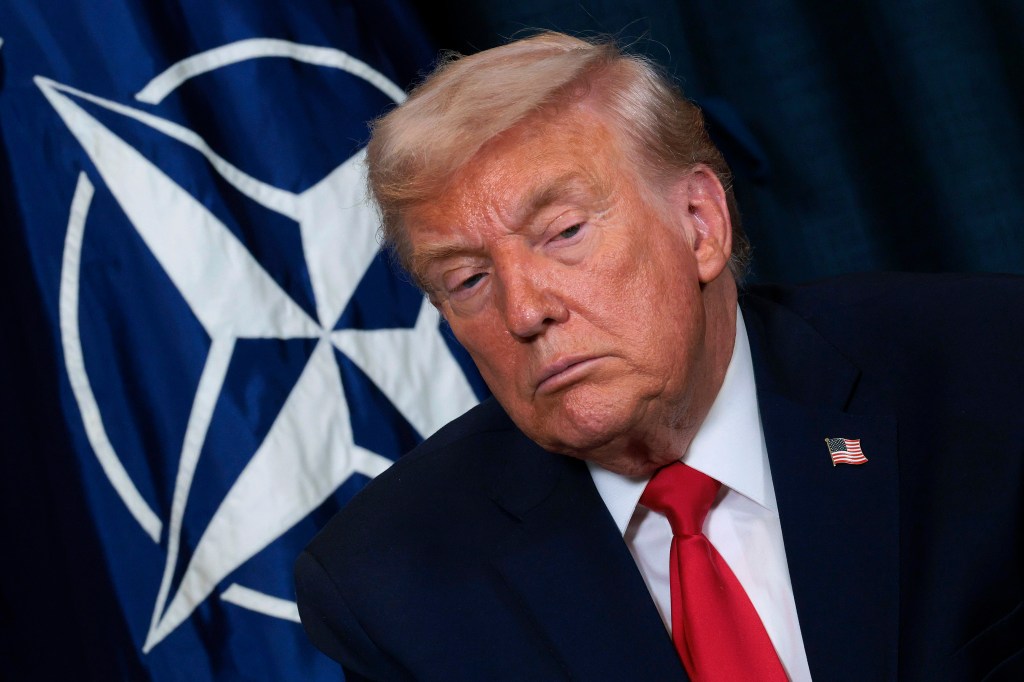
Donald Trump’s latest obsessive focus on acquiring Greenland appears to have, at the moment, reached some sort of conclusion. After a number of failed attempts over the last several days—including the hard sell, diplomacy, threats of economic warfare, threats of actual warfare, and straight-up demanding Greenland—the president has been unable to convince the Kingdom of Denmark to give up its Arctic island territory.
Instead, what appears to have been hashed out in Davos, Switzerland, this week is a “framework of a deal” that could include granting the U.S. sovereignty over the land on which our existing military bases in Greenland sit. The announcement coincided with a climbdown from Trump’s most egregious threats to use tariffs against Denmark and seven other European allies. Trump preceded these threats with a series of statements and actions over the last several days regarding the necessity of the U.S. having Greenland that all gave the distinct impression the self-generated crisis was about personal vanity and a desire to project strength, with America’s national security concerns an afterthought.
“Because that’s what I feel is psychologically needed for success,” the president told the New York Times earlier this month when asked why acquiring Greenland was so important. His most trusted aides have recently stated America could and would consider using the military to seize Greenland. And in a message sent to the prime minister of Norway on Sunday, Trump gestured at concerns about Russian and Chinese threats in the Arctic region only after complaining that he had not won the Nobel Peace Prize and stating he would no longer “think purely of Peace.”
Our NATO allies were understandably disturbed. Denmark sent more of its troops to Greenland. European leaders blasted the tariff threat for undermining ongoing trade negotiations between the U.S. and the European Union. There was much wailing and gnashing of teeth in Davos, where Trump and other world leaders were gathered for the World Economic Forum and the Greenland issue came to a head. And for all that anguish, Trump has appeared to walk away with little more than the status quo in Greenland: Denmark still owns the territory, and our existing military position—currently just Pituffik Space Base in the northwest corner of the island—will be maintained and perhaps expanded. (Though the reaction from Greenland and Denmark suggests there’s no space for an agreement on these terms, reminding us the framework of a deal is not, crucially, an actual deal.)
The president’s approach makes it difficult to take seriously the arguments from both administration officials and outside allies in Congress and the media that Trump is motivated primarily by national security concerns and had no choice but to employ maximum pressure at this exact moment. Those arguments, instead, are backfilling coherence, order, and procedure where there is none.
“Greenland is essential to the U.S. national security—we’re building the Golden Dome, the missile system,” Treasury Secretary Scott Bessent said on NBC News’ Meet the Press this week. “And look, President Trump is being strategic. He is looking beyond this year. He’s looking beyond next year to what could happen for a battle in the Arctic.” Bessent mentioned the president being “strategic” several more times in that interview, arguing that all of his efforts to obtain Greenland align with a unified approach to world affairs and national security.
Greenland may be “essential,” but don’t bother looking for its name in the Trump administration’s recently released National Security Strategy, because you won’t find it. Nor will you find references to the Arctic or concerns about Russian or Chinese incursions into that region that threaten American security and sovereignty. The 29-page document published in November purports to be a “roadmap” for restoring and preserving American strength and power on the global stage. The strategy’s “sole focus,” the document goes on, is “the protection of core national interests.” But nowhere in the strategy are there explicit references to how the protection of those interests runs, in any way, through Greenland.
Perhaps that’s an unfair way to judge the seriousness of the Trump administration’s Greenland quest. After all, the National Security Strategy also fails to mention Venezuela, where the administration recently arrested President Nicolás Maduro in a targeted military strike. And there are parts of the strategy that align with the goal of taking Greenland. There is the “Golden Dome” missile defense proposal that supports the idea of the island’s strategic importance, an argumentwhich Trump employed on Truth Social last week. The document also outlines the necessity of “expanding American access to critical minerals”—a goal that administration officials have floatedas a justification for the annexation of Greenland, which has deposits of the prized rare-earth minerals (though the scale of the island’s deposits is questionable).
Indeed, the National Security Strategy is not a prescription for how the United States will act in any or every given area of the world, but a general outline of how and where the administration will pursue its national security goals. But in what way is pressuring NATO allies in Europe to the point of alienation fulfilling the goals, as expressed in the strategy, of “promoting European greatness” and “reestablishing conditions of stability within Europe”? How has it advanced Trump’s own interest in securing placement of the Golden Dome missile defense system, or acquiring mining rights for obtaining important mineral resources?
In fact, given the eventual, tentative settlement in Davos this week, it’s not hard to imagine an alternative sequence of events in which Trump’s approach to achieving his administration’s stated strategic goals looks more like traditional diplomacy. Phone calls and meetings and summits, the use of behind-the-scenes sticks as well as carrots, and a collaboration rather than confrontation with NATO allies all might have done the work to convince the Danes to allow a greater American military presence on Greenland or more. No theater, gamesmanship, or crazy-like-a-fox negotiating necessary.
If it all feels chaotic and unplanned, it’s because it is. To the extent that this whole exercise has been strategic, the strategy seems to have been to ramp up the concern and fear from NATO allies in order to see what could be gained. And in the end, the Europeans and other NATO allies are expressing far less confidence in the rules-based and trade-based international order enforced by the United States.
Meanwhile, Greenland remains as out of Trump’s reach as ever before. Some strategy.