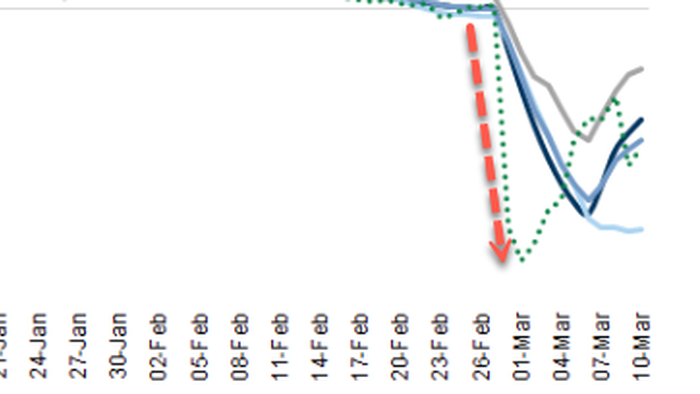
The Middle East conflict has triggered what the International Energy Agency earlier described as the largest oil supply disruption in global oil market history, as Iran continues to strike energy infrastructure across the Gulf. Against that deteriorating backdrop, Goldman analysts laid out how the shock is rippling through the global economy, disrupting oil flows, air travel, and freight markets.
Analysts led by Patrick Creuset said oil and transport markets have taken the hardest hit from the near-freeze in crude tanker traffic through the Strait of Hormuz. The disruption has also spilled into air travel, with a sharp decline in flights across the Gulf, though the fallout has so far remained largely contained to the region. Air cargo between Asia and Europe, however, has been hit the hardest, given the large role Middle Eastern airlines play in global freight.
Impact summary:
Oil
Crude tanker transits across the Strait of Hormuz have largely stopped over the past week (9 March, Exhibit 1). Saudi Aramco commented with their earnings release (10 March) they would be ramping their East-West pipeline to Yanbu (Red Sea export terminal) to full capacity; our oil team assume 3mb/d of extra pipeline flows/capacity vs. 20-21mbd of pre conflict exports via Hormuz. Direct (cost) and indirect (potential demand destruction) effects of disruption to energy flows remain the main impacts to watch across our transport coverage. The price of very low sulfur marine fuel (VLSFO) for instance has roughly doubled vs. the Jan/Feb average Exhibit 5, while NWE jet fuel cracks hit record highs also roughly doubling jetfuel prices Exhibit 3. Europe holds commercial jetfuel stocks equivalent to a couple of weeks worth of consumption, on our estimates, with the majority of imports coming from refineries in the Gulf and India Exhibit 4.
Air travel
The main impact on air travel thus far has been a significant reduction in flights to and from the Gulf, with about half of the initial decline in volumes recovered in recent days Exhibit 6. This has translated into a low single digit impact at major European hubs in the days following the start of the conflict, which seems to have been at least partially recovered as of yesterday Exhibit 10. Overall we see a slight reduction in overall air travel volumes in Europe Exhibit 8 and US Exhibit 7, but no sign of a broader impact on travel sentiment so far. North Atlantic activity levels for example continue to look normal Exhibit 9. On fares, our trackers point to increases recently, with high single digit % sequential increases on the main routes across our covered airlines for Easter and May travel Exhibit 12; all else equal and assuming no hedging in place we estimate unit revenues would need to increase by mid to high teens % vs. 2025 levels to cover current jetfuel prices, with higher % increases required for the LCCs vs. flags.
Freight
Given the Middle East airlines account for a mid-teens % of global cargo volumes, air cargo capacity between Asia and Europe has been significantly reduced since the start of the conflict, in line with our first take last week. The initial impact on volumes flown is negative, given the roughly ~50% reduction in Middle East flights over the last week Exhibit 6; however with the end of the Chinese NY holidays last week underlying demand is likely to increase from a seasonal perspective, driving rates higher Exhibit 14. Manufactured and perishable goods trade is clearly most disrupted in the Gulf, with some albeit limited capacity to re-route container flows via terminals in the Gulf of Oman/ east of Hormuz, as well as multimodal solutions (overland, air). In container shipping, while there is some regional disruption/port congestion plus c.1% of the global fleet trapped in the Gulf, the impact on the capacity side from a global level is much more limited than e.g. covid or the Red Sea crisis. From a demand point of view, the Middle East accounts for about 4% of global container imports, and many services have been suspended. For affected cargo in transit carriers have added emergency surcharges, and the industry is also implementing fuel surcharges more broadly across the network in order to pass on the significant increase bunker costs (liners don’t hedge but tend to have 4-6 weeks in the tank); while this is driving freight rates higher (futures, not actual rates as of yesterday Exhibit 17), the net impact of this conflict on container lines looks mixed overall and will depend on how global demand is affected, and how the conflict is resolved (given the impact this could have on also potentially reopening the Suez).
Creuset’s note includes 80 charts around the world showing disruptions. Here, we’ll focus on just a few, but Professional subscribers can view the full chartbook on our Marketdesk.ai portal.
VLCC rates on offer above covid highs

NWE jet fuel cracks hit record highs

Gulf air travel implodes

Air cargo volumes slide

Tanker traffic on Hormuz chokepoint

Certainly, the Middle East conflict has unleashed an energy shock that is now rippling across some transportation networks, while raising new concerns about stagflation. The key question is how insulated the U.S. economy will remain. As we noted on Wednesday, one growing risk is that fertilizer disruptions could evolve into a broader global food price shock.