Authored by Aamir Khollam via Interesting Engineering,
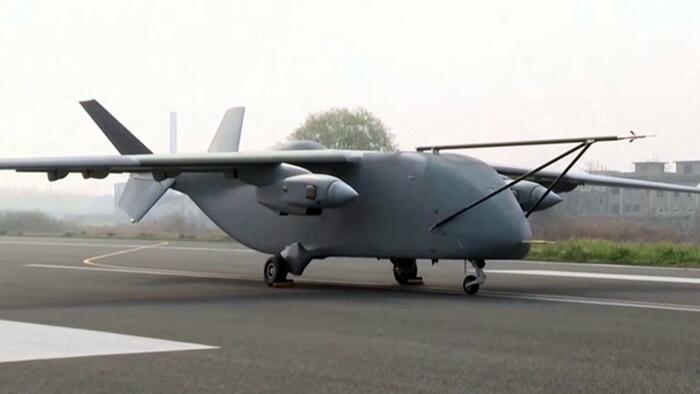
China has pushed further into heavy unmanned aviation with the first flight of the Changying-8 (CY-8), which it claims is the world’s heaviest cargo drone.

The aircraft combines high payload capacity with short-runway performance, targeting logistics operations across remote, high-altitude, and island regions.
The newly tested Changying-8 (CY-8) blends high payload capacity with short runway performance, signaling a push toward flexible, all-terrain aerial supply systems.
The aircraft completed its first test flight on Tuesday in Zhengzhou, located in central China’s Henan province.
It lifted off after a short ground run of 280 meters and stayed airborne for about 30 minutes.
According to state broadcaster CCTV, engineers used the flight to verify key onboard systems, including avionics, propulsion, and intelligent flight controls.
Built for heavy payloads
The CY-8 stands out for its size and carrying capability. It reaches a maximum take-off weight of 7 tonnes. The drone itself weighs 3.5 tonnes and can carry an equal load.
Its airframe stretches 17 meters long with a wingspan of 25 meters. Engineers designed a fully enclosed cargo bay with a volume of 18 cubic meters.
The aircraft includes both front and rear access doors, allowing faster turnaround during loading and unloading operations.
CCTV described the platform as an “unmanned aerial heavy truck.” The drone relies on twin turboprop engines and supports short take-off and landing operations.
This design allows it to operate on basic runways with limited infrastructure.
“This cargo drone is highly adaptable to its environment, uses twin turboprop engines, and has the ability to take off and land on simple runways in high-altitude areas, as well as perform short take-offs and landings,” said Cai Hangqing, chairman of Beijing Northern Changying UAV Technology, as reported by SCMP.
Developers built the CY-8 to support both civilian and military roles. The drone can switch payload configurations quickly, making it suitable for a wide range of missions.
CCTV reported that operators can deploy it for emergency communications, weather modification, and electronic reconnaissance.
It can also support logistics, disaster relief, and supply delivery in difficult terrain.
The drone’s design focuses heavily on high-altitude performance.
It can operate in regions such as the Tibetan Plateau, where elevations range between 4,000 and 5,000 meters.
Engineers also optimized it for island operations, enabling use on short and simple airstrips.
The CY-8 requires less than 500 meters for take-off and landing.
It also offers a range of more than 1,850 miles, extending its operational reach across remote or strategically sensitive areas.
Expanding global competition
China’s latest drone arrives as competition intensifies in the heavy cargo UAV segment.
Beijing continues to invest in uncrewed systems capable of operating in extreme environments.
Other Chinese projects are already in progress. Air White Whale is developing the W5000, a larger 10-tonne-class cargo drone.
A scaled prototype recently completed its maiden flight.
China has also tested a heavy-lift unmanned helicopter, the Boying T1400. That platform targets operations from mountainous regions to maritime zones.
The United States is advancing similar systems.
California-based Sabrewing developed the RH-1-A Rhaegal cargo drone, which completed its first hover flight in 2022.
A larger variant is expected to reach a maximum take-off weight of 6.25 tonnes.
Unlike the CY-8, Sabrewing’s design uses vertical take-off and landing. This removes the need for runways and enables operations in confined spaces.
The company has already secured collaborative orders from the US Air Force.
China plans to continue flight testing of the CY-8. The developer aims to move toward full-scale production before the end of the year.