IN THIS ISSUE:
- Greenland, Arctic Undermine ‘Unusual Climate Conditions’ Narrative
- Offshore Wind Doesn’t Deliver As Promised
- In 2025, the Rate of Disaster-Related Deaths Was Lowest in History
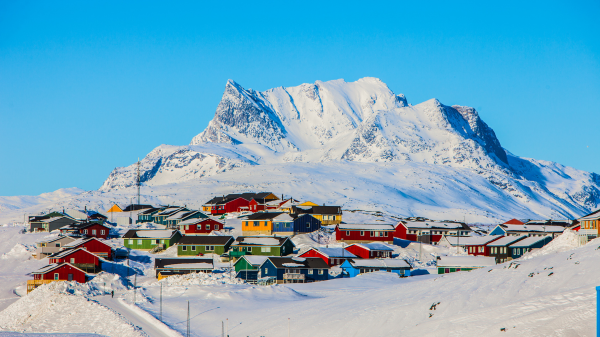
Greenland, Arctic Undermine ‘Unusual Climate Conditions’ Narrative
Greenland’s history and the broader Arctic’s recent conditions belie claims the climate of the Arctic region, including Greenland, is changing in a fashion never seen before and proving anthropogenic greenhouse gas emissions are driving dangerous climate change.
Recent research published in the peer-reviewed journal Nature Geoscience found Greenland’s Prudhoe Dome summit was exposed to sunlight and the elements approximately 7,000 years ago, during what some scientists refer to as a Holocene Thermal Maximum 9,000 to 5,000 years ago. Proxy data suggests temperatures were between 3℃ and 5°C higher than they are today. That is well beyond the 1.5℃ to 2.0℃ temperature rise that climate alarmists have warned would represent a tipping point producing cascading catastrophic changes. The study also suggests that despite temperatures being warmer than today and large parts of Greenland being ice-free, sea levels then were lower than they are today.
The international group of 14 researchers representing universities and research institutes in seven U.S. states and two countries drilled down and found evidence of past sunlight on the ground:
We drilled through 509 metres of firn and ice at Prudhoe Dome, northwestern Greenland, to obtain sub-ice material yielding direct evidence for the response of the northwest Greenland ice sheet to Holocene warmth [and] … stimulated luminescence measurements from sub-ice sediments … indicate that the ground below the summit was exposed to sunlight 7.1 ± 1.1 thousand years ago.
The dome is not exposed at present, with today’s temperatures: the researchers had to drill more than 509 meters to hit bedrock. They note their findings of massive deglaciation during the period are seemingly confirmed by research conducted at other locations across Greenland.
Therefore, regardless of whether the U.N. Intergovernmental Panel on Climate Change is right and the Earth is warmer today than at any time in the past 1,500 to 2,000 years, it was significantly warmer during at least one period of the present interglacial period, all without human help (CO2 levels were much lower), and neither human populations nor civilization went into a death spiral. Indeed, crop agriculture had only recently begun and started expanding just before and during this period, and populations grew.
That was then; what about now? It seems that for at least the past 20 years, Arctic Sea ice levels have been relatively stable, with sea ice behavior over that time indicating “natural variability” drives sea ice changes and long-term trends. This research flies in the face of the supposedly direct causal connection between rising CO2 causing temperature increases and shrinking sea ice, the latter supposedly a result of the former,
According to research published in the peer-reviewed journal Geophysical Research Letters by researchers from the University of Exeter in the U.K. and Columbia University in the United States,
Over the last 20 years, the decline of Arctic sea ice has slowed down substantially. Climate models (from CMIP5 and CMIP6) show that pauses in sea ice loss across multiple decades can happen, even as greenhouse gas emissions continue to rise. … Most of the evidence from these climate models suggests that natural climate variations have played a large part in slowing the human-driven loss of sea ice. However, it is not entirely certain whether changes in the human influence on climate (the “forced response”) have also contributed. Overall, while it may sound surprising that Arctic sea ice loss has slowed down even as global temperatures hit record highs, the climate modeling evidence suggests we should expect periods like this to occur somewhat frequently.
Therefore, not only can human CO2 emissions not be causally linked to declining sea ice (which, is not, in fact, declining) it’s not even clear that human activities influence sea ice levels at all. There is no correlation between changes in sea ice levels and human emissions or temperature changes, much less a causal connection or “forcing” of the latter over the former, found by this team of researchers.
Sources: Geophysical Research Letters; Nature Geoscience; Irrational Fear
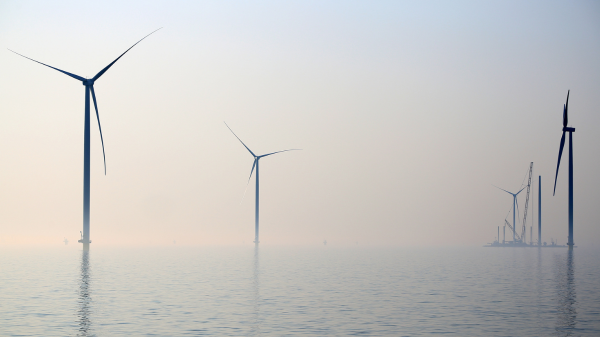
Offshore Wind Doesn’t Deliver As Promised
Research published in the journal Cell Reports Sustainability indicates physics, aerodynamics, and efficiency-related problems mean offshore wind turbines can never live up to their promise for electric power delivered per turbine or installation.
This conclusion wasn’t just generated by models or in the lab but is confirmed by an examination of data from existing turbines in operation.
After modelling wind turbine operations and outputs under different conditions, the researchers compared their outputs to data from 72 offshore industrial wind facilities over 420 cumulative years of operation. Even the most efficient designs had steep “operational losses,” meaning when governments forecast how much electricity a particular facility can produce and how much greenhouse gas emissions that will prevent or offset, they are grossly overstating the value of the facility. Thus, the high cost of wind farms as a means of fighting climate change may never be justified, even if one believes preventing climate change is possible and decreasing emissions will mitigate it.
“We benchmark national policy targets in Europe and the US, revealing large overestimations of energy production—by nearly 50% in one case—underestimating energy costs, power variability and integration costs, curtailment, and policy risks,” the paper concludes. “Our model provides a rigorous yet simple framework, readily usable by engineers, planners, and policymakers to forecast wind farm performance, support system planning, and to set realistic targets consistent with aerodynamic limits.”
Part of the problem, an article in Brussels Signal describing the research reports, is that “[a]s wind farms become more crowded, turbines compete for the same wind resource, reducing the overall efficiency of the farm. The study calls this the ‘wind shadow’ or ‘wake effect’, where upstream turbines slow the wind for those downstream.”
This and other factors have resulted in various governments overestimating the electricity they could expect, and the value of particular wind facilities. Specifically, the researchers found,
- the Dutch offshore wind programme predicted capacity factors nearly 50 per cent above feasible limits;
- France overestimated the power produced by its offshore wind facilities by 22 percent;
- Belgium overestimated the electricity produced by offshore wind facilities by 24 percent;
- and the U.S. wind facilities underproduced by 13 to 20 percent.
“Such widespread discrepancies underscore a global risk of inflated expectations, potentially leading to misguided investments, infrastructure planning failures, and energy supply shortfalls, the study warned,” Brussels Signal reports. “Current Dutch plans to increase turbine density on the North Sea could result in a capacity factor as low as 34.6 per cent, far below [20 percent below at least] what is needed” in the electricity sector to be 100 percent carbon dioxide emission free by 2040 to meet the country’s climate targets. The wind wake effect and other aerodynamic and physics limits mean building more turbines, especially by making existing offshore wind facilities more densely populated with turbines, will not remedy the shortfall, and doing the latter may actually exacerbate the power-production shortfall.
Source: Brussels Signal EU; Cell Reports Sustainability
In 2025, the Rate of Disaster-Related Deaths Was Lowest in History
There has been a dearth of mainstream media coverage of perhaps the most important climate-related story of the past year: it is likely that fewer people died as a result of extreme weather events and temperatures in 2025 than at any time in history for which there is hard data. I haven’t seen or heard a single mainstream media outlet reporting on this fact and celebrating the good news, but it’s true.
As Roger Pielke Jr., Ph.D. writes at his insightful Substack, “The Honest Broker”:
According to data from the Centre for Research on the Epidemiology of Disasters (CRED) at the Université Catholique de Louvain, Belgium (via Our World in Data), through October 2025, the world saw about 4,500 deaths related to extreme weather events. Tragically, the final two months of 2025 saw large loss of life related to flooding in South and Southeast Asia, associated with Cyclones Senyar and Ditwah.
While the final death tolls are not yet available, reports suggest perhaps 1,600 people tragically lost their lives in these and several other events in the final two months of the year.
If those estimates prove accurate, that would make 2025 among the lowest in total deaths from extreme weather events. Ever! I am cautious here because the recent decade or so has seen many years with similarly low totals—notably 2014, 2015, 2016, 2018, 2021.
A single year’s reduction of deaths may be down to luck, like having a year of relatively few extreme-weather events, but that isn’t the case for 2025: hurricanes were about normal, as were flooding, wildfires, and drought. Some places had worse weather than others, as in every other year, but the data overall show no substantial increases or declines relative to the average. What’s more telling than a single year’s low death toll from climate-related events is the long-term trend for such events. Pielke notes that according to the available data,
What we can say with some greater confidence is that the death rate from extreme weather events is the lowest ever at less than 0.8 deaths per 1,000,000 people (with population data from the United Nations). Only 2018 and 2015 are close.
To put the death rate into perspective, consider that:
- in 1960 it was >320 per 1,000,000;
- in 1970, >80;
- in 1980, ~3;
- in 1990, ~1.3;
Since 2000, six years have occurred with
Commenting on this trend, Marc Morano, who operates the Climate Depot website, told Houston’s KTRH 740 AM News, “What is amazing about this, it continues a trend. … If you go back to the 1920s, there has been a 97 percent drop in extreme weather deaths.”
In the end, climate alarmists cling to the dogmatic belief that humans are causing catastrophic climate change, which their oracles repeatedly say poses an “existential threat” to human civilization and ultimately survival, yet the evidence is that humans, in part through increased access to and use of fossil fuels, are making the Earth and the vagaries of its weather not just more survivable for the human race but making people more prosperous, with more people thriving. More people are living their lives by their own lights than ever before in human history. Resources aren’t constraining choices as much as they have for as many people as they have in the past.
This year’s data on climate-related deaths affirms what Alex Epstein wrote more than a decade ago in his powerful book The Moral Case for Fossil Fuels:
Climate is no longer a major cause of deaths, thanks in large part to fossil fuels. … Not only are we ignoring the big picture by making the fight against climate danger the fixation of our culture, we are “fighting” climate change by opposing the weapon that has made it dozens of times less dangerous.
The popular climate discussion has the issue backward. It looks at man as a destructive force for climate livability, one who makes the climate dangerous because we use fossil fuels.
In fact, the truth is the exact opposite; we don’t take a safe climate and make it dangerous; we take a dangerous climate and make it safe. High-energy civilization, not climate, is the driver of climate livability.
Restricting or ending fossil-fuel use, not climate change, is the real recipe for disaster, Epstein argues. It would set human civilization back centuries, ringing a true death knell for present and future generations.
Don’t believe Epstein? Follow the science by checking the data yourself.
Sources: KTRH; Just the News; The Honest Broker; The Moral Case for Fossil Fuels