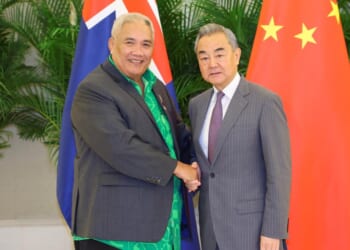
Newsweek recently reported that members of the international committee of the Democratic Socialists of America (DSA) “have been cultivating ties with officials of the Chinese Communist Party and agreeing to take pro-China positions.” Internal documents obtained by the outlet revealed (among other things) that Chinese officials had been interested in building a relationship with the DSA, and that the group had discussed strategies for portraying the authoritarian Chinese government in a positive light. Jodie Evans—who co-founded the activist group Code Pink, launched its China is Not Our Enemy campaign, and is married to pro-China activist-donor Neville Roy Singham—was reportedly involved in at least one of these discussions.
Left of the left
The DSA’s true political nature has been the subject of renewed interest after DSA member Zohran Mamdani’s recent election as mayor of New York City.
The group is considerably more radical than is widely acknowledged. For example, ABC News claimed in a November 2025 article that “experts…contend that the DSA’s platform is far removed from the socialism seen in the Soviet Union or Cuba.” City University of New York professor Carlo Invernizzi Accetti objected to any attempt to link the DSA with communism, arguing that “the core of democratic socialism is precisely to distinguish itself from communism.”
That may be true in the theoretical sense. It is also true that anti-communism was a pillar of DSA founder Michael Harrington’s politics, and that the DSA itself (which was formed in 1982) traditionally adhered to this orientation as well. Historian Harvey Klehr, an expert on the American far-left, wrote in 1988 that the DSA was among those socialist groups which had “vigorously and continuously denounced Marxism-Leninism and those regimes founded on its principles.” This is a genuine distinction, whatever one thinks of the socialist platform.
The twenty-first century DSA, however, is something else entirely. It has been steadily radicalizing—a process which accelerated in the aftermath of the October 2023 Hamas-led terrorist attacks upon Israel. At its 2025 national convention, DSA delegates approved a resolution entitled “For a Fighting Anti-Zionist DSA,” which declared the group’s unequivocal support for “the Palestinian cause” and provided that members who publicly spoke in opposition to that cause—such as through uttering the phrase “Israel has a right to defend itself”—could be expelled from the organization. It is worth noting that Harrington himself was decidedly pro-Israel.
The DSA has also increasingly moved into alignment with some of the most politically repressive regimes on the planet. In addition to its reported interactions with the Chinese Communist Party, the DSA’s international committee operates a Cuba Solidarity Working Group which supports “an independent, socialist Cuba” able to resist “U.S. aggression,” and it has dispatched official delegations to the country. Both China and Cuba, of course, are governed as Marxist-Leninist one-party states.
National Political Committee
The DSA’s flirtation with full-blown revolutionary communism is perhaps best-illustrated through the composition of its governing National Political Committee (NPC), which consists of 27 members (including two Young DSA members) elected every two years at the DSA’s biennial national convention. It is analogous to the group’s board of directors. NPC members are generally affiliated with one of the DSA’s numerous internal ideological caucuses, and the number of members elected from each caucus offers a rough method of gauging the DSA’s broader political alignment.
To an outsider not immersed in leftist sectarianism, the lines dividing these caucuses from one another are blurry and confusing—though something of an ideological spectrum exists. In the 2025 NPC elections, the DSA’s acknowledged “left” performed well, with some saying that it had secured an outright majority of the seats. In the modern DSA, “left” is often synonymous with “revolutionary communist.”
For instance, three members (or potentially four, if including an independent member who has been characterized as “politically sympathetic”) of the newly-elected NPC are associated with the Red Star caucus. This is an explicitly Marxist-Leninist caucus that believes in “the role of the vanguard in organizing the revolution,” with the ultimate goal being “to abolish capitalism and, ultimately, to achieve communism.” Its suggested political education readings include works by Marx, Engels, Lenin, Stalin, Mao, and Guevara. One of the DSA’s two national co-chairs is a member of this caucus.
Three more members of the NPC hail from the Marxist Unity Group, whose avowed purpose is to “fight to overthrow the Constitution” via “a working class revolution in the United States” that “take[s] power by any means necessary” so that it can produce “a fully liberated classless society: communism.” Marxist Unity Group’s logo is a modified version of the Bolshevik hammer and sickle, and Lenin features prominently in its political education curriculum.
Two members of the NPC represented the Reform & Revolution caucus, which explains that it is a “revolutionary Marxist” group whose politics are derived from “the Bolshevik Tradition.” It seeks to “dynamically apply the analysis of Marx, Engels, Lenin, Trotsky, and Luxemburg to the conditions and challenges of the 21st century.” Its “foundational readings” include The Communist Manifesto and Lenin’s The State and Revolution.
Four more members were elected from Springs of Revolution, which claims to not actually be a caucus and describes itself as “cross-tendency” movement that aims to build “DSA into a mass revolutionary force.” It represents the core of the DSA’s pro-Palestinian activism, and has written that “Palestine is the moral compass of the socialist movement, and our north star in our pursuit of justice.” Springs of Revolution has been characterized as part of the DSA’s “far-left” and its “revolutionary left.”
Recognizing radicalism
The Capital Research Center wrote in 2023 that the name “Democratic Socialists of America” might have become a Holy Roman Empire-style misnomer, in the sense that the group is neither particularly democratic, nor socialist, nor American. Certainly, China’s autocratic communist government is none of those things. Is it any surprise that members of an organization which has elected numerous avowed communists to its governing committee would find common cause with the Chinese Communist Party?
There will always be radicals, and radicals will always say and do radical things. The DSA is a nationally-prominent activist group which claims 95,000 members, including members of Congress and the mayor of the nation’s largest city. Yet its reputation continues to float on the (relatively) more moderate ghost of what it once was. It is important for media and the public to recognize the group for what it is now.