A Russian military-focused Telegram channel, Rybar, published an assessment that warned President Donald Trump’s gunboat diplomacy and the re-posturing of the U.S. Department of War toward the Western Hemisphere could generate drone threat risks to the US Homeland
“Given how the Americans are acting now, the main question is not whether the United States will strike Cuba, but when and how it will do so. Cuba, along with Venezuela and Nicaragua, has long stood as an anti-American stronghold in the Caribbean region, and after the takeover of Maduro, U.S. interest has increased,” Rybar wrote on its Telegram channel.
Rybar then laid out a scenario that, to us, suggests a Cuban Missile Crisis 2.0 in the making, in which it asked: “But what would the Cubans do in the event of a conflict? Let us hypothetically imagine that Havana decides to resist the Americans and chooses to fight. In that case, the already world-famous Geran strike drones could come to their aid.”
Russia may deploy Geranium strike drones in Cuba, a move that could reshape deterrence and force Trump to reconsider his options. pic.twitter.com/ujYKnqzcAf
— Rybar in English (@rybar_en) January 30, 2026
To bring readers up to speed, Russian-made Geranium drones are a family of long-range loitering munitions, most commonly referring to the Geran-2, which is a version of Iran’s Shahed-136. We have detailed how Russia has established domestic manufacturing plants to ramp up production, as well as the next iteration of these drones (read here).
The Geran-2 has a range of roughly 1,500 to 2,000 kilometers, carries a 30- to 50-kg high-explosive warhead, and is cheaper to produce than cruise missiles. One distinctive signature Ukrainians have learned to recognize is its sound: the drones are often described as lawn mowers in the sky.
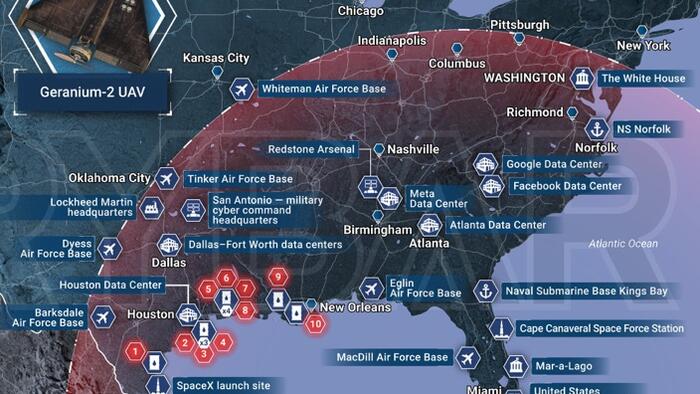
Rybar noted the potential strike radius of the Geran-2 if such systems were positioned in Cuba, concluding that under this scenario that major oil and gas refineries, key military bases, data centers, and even Washington, DC would fall within the drone’s strike envelope, representing a highly destabilizing escalation risk.
Rybar’s Geran-2 threat map will likely cause major concern at State Department and DoW …

We warned in recent days that trillions in dollars in CapEx will be spent on data centers worldwide, as per Morgan Stanley analyst Vishwanath Tirupattur‘s forecast, but Wall Street analysts largely end their analysis at the financing and construction of next-generation data centers, with limited discussion about modern security architecture required once these facilities are built and become instant high-value targets for non-state actors or foreign adversaries (read here).
“Future wars will be wars of attrition, where autonomous systems fight one another, overwhelming technologically superior but low-inventory expensive systems. Protecting cities will require mass-produced, cost-comparable, networked solutions,” Cameron Rowe of counter-UAS interceptor startup Sentradel told us.
Loading recommendations…