You’re reading the G-File, Jonah Goldberg’s biweekly newsletter on politics and culture.
Dear Reader (especially those of you really hoping the Saudis are going to pull an Imhotep with all their mummified cheetahs),
Let’s start with some good old-fashioned public choice theory. One of the foundational insights of Mancur Olson, the legendary economist, is the problem of concentrated benefits and diffuse costs. Take sugar subsidies. They make sugar slightly more expensive for everybody, costing the country writ large billions, but the subsidies reap huge profits for a handful of domestic sugar producers. So every time someone suggests getting rid of them, the tiny number of Big Sugar barons starts writing checks to politicians and starts screaming about the dangers of not having a domestic supply of sugar in wartime.
This dynamic is a feature of all politics. The people who care—for whatever reason—have more influence than those who don’t. Note: I didn’t say the people who have the most at stake, because economic interests aren’t the only thing that motivates people. Go to a school board hearing about what books school libraries should carry or not carry. Very few of the attendees have an explicit economic interest. They just care passionately whether or not the library will make Heather Has Two Mommies or Huckleberry Finn available to kids. Some of the attendees care so much about such issues that they show up, even though they don’t have kids. Simply by virtue of caring a lot, those people have more influence than the thousands of people who don’t bother showing up.
I am vulnerable to the charge of being irrationally obsessed with the problem of primaries. My argument is basically a version of the above dynamic. The people who care the most get to pick the party nominees for the general election. And because so many states are reliably “red” or “blue,” getting the nomination of the dominant party means you’ll most likely win in the general. This dynamic doesn’t just mean that the winning candidate will have pandered to the primary voters, it also usually means that the losing candidate will have pandered to their party’s electorate too. Imagine a fictional super-red district in the Trump years. The candidate who wins the Republican primary is likely the one who vows to be an ultra-MAGA loyal vassal to Donald Trump. The candidate who gets the Democratic nomination is likely the candidate who vowed to “resist” Trump at every turn. All of those urbanites and college-town professors and artsy types aren’t enough to win the general, but they dominate the primaries. The result is a general election contest between partisan caricatures. The general election voter is left with two suboptimal choices. Moreover, the casual citizen is left with the impression that both parties are defined by these caricatures. This is one reason the number of self-identified independents is exploding. A lot of normal people don’t want to associate themselves with caricatures.
But let’s move away from primaries and talk about the internet. A lot of people think Twitter/X is the real world. It drives a lot of the framing of politics, not just by politicians, but by journalists as well. But nearly 80 percent of Americans aren’t on it. Moreover, the top 10 percent of users produce roughly 80 to 90 percent of the tweets. More recently Pew found that 25 percent of Twitter users produce 97 percent of tweets. So however much you think Twitter drives politics, keep in mind that a tiny number of people are doing the driving. I say this as an inveterate Twitter user myself: These are not necessarily the best people. (And this leaves out the role of bots. X claims that less than 5 percent of accounts are bots. Outside experts put the number much higher, up to 80 percent!)
Here at The Dispatch, we spend a lot of time and energy trying to avoid the hellscape that is the typical comments section. We haven’t perfected it, but I think our comment sections are far superior to those of many publications. Even so, it remains the case that the vast majority of visitors to any news site rarely leave a comment and most don’t read them.
I’ve long said that there’s a kind of Gresham’s Law—“bad money drives out good”—to comment sections (though I think I need to credit the observation to Kevin Williamson). The more dominant the bad commenters become, the more you chase out the decent commenters.
And I think there’s a Gresham’s Law to democracy as well.

Have you tried Dispatch Voiced?
Our newest members-only feature makes it easy to listen to our journalism on the go. Listen to high-quality audio versions of our biggest stories in your podcast player of choice, and catch up while grocery shopping, commuting to the office, running at the gym, or walking the dog.
I recently started a fascinating book, Democracy in Darkness: Secrecy and Transparency in the Age of Revolutions by Katlyn Marie Carter. It was recommended to me by a historian when I floated my theory that one of the reasons the French Revolution went off the rails—while the American Revolution didn’t—was that so much of the French Revolution’s work was done in public. From the National Assembly to smaller or regional meetings of politicians and activists, the public was often invited to watch the deliberations. These attendees, often literally drunk and even more often figuratively drunk on radical politics, cheered and jeered speakers. The more successful ones increasingly put a premium on pandering to the audience rather than trying to persuade their colleagues about the wisest course of action.
Meanwhile, at the American Constitutional Convention, the delegates posted guards and nailed windows shut (despite the heat and those heavy outfits) to prevent eavesdroppers. One of the only times George Washington lost his temper was when he found that someone had dropped their notes from the meeting on the steps. One attendee recounted that Washington was so pissed that after he lectured the delegates about the importance of secrecy, he “quitted the room with a dignity so severe that every Person seemed alarmed.”
Two years later, when French deputies assembled in a storage hall outside the palace at Versailles to discuss what a French constitution might look like, they were joined by hundreds of looky-loos. Some suggested expelling the “strangers” so they could get to work. “Strangers! Are there any among us?” exploded the intellectual and politician Constantin-François Chasseboeuf de Volney. “Do they not have the greatest interest in having their eyes fixed upon you? Have you forgotten that you are all but their representatives, their proxies?” He went on: “I cannot respect he who seeks to hide himself in the shadows … the grand day is made to shed light on the truth, and I am proud to think like the philosopher who said that all his actions never had anything secret and that he wished that his house was made of glass.”
This sentiment plagued the Revolution from its laudable liberal beginning to the ultimate Terror phase. Carter writes about the early meetings of the National Assembly:
The presence of an audience in the meetings was central to the emergence of a new type of popular politics. Deputies made their names, and careers, by their orations on the floor of the assembly. Public speaking became a key component of political popularity, itself a creation of the revolutionary period. The meetings in the manège were raucous; onlookers were far from silent spectators and deputies catered to the crowd when speaking. There was a pervasive concern with the theatricality of politics in the National Assembly and many deputies were certainly savvy about playing to the crowd. Committee records reveal that some deputies may have hired spectators, providing them with cues for when to applaud.”
It’s an awkward fact for lovers of transparency to contend with: The American Revolution was a successful revolution in large part because the really important work was literally conducted in a smoke-filled room.
The other day I read an absolutely terrible editorial in the Washington Times about Greenland. But that’s not the important part. One of the only people quoted was “[f]ormer Belgian politician Dries Van Langenhove.” I didn’t know who he was. So I looked him up on Wikipedia. He’s a far right anti-immigration bro. But that’s not important either. What struck me is that he was elected to Belgium’s lower house of parliament in 2019. He quit a few years later, saying in effect that he could have more impact by becoming a Belgian podcast bro.
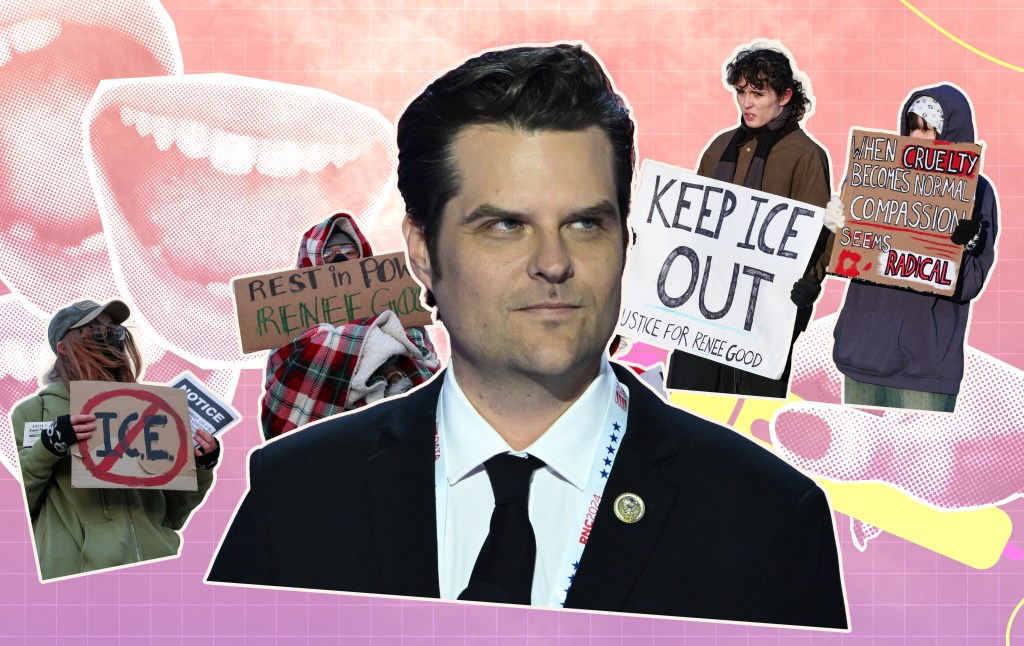
He may not be wrong. Look at all of the members of our Congress who’ve quit to become cable hosts and social media activists. Former Florida Rep. Matt Gaetz comes to mind immediately. In his memoir, Gaetz recounted how Paul Ryan told him he cared too much about TV. Gaetz mocked the idea. “Why raise money to advertise on the news channels when I can make the news?” Gaetz wrote. “And if you aren’t making news, you aren’t governing.” Gaetz, who literally grew up in the house occupied by Jim Carrey’s character in The Truman Show, declared that “I know that all the world’s a stage, especially when we all have cameras with phones.”
I wish I could say that the guy voted most likely to be featured on To Catch a Predator and who just this week asked a guest on his OANN show, “Are these intentional fires in Argentina part of a globalist master plan to create a new Jewish ethnostate in the Americas?” was entirely wrong—not about the Zionist Deforestation Plan, but the world being a stage.
I don’t want to get into the weeds on the ICE operations and counter-ICE protests in Minneapolis. Suffice it to say I think it’s a shameful spectacle, regardless of which “side” you’re on. But it is just a fact that neither the protesters nor the ICE agents are representative of Americans generally. I’m not making a moral equivalence or both sides point. Personally, I am very sympathetic to this guy. But the whole thing is playing out in front of America with hundreds of videos, with various degrees of reliability, in a rolling digital Rashomon. Some of the videos make the protesters look like jackasses, others make the agents look like thugs. I don’t like jackasses, and I really don’t like thugs, especially ones with guns and badges.
My only point is that no one benefits from a political, never mind, a policy debate, between Team Jackass and Team Thug fueled by a flood of voyeuristic videos. This spectacle feels to me like a metaphor in miniature of American politics generally. Every politician wants to claim to be an outsider, siding with looky-loos, the primary voters, the populists, the pundits. Everyone plays to the crowds for attention and funding. Nobody wants to hammer shut the windows and do the work of the American people.
The reason the Founders were skeptical of democracy was that, in their time, democracy was often synonymous with mob rule, because democracy implied that all of the demos would participate in decision-making. As the historian Paul Friedland noted, there’s an inherent paradox in the idea of “representative democracy.” From “its very inception a contradiction in terms, for the basic reason that a true democracy precluded representation.” To have representative government means to delegate authority to some people to make decisions, which is another way of saying other people won’t make decisions—and that’s counter to the understanding of what democracy actually meant. That’s why so many people emphasize the idea of republican government. People are answerable to “the people” for their decision through elections, but you have to kick out the looky-loos from the room where the decisions are made.
The new media environment, the primary system, the incentive structures of fundraising, and the maleducation of the public has screwed all of that up. We’ve turned government and politics into a giant glass house as Volney might say. And as a result, everyone is either performing, or in the case of Minneapolis, they’re staging a reality show. It’s a landscape where the people who want to live in “interesting times” are the ones who are showing up in the streets, on social media, and in primaries. They’re the ones who reap the concentrated benefits of attention, drama, and eternally sharpening contradictions, and widening the gyre. And the rest of us are left shaking our heads saying, “It’s not supposed to be this way.”
Various & Sundry
Canine Update
Overall, Zoë is doing much better. Some mornings she’s a bit lethargic, but more and more she’s her old self. This creates problems of course, because she still has a lot of stitches and we really don’t want them to tear or her to get an infection. But we’ve started taking her to the park again, with a little extra effort to get her in and out of the car. Pippa meanwhile is maximizing her aroo-free mornings and regularly bests me in Socratic dialogues. And Gracie continues her reign, and Chester’s shakedown operation endures.
I’ll be doing a virtual event for R Street about media and democracy this Thursday if you’re interested.
The Dispawtch
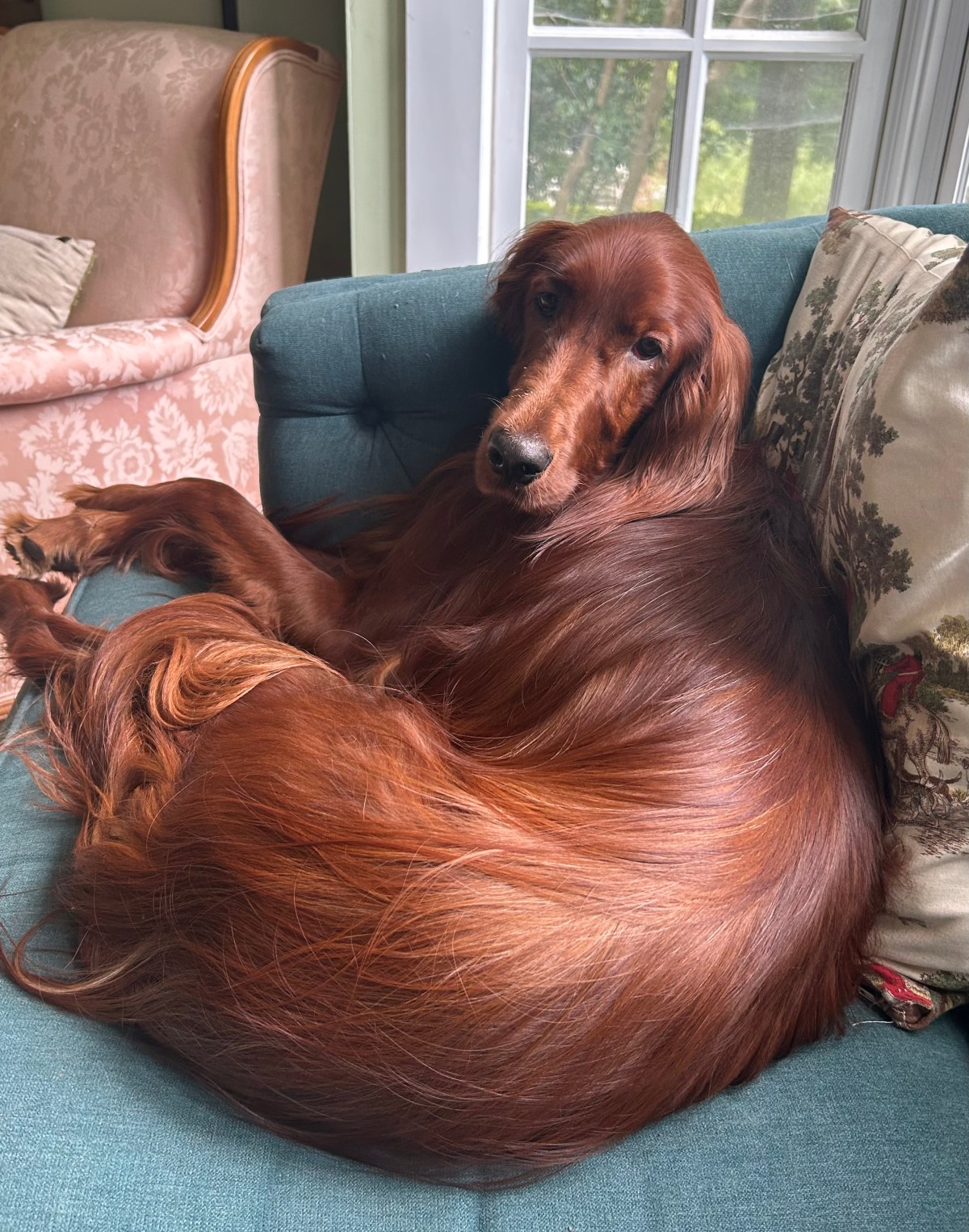

Why I’m a Dispatch Member: Oh Heavens! I am a member to let a little sanity reign in my mind. This world has succumbed to so much brain mush.
Personal Details: Gertie is the first non-rescue dog we have had in over 40 years of marriage, a sin for which my sisters will never forgive me.
Pet’s Name: Gertie. (Gertrude the Governless)
Pet’s Breed: Irish Setter
Gotcha Story: We always wanted an Irish setter, and figured this was our last chance for a puppy. We are in our 60s. It was also the pandemic, and we needed some joy. She is pure joy.
Pet’s Likes: Snuggles. Bacon, RUNNING. Playing catch. Did I mention snuggles?
Pet’s Dislikes: When her tummy is rubbed in the wrong spot. Having her sleep disturbed.
Pet’s Proudest Moment: When she learned to do “Big Ups.” That is high-fives on her hind legs. She is tall that way, and it is impressive and gets her lots of claps and cheers.
A Moment Someone (Wrongly) Accused Pet of Being Bad: No one has ever said she was bad, but she is perhaps not so well thought of when she is a little too happy to see someone
Do you have a quadruped you’d like to nominate for Dispawtcher of the Week and catapult to stardom? Let us know about your pet by clicking here.
Do you have a quadruped you’d like to nominate for Dispawtcher of the Week and catapult to stardom? Becoming a Dispatch member by clicking here.