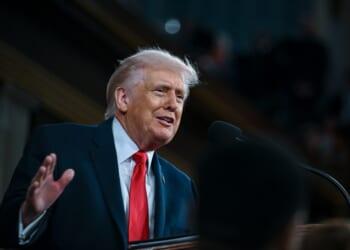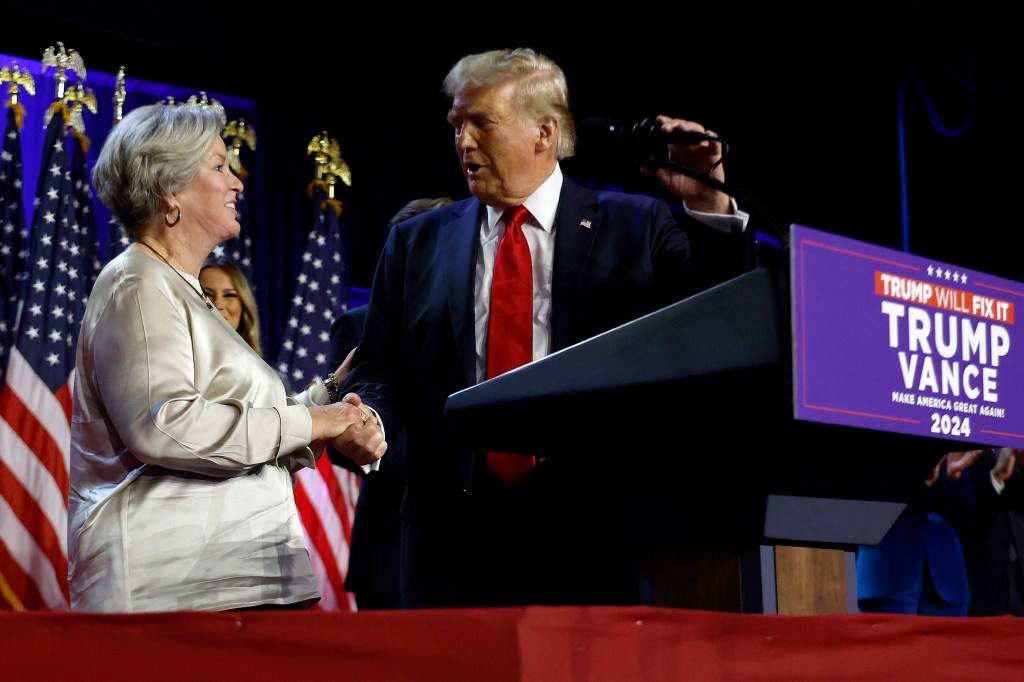
White House chief of staff Susie Wiles has revealed plans to deploy President Donald Trump across the country next year to juice Republican turnout and swamp any blue wave that might materialize in midterm elections. Democrats are thrilled, but the GOP reaction is decidedly mixed.
Wiles said during an interview on the Mom View YouTube program that Trump would “campaign like it’s 2024 again.” It’s part of a strategy, Wiles explained, to effectively “put him on the ballot,” motivating support for Republican congressional candidates from voters who back the president but tend to eschew participating in elections when he isn’t leading the GOP ticket. Democratic strategists with experience in the trenches of midterm campaigns, including in 2018 during Trump’s first presidency, aren’t the least bit worried.
The president spent eight months heading into that midterm contest on the road, holding his signature, high-attendance, high-energy campaign rallies. By Election Day 2018, Trump had hosted roughly 40 such events—more than one per week on average. Democrats still capitalized on broad voter dissatisfaction with the commander in chief, flipping 41 Republican-held seats in the House of Representatives and recapturing the majority. If Wiles wasn’t already preparing to put Trump on the road extensively next year, Democrats just might provoke him.
“The idea that sending Trump on the road in these midterms is a big part of their strategy is a huge gift to Democrats,” Meredith Kelly, a Democratic media strategist, told The Dispatch this week. She speaks from experience.
Kelly was a senior aide at the Democratic Congressional Campaign Committee, the party’s House campaign arm, during the 2018 midterm election cycle. Less than two years earlier, Trump had become the first Republican since Ronald Reagan in 1984 to win all three of the so-called blue wall states of Michigan, Pennsylvania, and Wisconsin. The president’s ability to dominate the media and pack big arenas was still a new phenomenon. That he couldn’t upend the typical political dynamic of a midterm election wasn’t entirely clear.
But as House Democrats gleefully discovered as the 2018 cycle progressed, the more Trump traveled—and the more campaign coverage revolved around the president—the brighter their prospects became in swing districts and other highly competitive seats that ultimately determined the majority. “We were always incredibly excited when Trump went into these districts,” Kelly said. “It’s not a new strategy, and it did fail them in 2018.”
Republicans, meanwhile, are vacillating between optimism and concern that Wiles plans to gas up Air Force One and get Trump out of the Washington, D.C., (and Bedminster, New Jersey, and Palm Beach, Florida) bubble to talk to voters about the economy. Public opinion polls show that voters are far and away most anxious about the high cost of living, that they hold Trump responsible, and that they’re poised to throw Republicans out of office as a result.
The optimists are relieved senior White House officials understand the GOP has an affordability problem, even if Trump scoffs at the notion. Indeed, in 2018, Trump’s travels helped Republicans grow their Senate majority by two seats, because the map of seats up for election that year were located largely in red states where the president was still popular. And even some Democratic insiders quietly concede that, in 2026, visits from the president could bolster GOP candidates in safe seats who might otherwise be vulnerable because of the national political environment.
“The president hitting the campaign trail in 2026 will be viewed by most Republican operatives as welcome news. The elections are going to be nationalized whether he is fully engaged and campaigning or not,” GOP consultant Rob Simms told The Dispatch. “The White House operating as though he’s on the ballot—with travel and financial resources—can go a long way toward engaging, energizing, and ultimately turning out Trump supporters in the [midterm] which has historically been a problem for us.”
Control of the House, where Republicans are clinging to a majority that rests on less than a handful of seats, could boil down to whether Trump can revive his image with an electorate unhappy with his leadership broadly and stewardship of the economy specifically. After an uneven performance from Trump Tuesday evening, it’s unclear whether that is possible. During a campaign rally in northeastern Pennsylvania to connect with voters on affordability—the sort of event Wiles says will fill Trump’s 2026 calendar—he continued to mock the idea that there’s a problem.
On Wednesday, Trump’s job approval rating in the RealClearPolitics average was 43.9 percent, similar to the 43.5 percent mark voters gave him on Election Day 2018. Approval of Trump’s handling of inflation was even worse—only 34.7 percent—while Gallup found the president’s overall job approval ratings with crucial independent voters to be worse still: 25 percent.
Numbers like that threaten to put the Senate in play next year, although, for now at least, the Republicans benefit from a favorable map in terms of which seats are up for election. The party is favored to preserve its majority, which numbers four when accounting for Vice President J.D. Vance’s tie-breaking vote.
That’s why some Republicans (not to mention Democrats) are questioning this particular line of thinking as expressed by Wiles during her Mom View interview: “Typically, in the midterms, it’s not about who’s sitting at the White House. You localize the election, and you keep the federal officials out of it. We’re actually going to turn that on its head.” That sounds like Wiles’ strategy is innovative for nationalizing the midterm elections around Trump—except midterm contests have been nationalized affairs since at least 2006.
That applies to Trump circa 2018 as well. Just listen to what the president said during a rally just weeks before the 2018 elections, according to a Voice of America story published October 31 of that year: “I’m not on the ticket, but I am on the ticket because this is also a referendum about me. I want you to vote. Pretend I’m on the ballot.”
Even before 2006, midterm elections were usually a referendum on the party that controls the White House, leading some Republican operatives to bury their heads in their hands. “I had hope. But if this is the strategy, all is lost,” a veteran Republican strategist told The Dispatch, requesting anonymity to speak candidly. “This is idiotic.” This Republican emphasized that this wasn’t a gratuitous shot at Trump, but rather a recognition of the realities of midterm politics.
The president’s predecessors, including Democrat Barack Obama, vowed to save their party’s congressional majorities by making use of their unique bully pulpit and hitting the road to reignite the voting coalitions that carried them to the White House two years earlier.
Obama’s 2008 victory was impressive, the closest outcome to a presidential landslide this century—before or since. Yet in his first midterm election in 2010, the end result of campaigning to defend Democratic congressional majorities was a historic Republican gain of 63 House seats, plus a pickup of six Senate seats. That drubbing was fueled by overwhelming opposition to the Affordable Care Act, aka Obamacare, the 42nd president’s signature health care reform law. Trump might similarly find himself in trouble next year over his stubborn support for tariffs, which voters believe are contributing to higher prices.
Recalled the GOP strategist: “The White House thought they could just put Obama on the trail and all would be good. Most Democratic campaigns didn’t want him toward the end. It will be the same with Trump.”
The White House did not respond to an email requesting comment.