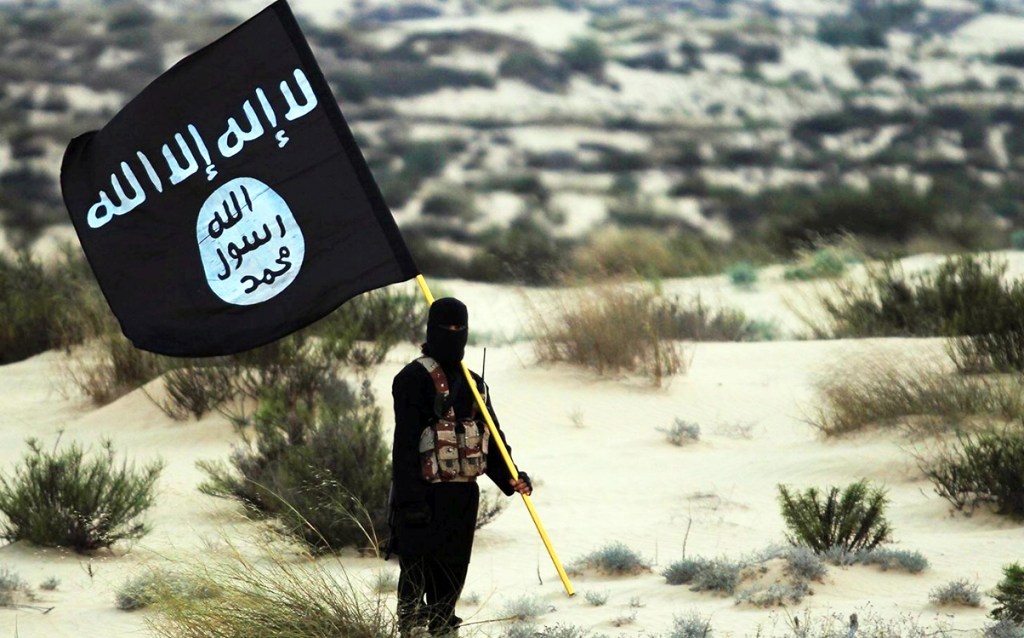
As TMD reported back in July 2024, the first Trump administration was under the impression that the Islamic State’s power had waned.
In March 2019, a U.S.-backed coalition declared “mission accomplished” in the campaign to retake territory controlled by the Islamic State in Iraq and Syria (ISIS). Soon after, then-President Donald Trump withdrew American troops from northern Syria, marking the effective end of a high-profile battle to put down the brutal terrorist organization.
“But ISIS didn’t go away,” Bruce Hoffman, a senior fellow for counterterrorism at the Council on Foreign Relations and a professor at Georgetown University’s School of Foreign Service, told TMD. The U.S.-led coalition snuffed out its regional dominance in Syria, but counterterrorism measures haven’t sufficiently challenged the Islamic State’s ideology and propaganda. “ISIS has gone from being the governing body that we defeated six years ago to returning to its roots, or its original DNA, as a terrorist organization.”
Since the overthrow of Syrian dictator Bashar al-Assad last year, the U.S. and allied forces have sought to prevent ISIS from using the instability to reestablish a foothold in the country. In September, a U.S.-led coalition force in Syria killed a senior Islamic State military official, Omar Abdul-Qader, who the U.S. military labeled a “direct threat” to the U.S. homeland. Earlier, in July, the U.S. military killed a separate top Islamic State leader, Dhiya’ Zawba Muslih al-Hardani, along with his two Islamic State-affiliated adult sons. And, in November, U.S. military forces worked with Syria’s Interior Ministry to target and destroy more than 15 Islamic State sites where the terrorist group had stashed weapons, an operation that destroyed more than “130 mortars and rockets, multiple rifles, machine guns, anti-tank mines, and materials for building improvised explosive devices,” according to U.S. Central Command. Last month, Syria’s new president, Ahmed al-Sharaa, became the first Syrian leader ever to visit the White House, where he formally agreed to join a U.S.-backed force formed to combat the Islamic State.
The Islamic State hasn’t claimed responsibility for the Saturday shooting in Syria, but U.S. Central Command described the shooter as “a lone ISIS gunman” and a spokesman for Syria’s Interior Ministry said the shooter—who had been employed by local security forces—was identified as a threat days before the attack, and planned to fire him for holding “extremist Islamist ideas.”
In a Wednesday press release, U.S. Central Command said that Islamic State-inspired extremists had schemed or carried out at least 11 attacks in the U.S. in the past year. This started mere hours into 2025, when a 42-year-old American-born citizen and U.S. Army veteran—who the FBI later concluded was “100 percent inspired by ISIS”—intentionally drove into a crowd on Bourbon Street, New Orleans, before opening fire, killing 14 people. Officials soon after discovered that the Islamic State-inspired perpetrator had placed undetonated pipe bombs in the area beforehand.
And Europe is confronting the same strain of radical jihadism. Earlier this month, German police arrested two Iraqi nationals alleged to have belonged to the Islamic State between 2016 and 2017. On Tuesday, Polish authorities announced they had detained a university student suspected of plotting a “mass attack” at a Christmas market in support of the Islamic State. Polish authorities said the suspect “took steps to establish contact with a terrorist organization, including obtaining its support in carrying out the attack.”
“To survive, [the Islamic State has] devolved more and more authority and autonomy to those branches and to those cells and networks,” Hoffman explained, noting that encrypted messaging services, including Telegram, have made it easier for the group to communicate with its offshoots and establish a well-maintained network of supporters. In some cases, Islamic State members will even connect via online gaming platforms, such as the popular social messaging app Discord. “There’s any number of ways that they can clandestinely communicate with one another,” Hoffman told TMD.
These digital networks are key to the Islamic State’s global strategy, according to Javed Ali, a professor at the University of Michigan who held senior roles at the FBI, Defense Intelligence Agency, and Homeland Security Department. “The affiliated groups, or the networks, or the nodes around the world are still able to function and do certain things, and one of those things is continue to generate propaganda and promote the ISIS ideology that was so attractive a decade before, and now, a decade later still,” he told TMD.
This decentralized structure means that individual attacks don’t typically require or involve collaboration with fellow terrorists. The Bondi “attackers were a father and son,” Hoffman said. “It’s not as if you had a terrorist cell.”
And this event likely mirrors the group’s operations in Syria, Ali explained. “My understanding is they don’t have a firm physical base—certainly at the scale of what they had in Raqqa, Syria, or in Mosul, Iraq, in its heyday—where they can centralize and coordinate and bring … people together to kind of oversee the different functions of the organization,” he said. “It’s much more decentralized, and there are probably just individuals who … try to manage these functions on their own,” adding that attack plans can be formed in one’s own home.
The decentralization that has allowed ISIS to survive has also made it harder to eradicate. Seamus Hughes, a senior researcher at the University of Nebraska Omaha’s National Counterterrorism Innovation, Technology, and Education Center, told TMD that some recruits “come to the ideology on their own and then proactively reach out to individuals, particularly online” to ask how to get involved. Others “are off the grid and don’t contact anyone connected to ISIS, and just kind of consume the ideology and the propaganda and then commit the act.”
What binds these dispersed actors together is often antisemitism. “There is kind of a connective glue through a lot of these attacks,” Hughes said. “The target is going to be individuals of Jewish faith—that is generally the first target on their list.”
“In my opinion, it’s not that ISIS is resurging or regrouping,” Ali said. “This is just an indication of this persistent and enduring threat from ISIS, but one that looks very different than it did a decade ago. They’re not able to do the things [they did] a decade ago now, but it doesn’t mean that they have zero capability to conduct attacks, and obviously we’ve seen that.”