
Persecution, then, gives rise to a peculiar technique of writing, and therewith to a peculiar type of literature, in which the truth about all crucial things is presented exclusively between the lines. That literature is addressed, not to all readers, but to trustworthy and intelligent readers only. It has all the advantages of private communication without having its greatest disadvantage—that it reaches only the writer’s acquaintances. It has all the advantages of public communication without having its greatest disadvantage—capital punishment for the author. But how can a man perform the miracle of speaking in a publication to a minority, while being silent to the majority of his readers? The fact which makes this literature possible can be expressed in the axiom that thoughtless men are careless readers, and only thoughtful men are careful readers. Therefore an author who wishes to address only thoughtful men has but to write in such a way that only a very careful reader can detect the meaning of his book.
Leo Strauss, Persecution and the Art of Writing, 1941
“Snooch to the m———-g nooch!”
Jay, Dogma, 1999
Angels. Demons. Strippers. Weed. And, maybe, a not-so-secret secret message? “I’ve seen what happens to the proud when they take on the throne!” says Matt Damon’s fallen angel in Kevin Smith’s apocalyptic comedy, Dogma. “I’m going back to Wisconsin.”
Dogma has a great deal going on in it that seems designed to irritate a certain kind of Catholic: The heroine, supposedly a blood relative of Jesus, works in an abortion clinic; George Carlin plays a smarmy cardinal; Chris Rock plays the 13th apostle, Rufus, who was carefully edited out of the New Testament and insists that Jesus was a black man; God is played by Alanis Morissette; in the end, the entire universe is saved from instantaneous negation by disconnecting a grievously injured man from life support. Smith apparently worried that he might have been too effective bugging the Catholics—the film begins with a disclaimer asking people to think twice before deciding to “hurt someone over this trifle of a film,” which, even in the pre-9/11 year in which it was made (1999) was a little bit ridiculous: The religion heavily invested in murdering people over pop culture trifles is, and was, not the one headquartered in Rome.
The Mormons had the good humor—and good marketing sense—to forgo protesting The Book of Mormon: Rather than marching up and down Broadway with picket signs in their hands, the Mormons instead decided to buy an advertisement in the playbill offering a free copy of their scripture: “You’ve seen the show, now read the book.” (Being a fairly traditional Catholic, I roll my eyes at the Mormon account of the universe, which is—let’s not sugarcoat it!—slightly more ridiculous than the one I profess, but if I were thinking of buying a house and learned that I’d have Mormon neighbors on both sides, I’d be willing to pay a little extra.) Some of my fellow mackerel-snappers took the bait and gave Dogma a fair bit of free publicity, which does not seem to have helped or hurt the film very much. The film did disappear from circulation for many years: It was released in the pre-streaming era, and the rights to the film, owing to some Hollywood machinations that do not need to be explored here, ended up being personally owned by Harvey Weinstein, with whom no one is very eager to do business. “My movie about angels is owned by the devil himself,” Smith observed. But the needful things were done, and a 25th anniversary edition of the film finally became available for streaming late last year, giving a new generation of Catholics a chance to be offended by a film that they should like and maybe even love: Dogma may not be exactly orthodox, but it is, in its crackpot way, quietly devout.
Not to go all Leo Strauss on you, but there is some interesting reading between the lines.
Let me stipulate at the beginning that the job of any movie—especially a Kevin Smith movie—is not to advance a religious, political, or moral point of view, and as far as criticism goes it is almost always a mistake to judge a film or a book or an opera or a painting in those terms. Dreck is dreck even if it has a “pro-family message” or incorporates patriotic gobbledygook or uplifting sentimentality: Don’t try to sell me a crappy film such as Forrest Gump or The Blind Side on the grounds that it is good for my soul. Likewise, there are many great films that give the complainers something to complain about: Consider the implicit politics of Gone with the Wind or the wildly dysfunctional family dynamics of the Star Wars saga. (Never mind the implicit biological racism of the series’ “midi-chlorians” era, about which the less said the better.) Kevin Smith’s movies can be disgusting and immoral—I made the mistake of watching Clerks for the first time with my mother—but Dogma’s occasional forays into illiterate theology and bad dorm-room philosophizing are not bad because they direct the film into a theologically or morally distorted direction but because those sequences are clunkily written and distracting, by far the worst parts of generally enjoyable film.
All that being written, I do wonder what my fellow Catholics, and Christians at large, object to in Dogma. Linda Fiorentino plays Bethany Sloane, a great-great-(etc.)-grand niece of Jesus who works in an abortion clinic in McHenry, Illinois. She receives a late-night visit from a fiery angel, Metatron, played by a perpetually exasperated Alan Rickman in one of those roles for which he was made. Metatron explains that he acts as the voice of God. “Any documented occasion when some yahoo claims to have spoken with God, they’re speaking to me.” He adds, a little sadly: “Or else they’re speaking to themselves.” Rickman’s ability to project arch annoyance shot through with sadness was his great gift, as anyone who saw him in Seminar could attest. When Bethany asks him what God is like, he answers: “Lonely. But funny.” He charges Bethany with a holy mission—she is supposed to stop two angels from exploiting a “loophole” in Catholic dogma that would allow them to reenter Heaven, thus reversing God’s decree and, consequently, annihilating the universe, which is organized and sustained by the single principle of God’s infallibility. When the angel tells her she has been chosen for this special task, she spits back: “I work in an abortion clinic.” Metatron’s answer should have been an indication to those annoyed Catholics that Dogma is not exactly what they were expecting: “Noah was a drunk, and look what he accomplished. And nobody’s asking you to build an ark.”
Bethany’s work at the abortion clinic is, we learn, part of a revenge campaign against God. “When some quiet infection destroyed my uterus, where was God?” she demands. “When my husband decided that he couldn’t be with a wife who couldn’t bear his children, where was God?” Smith is not above compromising with Hollywood political sensibilities: In the original screenplay, that quiet infection was “some asshole abortion doctor.” Bethany’s involvement with abortion isn’t an act of libertarian principle but outrage and grief at being denied those most traditional—and Catholic—blessings in a woman’s life: marriage and motherhood. She isn’t a modern libertine but a weekly Mass-goer. And—forgive the spoiler, but the movie is a quarter-century old—her great reward for successfully serving God is a miraculous pregnancy.
Which is to say, Dogma’s account of abortion is not Phyllis Schlafly’s, but it is tragic—and true. Its account of motherhood is one of fulfillment, not the modern view of pregnancy as a disease and children as a burden. The Biblical character Bethany calls to mind is not the adulterous woman facing stoning but Sarah, the wife of Abraham, relieved from the shame (as it was then understood) of her barrenness very late in life to become the “Mother of Nations.” Jay and Silent Bob, the Don Quixote and Sancho Panza of Kevin Smith’s cinematic universe, declare that they are pro-choice but also confess that they were loitering outside the abortion clinic where they meet Bethany because they assumed it would be a good place to meet “loose women.” “Why else would they be here?” Jay asks.
There is much more in Dogma that any Catholic halfway paying attention might notice and appreciate, including penance and reconciliation: When Bethany finally accepts her role, she says: “I guess this means no more cheating on my taxes.” And though the film does not make this explicit—a wise writing choice—it is obvious enough that she is not talking about taxes but her job and all that it entails: Go and sin no more.
George Carlin’s cardinal, obsessed with marketing schemes and performance metrics, announces that the church is retiring the crucifix—“a time-honored but wholly depressing symbol”—and replacing it with “Buddy Christ,” a cheerful Jesus who is winking while pointing to an unseen interlocutor with one hand and offering an encouraging thumbs-up with the other. I do not think there is a traditionalist Catholic in these United States—maybe in the world—who has not encountered such a wearisome clergyman, obsessed with “relevance,” who would if sufficiently empowered direct the church in precisely such a profane and banal direction, if not quite so humorously. “Get ’em young!” the cardinal barks. “Like the tobacco industry?” Rufus rejoins. “Christ, if only we had their numbers!”
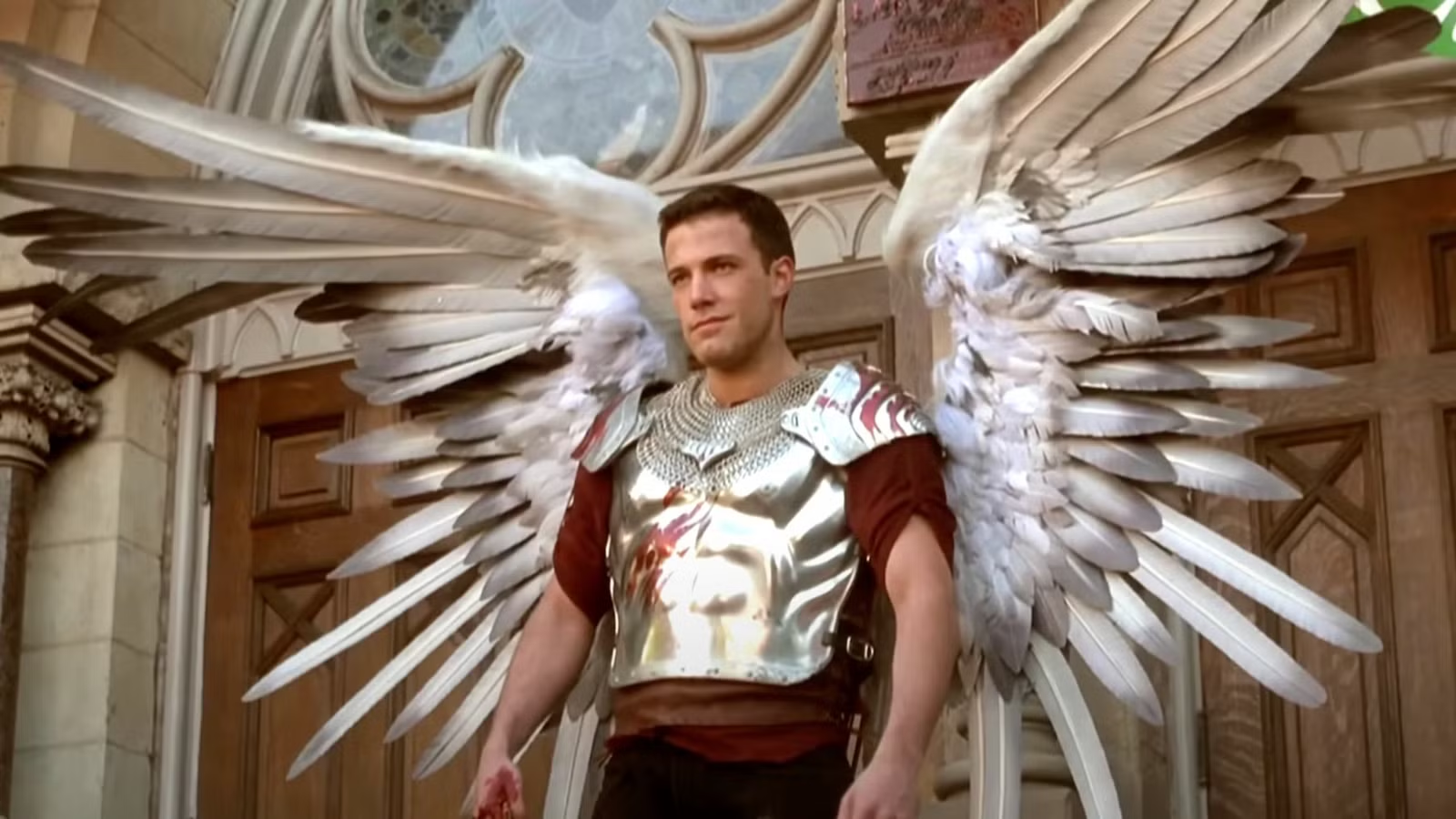
The acting in Dogma is, to put it mildly, uneven. This is not to say that Linda Fiorentino’s performance is a poor one, but she seems at times to be in a different film from the weary and rueful Alan Rickman or Ben Affleck, who starts off in his charming, goofing-around-with-Matt-Damon mode but builds into real anger and real menace as the second fallen angel, who decides to go through with his plan even after he learns that it will unmake all of existence. There are a few bits in which Kevin Smith would have benefited from a little more oversight, but these are cinematic failings rather than moral or theological deficiencies.
The performance that most stands out in my mind is the silent one—not Kevin Smith as Silent Bob, who speaks one word (“Thanks!”), but Alanis Morissette’s unspeaking but unimprovable turn as God, communicating only through expressions and gestures. (One of the film’s conceits is that the true voice of God is lethal to humans.) The casting was controversial, but she is genuinely terrific. She just has the right kind of face for the job. She is silly, delightedly sniffing flowers and failing to perform a headstand while wearing a tutu, but also indulgent and forgiving. Even Affleck’s murderous fallen angel needs only to turn to Her penitently to be forgiven—and then She opens Her mouth and causes his skull to explode in a horrifying bloody mess, which is, in the perverse spirit of Dogma, a happy ending for him.
Dogma is a funny and fundamentally silly movie, but it also is a movie about grief, about sin and its consequences, and, finally, about penance and reconciliation—serious subjects that sometimes benefit from being handled in a way that is not too serious. It is a good-hearted film and, in its sneaky way, devout. One gets the feeling that Smith really had an itch that he needed to scratch and not just another idea for a fun little movie with Jay and Silent Bob. I am not ready to set it up alongside The Calling of Saint Matthew, but, whatever the intentions of its creator, Dogma deserves its own place in the great long beautiful catalog of Christian art.