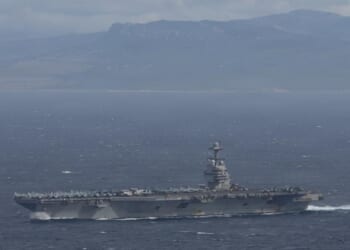
Operation Epic Fury is now in its third week and, while the operational successes are clear, understandable interest in tracking the cost of the operation continues.
The Pentagon has reportedly sent a $200 billion supplemental request to the Office of Management and Budget for review. Details of that estimate, which likely includes a projection of costs through the year and a much broader set of requirements, are not yet available as it goes through evaluation. The Pentagon has also submitted a $1.56 billion reprogramming action to Congress notifying the movement of funds from nearly 70 individual program lines to navigation systems and interceptors including PAC-3 MSE (85), SM-6 (1), SM-3 1B (23), and THAAD (15).
We have updated our March 10, 2026 estimate through March 19, 2026. This update includes operations and additional personnel deployed the last ten days as well as refined numbers where more information has been released. It also covers initial battle damage and repair costs and ship maintenance and repair for those vessels that are now missing their planned availability schedules.
We estimate the incremental cost of Operation Epic Fury, including positioning maritime and aviation assets in the Middle East starting at the end of December, is between $16.2 and $23.4 billion.
The assumptions used to generate the estimate rely on publicly available information from the Pentagon and United States Central Command (CENTCOM) briefings and fact sheets on the ships deployed, aircraft flying, defenses employed, and targets reported. We then used official sources of cost data for operation and sustainment and procurement of replacement interceptors, missiles, munitions, and lost aircraft. Finally, we applied informed judgements regarding distances, specific platforms engaged on missions, and the likely mix of munitions and interceptors expended.
The estimate’s high/low range largely depends on the percentage split between the United States and regional partners in intercepting Iranian attacks and the shot doctrine used to put munitions on target. The high estimate also includes replacement of a radar at Al Udeid in Qatar and some repair costs for the Ford carrier.
The concept of incremental costs is important as they do not include basic pay, training, original platform procurement, or other costs that would have been incurred regardless of the specific operation conducted. This is a backward-looking number that, given the continued non-steady-state nature of the operation to date and the possibility of Kharg Island or other ground operations, is not useful in projecting forward or in calculating daily burn rates.
Our sources include: U.S. Naval Institute Fleet Tracker, Military Air Tracker Alliance open-source data, Congressional Budget Office reports on force structure operation and sustainment costs, fiscal year 2026 budget justifications and published reimbursable rates, AEI Critical Threats Project and Institute for the Study of War intelligence reports, and additional news and imagery reporting on battle damage to U.S. assets in the region.
The estimate cost drivers are summarized by category here.

The estimate captures the cost of moving military assets to the region starting December 29, 2025 and assumes replacement of a variety of interceptors and munitions expended as of March 19, 2026.
This estimate does not account for use of national assets in this region, rather than elsewhere, or other agency—or partner—capabilities involved in the operation.
Even with the influx of 2025 budget reconciliation funds that augmented the low 2026 defense base budget, the DoW will need a supplemental to cover these contingency funding requirements. Without a supplemental, long-standing funding gaps that led to defense industrial base and shipbuilding production challenges and lagging military capacity and capability would continue. Last year’s budget reconciliation intended to start addressing some of these shortfalls which are now highlighted in the current operation as the Pentagon shuffles resources between regions and fires old munitions from within an even further diminished arsenal.
Congress should provide supplemental funding and a 2026 budget reconciliation for defense this summer to address both the overall strain on the force and deficiencies in stockpiles, the reconstitution of which can take years. A history of strategy/resource mismatches combined with the immediate and accumulating costs of delayed and uncertain budgets, helped produce the shortfall in steady-state and surge capacity and the limited supplier base the nation now needs to rebuild and expand across both traditional and emerging firms. While the long-term strategic return for the United States on the Epic Fury investment remains to be seen, the value of the overdue reduction of the threat posed by Iran’s nuclear, missile/drone, naval, and proxy capabilities is clear. For almost 50 years, the Iranian regime has held the United States and its partners’ interests in the region under constant threat. As Operation Epic Fury accomplishes its goals (which early costs imposed on the regime indicate are substantial), American peace through strength interests in the region will be met.
The post Epic Fury at Three Weeks appeared first on American Enterprise Institute – AEI.