Authored by Evgenia Filimianova via The Epoch Times (emphasis ours),
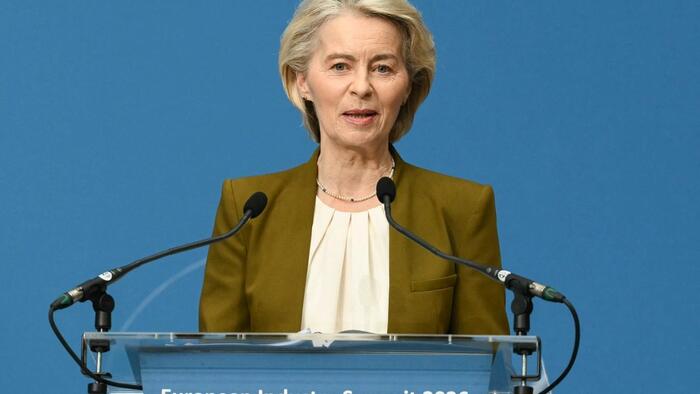
The European Union is weighing electricity tax cuts and targeted subsidies to shield consumers and industry from surging energy costs amid the ongoing Iran war, European Commission President Ursula von der Leyen said on March 19.

Speaking after a European Council meeting in Brussels, von der Leyen said electricity prices are driven by energy costs, grid charges, carbon pricing, and taxes.
Electricity taxes and levies in the European Union are on average about 15 percent, she said, adding that the bloc will “propose to mandate lower tax rates on electricity” and ensure that “electricity is taxed less than fossil fuels.”
“In some cases, electricity is taxed much more than gas—partially up to 15 times more. This cannot be,” said von der Leyen, according to a statement.
In the European Union, electricity is primarily taxed through the value-added tax and energy taxation under the Energy Taxation Directive, with additional national levies applied by individual member states.
In the first half of 2025, EU household electricity prices averaged 28.72 euros ($33.20) per 100 kilowatt-hours (kWh), roughly unchanged from the second half of 2024, according to Oct. 29, 2025, Eurostat figures.
Although pre-tax prices declined slightly, the share of taxes and levies rose from 24.7 percent in the second half of 2024 to 27.6 percent in the first months of 2025.
Prices varied widely across the bloc. Germany recorded the highest household rates at 38.35 euros ($44.30) per 100 kWh, followed by Belgium and Denmark, while Hungary, Malta, and Bulgaria had the lowest prices.
Compared to a year earlier, electricity costs surged in Luxembourg, Ireland, and Poland but fell in Slovenia, Finland, and Cyprus.
Supply, Prices
Von der Leyen said that the conflict’s immediate impact on Europe was higher energy prices rather than disruptions to physical supply. The EU remains diversified in its gas sourcing, which has helped shield it from shortages, she said.
Norway was the bloc’s largest gas supplier in 2025, accounting for 31.1 percent of imports, followed by the United States at 25.4 percent, Russia at 13.1 percent, and North Africa at 12.8 percent, according to the Council of the European Union. Smaller shares came from the UK and Azerbaijan.
The EU imported more than 140 billion cubic meters of liquefied natural gas (LNG) last year, with the United States supplying nearly 58 percent of that total, according to research group Bruegel. U.S. LNG deliveries have tripled since 2021. France, Spain, Italy, the Netherlands, and Belgium are the largest importers within the bloc.
Von der Leyen said energy costs themselves account for about 56 percent of electricity prices on average.
EU member states already have tools to cushion these costs through state aid, she said, and the Commission will further relax rules to allow more support for vulnerable consumers and energy-intensive industries.
Grid charges are another significant component, making up roughly 18 percent of prices.
The EU plans legal changes to boost infrastructure efficiency and potentially lower charges for heavy industry, von der Leyen said.
Carbon Market Under Scrutiny
Carbon pricing under the EU’s Emissions Trading System (ETS) is also being reviewed as leaders seek ways to stabilize power costs without abandoning climate goals.
The system requires companies to purchase permits for each ton of carbon dioxide emitted.
Von der Leyen said that the ETS has helped reduce dependence on imported fossil fuels and spurred investment in cleaner energy, but acknowledged that volatility in permit prices has raised concerns among manufacturers.
The Commission will propose measures to modernize the system while preserving its environmental objectives, she said.
EU officials aim to complete the review by July, though member states remain divided on how far reforms should go. Some governments favor expanding free emissions allowances for industry to shield companies from high energy costs.
Italian Industry Minister Adolfo Urso suggested more drastic steps could be necessary if consensus proves elusive. On March 9, he said suspending the ETS could serve as an “emergency response” if reforms cannot be agreed quickly.
Urso said industry estimates indicate that scrapping the system could cut electricity prices by 25 to 30 euros ($29 to $35) per megawatt-hour.