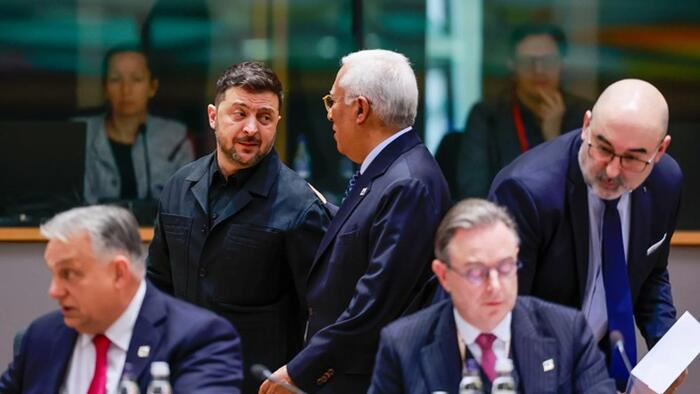
Europe has folded rather quickly on EU leaders’ controversial plan to confiscate Russian assets held in Belgium’s depository Euroclear to use as a reparations loan for Ukraine.
On Friday it became clear in the two day Brussels summit the EU was unable to agree on the plan, but instead has opted to raise €90 billion ($105 billion) in joint borrowing, with Hungary, the Czech Republic and Slovakia choosing not to take part.

Not only had objecting member states like Hungary sent EU leaders scrambling to circumvent a normal vote, but Belgium has remained unwavering in insisting on unlimited guarantees tied to assets held on its territory.
Fearing immediate Russian retaliation, Belgium wanted assurance that the rest of the EU would step in and absorb whatever retaliatory measures, including lawsuits, would result from the asset seizure.
Belgian Prime Minister Bart De Wever recently summed up the dilemma best: “We do not wish to be at war with Russia. We must negotiate based on reality, not fantasy. In reality, you don’t steal money from a foreign central bank. Stealing from a central bank is like robbing an embassy.”
So it appears EU leadership has backed down, perhaps having learned their lesson from Biden weaponizing the dollar early in the Ukraine war. As a reminder, here’s what President Vladimir Putin had to say by way of warning back in spring of 2024:
“The dollar is the cornerstone of the United States’ power… it is the main weapon used by the U.S. to preserve its power across the world,” the Russian leader said. “As soon as the political leadership decided to use the dollar as a tool of political struggle, a blow was dealt to this American power.”
As for the failed effort to permanently seize the some 210 billion euros ($247bn) in Russian assets held in Europe, EU officials had played down the possibility of an alternative plan right up to the eve of the summit.
And just like that, France’s Macron calls for renewed push for diplomacy with Moscow…
Funny how one’s perspective changes once you’re the one footing the bill.
Mere hours after the EU fails to agree on using frozen Russian assets – meaning they’ll have to fund Ukraine themselves – Macron magically rediscovers diplomacy 😏 https://t.co/fY4ebUYlz2
— Arnaud Bertrand (@RnaudBertrand) December 19, 2025
German Chancellor Friedrich Merz spearheaded the efforts, but now the setback marks a blow for he and European Commission President Ursula von der Leyen, who had pitched the reparations loan hard while not presenting another alternative.
Still, Danish Prime Minister Mette Frederiksen proclaimed that the immediate objective had been met. “The bottom line is that our support for Ukraine is secured,” Frederiksen told reporters. But Russia won’t be the one being forced to pay for wartime destruction.
As it stands now, EU member states will borrow from financial markets and cover the interest costs themselves. The loan is intended to be interest-free for now, with no clear future plan on just how it will be recouped. European Council President Antonio Costa said that “technical aspects of the reparations loan” must still be “worked out.”
EU is now fully funding Ukraine. Without this funding the hryvnia would collapse and Ukraine would descend into hyperinflation. The EU is stuck providing funding now. Either they fund it forever or at some point they allow the collapse. This might end up collapsing the EU. 🇺🇦 pic.twitter.com/URRc6kNd0W
— Philip Pilkington (@philippilk) December 19, 2025
In the end this marks another behind the scenes victory for Russia after ramping up the pressure on Belgium. RT underscores in its story headlined EU’s plan to steal Russian assets for Ukraine fails that “Without the EU war chest, Zelensky faces a short-term economic crisis. Ukraine needs some €72 billion to repay a G7 loan and stay afloat fiscally.”
Loading recommendations…