Remember Uranium One? The massive 2010 sale of US uranium deposits to Russia approved by Hillary Clinton and rubber-stamped by the Committee on Foreign Investment in the United States (CFIUS) – after figures linked to the deal donated to the Clinton Foundation?
Turns out rank-and-file FBI investigators thought there was enough smoke to launch a criminal investigation, but internal delays and disagreements within the DOJ and FBI ultimately caused the inquiry to lapse, newly released records reveal.

The materials, made public by Senate Judiciary Committee Chairman Chuck Grassley (R-IA) and first reported by Just the News, reveal that investigators argued internally over the delays – which allowed the statute-of-limitations to expire and ultimately halt the case.
The Uranium One transaction – involving the sale of a Canadian mining company with substantial U.S. uranium assets to Russia’s state-owned nuclear firm Rosatom – became a flashpoint during Hillary Clinton’s 2016 presidential campaign. Critics argued that then-Secretary of State Clinton, a member of CFIUS, helped approve the deal while donors connected to Uranium One made large contributions to the Clinton Foundation.
The New York Times reported in 2015 that “as the Russians gradually assumed control of Uranium One in three separate transactions from 2009 to 2013 … a flow of cash made its way to the Clinton Foundation. Uranium One’s chairman used his family foundation to make four donations totaling $2.35 million. Those contributions were not publicly disclosed by the Clintons, despite an agreement Mrs. Clinton had struck with the Obama White House to publicly identify all donors. Other people with ties to the company made donations as well.”
“And shortly after the Russians announced their intention to acquire a majority stake in Uranium One, Mr. [Bill] Clinton received $500,000 for a Moscow speech from a Russian investment bank with links to the Kremlin that was promoting Uranium One stock,” the Times reported. “At the time, both Rosatom and the United States government made promises intended to ease concerns about ceding control of the company’s assets to the Russians. Those promises have been repeatedly broken, records show.” -Just the News
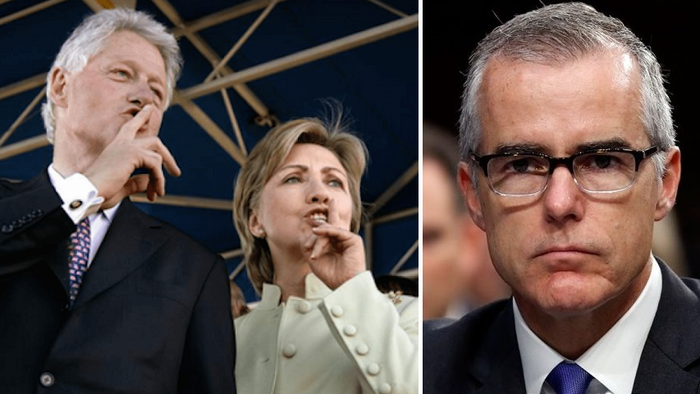
Resistance from senior officials – including then-Deputy Attorney General Sally Yates and then-FBI Deputy Director Andrew McCabe – slowed the inquiry to the point where statute-of-limitations concerns were later cited to justify shutting it down.
Investigators disputed statute-of-limitations claims
Thanks to Grassley we now have a newly declassified FBI investigative timeline surround the deal, as agents in multiple field offices opened inquiries in early 2016 examining the Clinton Foundation’s intersection with the Uranium One deal. The Little Rock field office initiated a full field investigation, while New York and Washington opened preliminary investigations.
Internal records show that agents and prosecutors continued to debate whether the investigation was time-barred. Jonathan Ross, then First Assistant U.S. Attorney for the Eastern District of Virginia, argued in a 2018 email that “there is no legal barrier in continuing the present investigation.” Ross has served as U.S. Attorney in Arkansas since 2022.
Then-U.S. Attorney Cody Hiland of Arkansas echoed that view in a separate email to then-U.S. Attorney John Huber of Utah, stating that the team did not believe the case was barred by statute of limitations because payments to the Clinton Foundation “were made continuously from 2007 through 2014.”
The FBI timeline also noted that statute-of-limitations arguments “failed to include whether Acts of Concealment such as deleting emails in 2015” could have extended the filing window. Investigators pointed to possible statutes including the Racketeer Influenced and Corrupt Organizations (RICO) Act, major fraud against the United States, bank fraud, and the Wartime Suspension of Statute of Limitations Act.
Despite those arguments, senior DOJ officials expressed growing reluctance to proceed. In late 2016, then-U.S. Attorney Robert Capers and then-Criminal Chief James Gatta raised concerns about potential statute-of-limitations issues and urged moving on from the case.
Internal emails show morale collapse among agents
The records reveal frustration among investigators who believed conflicting legal guidance undermined their authority to continue the probe. Hiland wrote in June 2018 that an email circulated by then-First Assistant U.S. Attorney Patrick Harris, asserting that the statute of limitations expired on Feb. 1, 2018, “cast a permanent pall over the local agents’ attitude” toward the investigation.
Ross later disputed Harris’s conclusion, writing that Harris was unaware of 18 U.S.C. § 3287 when issuing his assessment. Ross warned that agents’ confidence had been damaged and urged additional resources or reassignment of the case to a new investigative team.
The timeline indicates that prosecutors believed additional interviews and investigative steps remained unfinished, including questioning Uranium One executives, foreign nationals, State Department officials involved in the CFIUS vote, and Department of Energy personnel who approved export authorizations after the deal closed.
Political scrutiny and congressional oversight
The Uranium One deal drew sustained attention from Congress. In 2010, Sen. John Barrasso (R-WY) warned that the transaction would give Russia control over a sizable share of U.S. uranium production capacity. Grassley repeatedly pressed DOJ officials to examine whether donations to the Clinton Foundation influenced the CFIUS process.
The Hill reported in 2017 that the FBI had gathered evidence as early as 2009 that Russian nuclear officials engaged in bribery, kickbacks, and money laundering connected to U.S. uranium interests. That reporting cited a confidential U.S. witness and financial records tied to the Russian nuclear industry.
Attorney General Jeff Sessions later tasked Huber with reviewing the Uranium One matter in 2017, but did not appoint a special counsel. By early 2020, reports indicated that Huber’s effort was winding down. Special Counsel John Durham later stated that his mandate did not include Uranium One.
Fallout continues amid uranium supply concerns
The release of the FBI records comes as U.S. reliance on Russian-sourced uranium remains a national security concern. Russia accounted for roughly 20% of U.S. enriched uranium supplies in 2024, according to the Energy Information Administration, down from prior years.
Congress banned Russian uranium imports following Moscow’s invasion of Ukraine, but experts have warned that decades-old policy decisions left the United States vulnerable.
The newly released documents suggest that the circumstances surrounding Uranium One were never fully investigated, leaving unresolved questions about how a strategic U.S. asset came under Russian control – and whether potential criminal conduct went unexamined due to internal delays and legal disputes.
Loading recommendations…