As we reported earlier, the important Miami meeting wherein American and Ukrainian delegations hammered out a revised ceasefire draft for some five hours on Sunday did not have European participation. But this is where the real deal-making is taking place. Trump envoy Steve Witkoff is en route to Moscow, where he’s expected to meet with President Putin on Tuesday, in order to present where things stand on the peace plan.
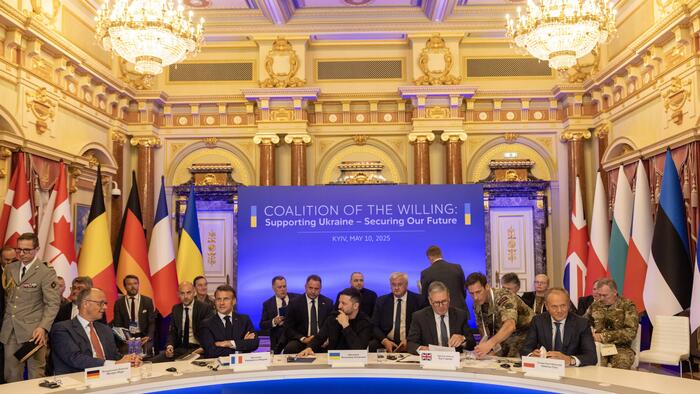
The Miami meeting reportedly focused on where the new de facto border would be in the east, after the 19-point plan featured significant territorial concessions in the Donbass and Crimea. As for Europe, is still touting a “coalition of the willing” which are vowing ongoing military support to the Zelensky government.
At this moment, France and the United Kingdom especially are continuing to push for the deployment of troops from NATO-member states to Ukraine as part of their version of peace settlement, despite this being very obviously unacceptable to Moscow.

Last week Politico reported that when US Secretary of State Marco Rubio joined a discussion involving the coalition of the willing via phone call, he made clear to all that the White House wants a peace agreement in place before committing to any long-term security guarantees for Kiev.
But UK Prime Minister Kier Starmer tried to push back, arguing that a “multinational force” would be essential for ensuring Ukraine’s future security.
Bloomberg then followed with a report saying that UK officials have already selected the military units they plan to deploy, based on several reconnaissance trips to Ukraine.
France’s President Emmanuel Macron proposed that such troops could operate in the capital area or western regions of the country, far from the front lines. But this would flagrantly cross all Russia’s red lines. NATO troops on its doorstep was key Putin’s decision-making in launching the ‘special military operation’ in the first place.
It must be recalled that the original US-drafted 28-point peace plan, which leaked to the press and more recently was condensed down to 19 points, included an explicit prohibition on deploying NATO troops to Ukraine.
The European-proposed counter-plan, which was also quickly leaked to the media, greatly softened that stance and laid out that instead of a blanket ban, NATO would not “permanently station troops under its command in Ukraine in peacetime.”
At a moment Trump’s peace plan advances, and with Witkoff on his way to meet with President Putin, hawks in Europe are growing even more hawkish:
⚡️BREAKING: NATO may carry out a preemptive strike against Russia
For the first time, the alliance is discussing the possibility of a preemptive strike on Russia in response to its hybrid attacks. Admiral Giuseppe Cavo Dragone, the head of NATO’s Military Committee, told… pic.twitter.com/57RgfyNZpn
— NEXTA (@nexta_tv) December 1, 2025
Such intentionally vague language leaves open the possibility of NATO troop rotations into Ukraine. The Kremlin has time and again said it would not tolerate this, and such a move would lead to direct war with the West.
Europe’s plan also seeks to leave open a Ukrainian path to NATO, but this is also a sticking point which the US plan leaves out, given it would of course be dead on arrival if presented to Putin.
Loading recommendations…