Authored by Mateusz Morawiecki
A year after Friedrich Merz’s narrow victory and the formation of a new grand coalition between the CDU-CSU and the SPD in May 2025, Nicolas Baverez writes about the existential crisis Germany is experiencing. A crisis on several levels.
Firstly, Germany is experiencing a demographic crisis, with its population expected to decline by 100,000 people by 2025. Secondly, the economic crisis, following successive recessions in 2023 and 2024 and very weak growth of 0.2 percent in 2025. Thirdly, the social crisis, with the end of full employment and rising unemployment (6.5 per cent of the economically active population), resulting from increasing layoffs (52,000 jobs lost in the automotive industry and 150,000 in metallurgy and electronics in 2025). And finally, fourthly, the strategic crisis resulting from the situation in which Germany finds itself trapped between Donald Trump’s illiberal America – which is no longer a protector but a predator – the military threat from Russia and the economic domination and unfair competition of China.
And one answer from Friedrich Merz: Germany first and the militarization of Germany. According to Nicolas Baverez, Friedrich Merz found the answer to all his country’s problems in the militarization of Germany. To this end, he brought about a constitutional revision that allowed for the abolition of the debt brake limiting new federal loans and the creation of a special investment fund worth €500 billion.

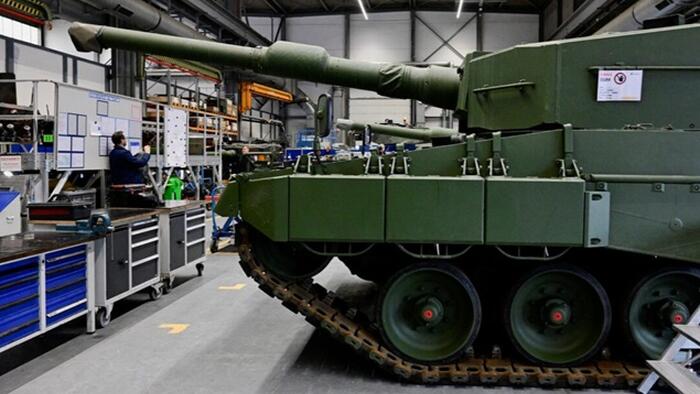
Germany’s militarization entails converting part of its industrial capacity, particularly its automotive plants, into arms production. Spectacular expansion has been emphasized, as evidenced by the meteoric success of Rheinmetall, whose order book is approaching €55 billion. By 2025, Germany will become the world’s fourth-largest arms exporter, overtaking China (5.6 percent).
“It is regrettable that Germany is carrying out the rescue of its industry and its own armaments, ignoring and even overwhelming its partners,” concludes Nicolas Baverez. The columnist notes that Friedrich Merz’s goal is to strengthen Germany’s dominance over the European Union – its vast market and its currency – through control of the European Commission and the European Parliament. The goal is to redirect German industrial exports toward Europe, but also toward the dynamic poles of the global economy: China and the United States, ASEAN, Australia and Korea, India, and Latin America.
The Germans only care about their own particular interests. Nicolas Baverez isn’t afraid to make a very strong claim, one that hasn’t appeared in mainstream French journalism until now. He writes that Germany is subordinating the European Union to its own goals (taking advantage of the controlling role it has held over the EU since Brexit).
Another thesis of Nicolas Baverez, which has not been heard in the French media so far, is that Germany is responsible, and it is primarily responsible, for most of the strategic mistakes that have weakened Europe since the beginning of the 21st century: from the strong euro, through the deflationary response to the crash of 2008, the unilateral disarmament of the continent after 1989, the dismantling of the nuclear industry and distortions of energy policy, the methodical destruction of the car industry after the disclosure of Volkswagen’s fraudulent practices, to the unconditional opening of borders to immigration.
Such sharp “anti-German” theses have never been seen before in the most serious French press title, i.e. “Le Figaro”, at most in the right-wing “Journal du Dimanche”, where recently Philippe de Villiers came out with a hard and very sharp thesis: “Berlin is imposing its position on France, pushing it to the margins.”
Germans are freed from any guilt for World War II: It must come as a shock to anyone following mainstream French journalism that Nicolas Baverez’s piece in Le Figaro includes another sentence that has never before been used in French journalism. Until now, it has been careful not to offend its German neighbor. Now, however, Nicolas Baverez writes bluntly:
“Germany is reinventing itself today, with a sovereignty without borders, freed from all guilt and rooted in the memory of World War II. The return to a language and strategic stance serves a national ambition without complexes, which does not hesitate to directly clash with its partners. This is particularly true of France, whose economic ruin, financial insolvency, and the complete disgrace of its leaders are being exploited by Berlin to undermine its last remaining strengths in nuclear energy, defense, aviation, and the space sector.”
So Germany will once again build itself on the ambition, militarization, and weakness of “declining France.” And there is no doubt that this process overlaps with the changes possible both in Germany (here the shorthand for these changes is AfD) and in France (here the slogan is Marine Le Pen and Jordan Bardella’s National Rally ).
The return of German power also worries former Polish Prime Minister Mateusz Morawiecki, who writes in an article for “Wszystko co Słońca”: “If Germany actually allocates 5% of its GDP to armaments, it will not only be the greatest effort since the Cold War, but also a turning point for the balance of power in Europe.”
“Something new is beginning before our eyes: Germany’s industrial awakening, and with it—even more importantly – a military awakening. Berlin is emerging from decades of military minimalism and preparing to become a real power. This time, these are not symbolic gestures or image-boosting tactics – but a systemic change that must be monitored closely. And understood before it’s too late again.”
If Germany truly devotes 5% of its GDP to armaments, it will not only be the greatest effort since the Cold War, but also a turning point for the balance of power in Europe. And the return of German military power will no longer be a hypothesis—it will be a matter of time. And it is precisely this possibility that Germany is consistently preparing for—step by step, lifting budget constraints, mobilising special funds, and transforming state structures into a wartime economic mobilization mode…
There is no doubt that Germany is striving to build a world-class army, one of the greatest forces on the Old Continent. The sheer scale of the funds it intends to allocate to broadly defined defense expansion suggests that we’re talking about a decade rather than decades. Or, if the federal government makes the right decisions, even sooner. Berlin is clearly articulating its desire to expand its role in NATO structures and to take responsibility for European security , especially Mitteleuropa. If Germany maintains this chosen course, it could fundamentally alter the geopolitical security puzzle in Europe .
From the German perspective, two key aspects are worth noting: ensuring financing for armed forces modernization through stable economic growth and the ambition to build a common European defense system, including the creation of a European army. The foundation of both goals is a strong arms industry – one of the most powerful in Europe.
Rheinmetall, known for its production of Leopard 2 tanks, ammunition, and air defense systems, remains the leader in this sector. The company is rapidly increasing its production capacity – in 2025, it will invest €600 million to produce 350,000 artillery shells annually. In 2024, it achieved record profits and an order book worth €55 billion. It’s worth noting that Rheinmetall has just entered into cooperation with the American Anduril – a symbol of a new arms paradigm based on AI and automation – which, somewhat contrary to Münchau’s thesis, demonstrates that Germany not only maintains its ambitions but is attempting to leapfrog into the technological vanguard. Meanwhile, companies like Anduril and Palantir remain virtually nonexistent on the map of decision-makers in Warsaw.
In addition to Rheinmetall, other significant companies operate: TKMS (warships), Hensoldt (battlefield radars and sensors), which is closely monitoring the changes on the battlefield in Ukraine, and Diehl Defence (air defense systems and precision weapons). The scale of public investment translates into tangible benefits – as shown, every €1 billion spent translates into a €1.23 billion increase in production, and the sector already employs nearly 400,000 people. German arms exports reached a record €13.2 billion in 2024.
History teaches us that industrial and military potential can be just as easily used as a tool of defense as it is a means of pressure – internal or external. The German arms industry, recently rebuilt on such a grand scale, is not developing in a vacuum. On the contrary, it is maturing in an atmosphere of political turmoil and growing support for parties challenging the post-war consensus. The Alternative for Germany (AfD), increasingly strong in the east of the country and leading in polls in some federal states, is openly questioning the pillars of Berlin’s current policy – both towards Russia, the EU, NATO, and the United States.
Read the full story here.