Here at The Dispatch, we make a point of sitting out the race to be first to get it wrong on a story, and there is much that we do not know about the shooting of Alex Pretti by federal agents in Minneapolis on Saturday. That said, I will for the purpose of this column work from these assumptions, which at the moment seem reasonable: Agents made an attempt to arrest Pretti, who was legally carrying a pistol; Pretti was disarmed by an agent; the other agents in the scrum may not have been clear on the fact that Pretti had been disarmed; the agent in possession of Pretti’s pistol possibly—this is not an established fact—discharged it by accident; hearing the shot—and the word “Gun!” having been shouted—the agents shot and killed Pretti, firing a total of 10 rounds. The Trump administration, being the Trump administration, immediately set about lying about what had happened, and the usual politics of gun rights were immediately flipped on their head, with Homeland Security Secretary Kristi Noem insisting that Pretti had been an armed rioter, which is—I do not suppose this even needs saying at this point—not true. Among others, the president of the Minnesota Gun Owners Law Center affirmed: “I see nothing that Mr. Pretti did that was unlawful,” at least with respect to his gun.
But strangely, a great many people who sometimes call themselves libertarians began to insist that when an officer of the state gives you an order, your choices are: 1) comply meekly; 2) get gunned down. Ernest Hemingway had their number way back in 1940: “There are many who do not know they are Fascists, but will find it out when the time comes.”
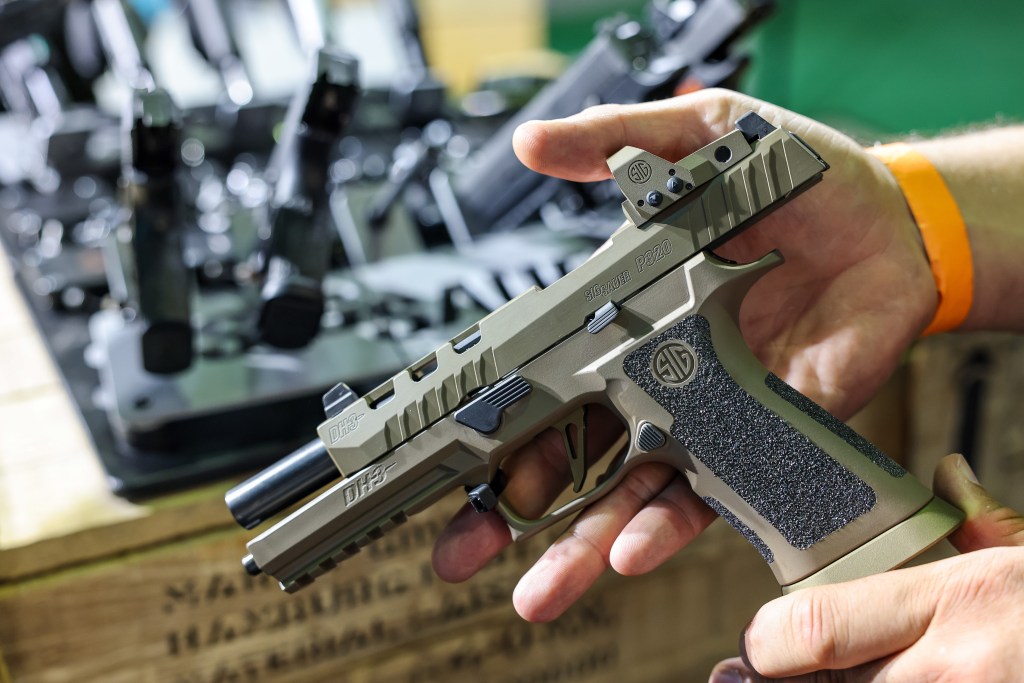
Already there is percolating a story that the real fault here may lie not with the federal agents but with Pretti’s firearm, a Sig Sauer P320. Anthony Blair, writing in the New York Post (a once-great institution that has become the in-house organ of the Trump administration), describes the pistol as “a popular handgun that has a history of unintentionally firing,” which is not quite right—but it is the case that there is a legend to that effect. There are many firearms that have a “history of unintentionally firing,” and they mainly fall into the category of “firearms in the hands of poorly trained people looking for an excuse after accidentally firing a gun.”
The Sig P320 is one of the most widely deployed firearms in the world, with millions and millions of them in use, many among civilians but also, more to the point here, among the professionals in law-enforcement and military organizations, which often use the P320 as a standard-issue sidearm. (I myself own one and have owned a few others.) There have been more than 100 lawsuits and many investigations stemming from claims of the P320 going off by itself. These fall into two categories: 1) drop-firing, i.e., the question of whether the pistol may go off when dropped; 2) other kinds of accidental discharge, with claims of the pistol going off with no trigger pull when in the hands of a shooter or in a holster.
It is entirely possible for a gun in a holster, or in a pocket, to go off unintentionally owing to an unintentional trigger pull. You probably have had an experience like the one I had a week ago when one of my little ones woke up early and I decided to take him on an early-morning coffee run; while undertaking the necessary contortions to strap him into his car seat, I somehow managed to set off the alarm on my minivan, almost certainly by unintentionally pressing the panic button on the key fob, which was in my right front trouser pocket. It is a little button and not easy to get to, but things in pockets get bumped around in unpredictable ways, which is why we have the phrase “butt-dialing.” As it goes with key fobs and mobile phones, so it goes with pocketed pistols.
This can be a deadly thing when it comes to firearms. I knew a man who accidentally shot himself to death with a double-action revolver, “double-action” meaning that pulling the trigger is a relatively long and heavy affair that causes the hammer to go all the way back before being released, as opposed to the single-action revolvers you’ve seen in Westerns, where you have to pull the hammer back with your thumb each time before firing it. The accidental shooting victim in this case had the revolver in a shoulder holster, and it seems that he was trying to climb over a wire livestock fence when he either got tangled up or experienced some other difficulty. We do not know exactly what happened, but the revolver was fired while in his shoulder holster, and the bullet struck his abdomen, killing him. That is an unlikely occurrence, though obviously not an impossible one: The long and heavy pull of the double-action trigger is a very reliable safety feature, which is why many of these revolvers do not have a manual safety—the trigger itself is a safety. (The double-action trigger pull is so much longer and heavier than on a modern semiautomatic pistol that shooters trained mainly on contemporary firearms find such handguns difficult to shoot as accurately as modern semiautomatics, and those looking to make a particularly accurate shot often go to the trouble of thumbing the hammer back to fire in single-action mode on firearms where that is possible.) The P320 is a single-action automatic, double-action automatics being uncommon. (To be precise: Double-action only automatics are uncommon; most automatics with exterior hammers can be hammer-cocked the way most revolvers can.) The double-action only automatics on the market often are marketed as carry guns, with the double-action trigger being highlighted as a safety feature. The old single-action Colt-style revolvers were notoriously easy to accidentally discharge for several reasons, which is why the wise cowboy’s six-shooter was, in practice, a five-shooter, with prudent men carrying the revolver with the hammer down on an empty chamber.
I have made a fair study of the claims of the P320’s supposed vulnerability to accidental discharge, and what I reached are two tentative conclusions:
First: Like almost any handgun, the P320 will discharge unintentionally if dropped in precisely the right way (meaning precisely the wrong way) from a sufficient height, the going theory there being that the weight of the trigger is enough that the trigger can be in effect pulled by momentum if it lands at a very specific angle. It is worth noting that some of the drop tests that have found the P320 vulnerable to drop firing involve some very unlikely scenarios—such as the gun being dropped 50 feet or fired out of a trebuchet—and that all of them involved essentially reverse-engineering a drop fire and trying to make it happen. I would be very surprised (and I’ll take your bets here) if 1,000 random drops of a P320 from shoulder height produced a discharge.
Second: I have found no persuasive evidence that the P320 can be fired without the trigger being depressed. But it may be easier to accidentally depress the trigger than one might expect. The manufacturer (which obviously has financial and legal incentives to minimize the perception of risk) offers an animated video of how the mechanism works here, and it is worth watching. That is not to say that the trigger cannot be accidentally operated even when the pistol is holstered, particularly if the holster is not designed for that firearm. Of the many claims of self-actuated P320 discharges, none has even been repeated in the kind of observable demonstration that one would expect could be easily achieved if there was some special defect in the design. For comparison, getting an old Colt Army revolver to fire accidentally from snagging the hammer on something is pretty easy to replicate. Some people—including some very knowledgeable experts—do not think much of the P320 design, and a few think it is uniquely dangerous. But this remains—at best—a contested claim, and in the cases in which accidental discharges have been rigorously investigated, the cause of the accident was found to be operator error in the overwhelming majority, while poor holster design—allowing the trigger to be accidentally pressed like my minivan key fob—played a role in a few, as did malfeasance. It is worth noting that the best-known case of an unintentional P320 discharge involved an Army veteran who had a holstered P320 inside a zipped pants pocket. Pocket carry, even with a holster designed for pocket use, is a controversial practice among shooters; I myself would not carry any automatic pistol with a round in the chamber in a pants pocket, even in a pocket holster.
I have fired and (unhappily!) owned defective handguns. They are a real thing. I once owned a semiautomatic pistol made by a very well-known U.S. manufacturer that would discharge unintentionally—not without the trigger being pulled but, owing to what my gunsmith informed me was a problem with the sear, firing two- or three-round bursts with one trigger pull, effectively becoming a fully automatic weapon for a moment until it jammed. Needless to say, I did not carry that pistol—or keep it, in spite of the manufacturer’s offer to repair or replace it.
Firearms bring something out in people—a strange mix of fear, enjoyment, and awe. Urban legends and conspiracy theories have a way of attaching themselves to firearms, especially those that are associated with military or police use. Before it was the P320 that was supposed to be extra-dangerous, similar stories circulated about Glock pistols, which are (according to the consensus view of people who have spent years and years subjecting them to sometimes extraordinary testing, from running them over with trucks to freezing them in ice) damned near impossible to get to fire accidentally but which will fire every single time when the trigger is pulled—intentionally or by mistake. But we’ve gone through a million versions of this: Glocks, being made of polymer, can be sneaked through airport metal detectors (a fantasy); AR-15 rounds are specially designed to tumble in human flesh to inflict maximum damage (a myth that probably was furthered by people with an interest in selling AR-15s to the army back in the day); that idiotic NPR story about “exploding” handgun rounds (short version: They do not explode); etc. There are millions of P320s in use (about 3 million sold in the civilian market alone and about a million more to police and military agencies worldwide) and millions of Glocks, and it seems to me that, given the numbers, genuine design flaws in either firearm would be much more conclusively demonstrable if they existed.
On the other hand, poor training and irresponsible gun-handling are facts of life—and in particular facts of life when it comes to ICE and, to a lesser extent, federal agencies such as the Border Patrol. As much as Kristi Noem gets her tactical panties in a bunch when it comes to protesters in Minneapolis, it seems to me undeniable that Renee Good and Alex Pretti would be alive today but for the incompetence of the federal agents under her supervision. Even if you believe that Good or Pretti acted irresponsibly—even if you believe one or both acted illegally—competent and properly trained agents would have been able to handle either situation in a non-lethal way. And it is not clear that Good or Pretti acted in any way illegally. It has been especially galling to watch charter members of the Kyle Rittenhouse Fan Club clutch their pearls at the sight of Alex Pretti exercising his constitutionally protected rights—one can, after all, exercise First Amendment rights and Second Amendment rights at the same time.
I myself probably would not choose to carry a firearm into the Minneapolis situation for much the same reason I do not avail myself of the option of open carry where it is legal unless I am, for example, in the woods in bear country. People who swagger around with guns on their hips or with rifles slung over their shoulders seem to me to be acting in a way that shows a lack of prudence and good taste—but we do not shoot people nine or 10 times over matters of good taste, or for having the wrong kind of politics, or for living in a city and a state where the mayor and the governor have politics that are different from those of the president and the secretary of Homeland Security.
The National Rifle Association (of which I am a former member) has here been mostly consistent, at least: The NRA’s political cowardice and its utter subordination to momentary Republican political needs are very nearly unwavering. Some Democrat gets froggy about scary black rifles and the NRA unleashes a barrage of angst and wailing that sounds like a Chinese opera company in a pitched battle with 14 tons of wind chimes, but when the Trump administration and its sycophants unveil a new policy—basically, “Do as you’re told, peon, or we’ll shoot you on the spot!”—all these craven monkey-butlers have to say is very little more than, “Responsible public voices should be awaiting a full investigation,” and “lower the temperature.” Who do you think is raising the temperature in Minneapolis, you ridiculous ninnies?
But I think I know how this will go: blame the victims, blame the gun, blame anything but the incompetents making the policy and the incompetents carrying it out.