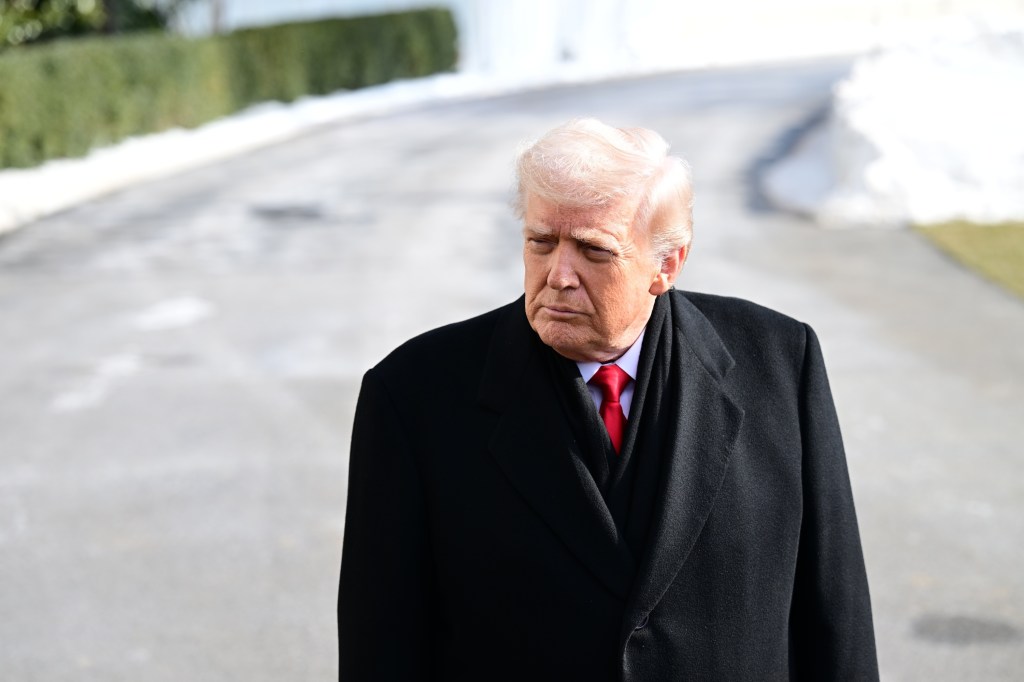
“I don’t like that he had a gun. I don’t like that he had two fully loaded magazines. That’s a lot of bad stuff.”
That’s President Donald Trump’s latest message about the killing of concealed-carry permit holder Alex Pretti by immigration agents. It’s in line with the general thrust of his administration officials, from Homeland Security Secretary Kristi Noem to Treasury Secretary Scott Bessett to even Transportation Secretary Sean Duffy.
‘This individual went and impeded their law enforcement operations, attacked those officers, had a weapon on him and multiple, dozens of rounds of ammunition,” Noem said the day Pretti was killed.
“If you approach law enforcement with a gun, there is a high likelihood they will be legally justified in shooting you,” Bill Essayli, assistant U.S. attorney in California’s Central District, posted.
“You cannot bring a firearm loaded with multiple magazines to any sort of protest that you want,” FBI Director Kash Patel said the day after the shooting. “It’s that simple.”
Many of the factual claims in those statements are false. It isn’t illegal to carry a gun at a protest under Minnesota law, law enforcement can’t shoot you merely for approaching them while armed, and the videos of Pretti’s shooting show he didn’t attack the agents or even reach for his firearm during the altercation that led to his death. The anti-carry sentiment pushed out by the administration also drew criticism from essentially every gun-rights group.
“The claim that some are now making—that the peaceable carry of a firearm near officers is enough to justify them using lethal force—is an affront to the Second Amendment rights of all Americans,” Kostas Moros, the Second Amendment Foundation’s director of legal research and education, told The Reload. “People should not fear interacting with police officers just because they are lawfully carrying. We hope that U.S. Attorney Essayli and others espousing that view reconsider the constitutional implications of what they are suggesting, or clarify their statements to specify that they did not mean to include those who are simply carrying a firearm without more.”
“We condemn the untoward comments of U.S. Attorney Bill Essayli. Federal agents are not ‘highly likely’ to be ‘legally justified’ in ‘shooting’ concealed carry licensees who approach while lawfully carrying a firearm,” Gun Owners of America said in a statement. “The Second Amendment protects Americans’ right to bear arms while protesting—a right the federal government must not infringe upon.”
The National Rifle Association (NRA) called Essayli’s comments “dangerous and wrong” in a social media post and said “responsible public voices should be awaiting a full investigation, not making generalizations and demonizing law-abiding citizens.”
Trump and his top officials’ blame-the-gun comments certainly risk backlash from a key Republican constituency, but they also put the gun-rights movement in a no-win position. The heel-turn was foreseeable since this isn’t the first time Trump has proved unreliable on guns.
Trump backed the idea of stricter gun laws three times during his first term. The first happened in 2017 after a gunman killed 60 people in Las Vegas, to which Trump responded by supporting a ban on the bumpstocks utilized by that shooter. Next was after the shooting at Marjory Stoneman Douglas High School in Parkland, Florida, where he told then-Vice President Mike Pence he thought the government should “take the guns first, go through due process second” if somebody was suspected of being a threat. Finally, he privately advocated for an “assault weapon” ban in the wake of a major mass shooting at a Walmart in El Paso in 2018.
Democrats, in theory, could use this opportunity to win the support of gun-rights advocates by running candidates who are more pro-gun than Trump. Connecticut Sen. Chris Murphy, the leader of many Democratic gun-control efforts, has expressed an openness to bringing more candidates into the fold who disagree with him. The party has managed to recruit the only remaining Democrat endorsed by the NRA to run for an Alaska Senate seat, where she is currently leading in the polls.
But there aren’t many pro-gun Democratic candidates who have risen to prominence through the early days of 2026 besides former Rep. Mary Peltola. And gun-control advocates have been able to hold an increasingly firm grip on the party over the past decade. Their influence in the party is likely only stronger after a red-flag law ballot initiative, and Democrats who’ve endorsed further gun restrictions fared well in the 2025 off-year elections.
Still, Trump’s comments don’t always translate to policy changes. In fact, more often than not, they don’t. Take those three examples of Trump suggesting he’d back new gun restrictions during his first term. The bumpstock ban, unilaterally pushed through by the Bureau of Alcohol, Tobacco, Firearms, and Explosives, was the only new gun restriction he successfully implemented, and it was later struck down by the Supreme Court.
One of the main reasons Trump didn’t pursue legislation to “take the guns first” after Parkland or an “assault weapons” ban after El Paso is because gun-rights activists had a direct line to the Oval Office at that time. NRA Executive Vice President Wayne LaPierre and the group’s top lobbyist, Chris Cox, both had direct conversations with Donald Trump throughout his first term, according to numerous sources with knowledge of the situation, including moments when he was considering backing new restrictions.
They’ve both since left the NRA after allegations of LaPierre’s corrupt handling of the group’s money surfaced and an internal power struggle ensued. Now, my sources indicate there is nobody with the same level of personal connection to Trump left at any of the gun groups. The groups have connections with Trump officials across various levels of the administration, including in the White House, but nobody really has a direct line to the president himself anymore.
So, while gun-rights activists were never able to prevent Trump from going off on an anti-gun tangent, they’re less capable than ever of convincing him he’s headed in the wrong direction. Ultimately, they are left with two unappealing options: Gun-rights activists can either hope that the recent acknowledgement of the Second Amendment’s value by Democrats blossoms into actual policy changes, or they can hope that Trump once again backs down and his rhetoric doesn’t translate to actual policy changes.