from the not-how-any-of-this-works dept
We called bullshit when Republicans tried to order websites to carry content. We’re calling bullshit now when Democrats are trying to do the same.
We spent years explaining to politicians across both parties why the government can’t dictate how private platforms moderate content. During the Biden admin, GOP governors seemed most aggressive about trying to tell platforms they couldn’t moderate. We wrote many thousands of words words about why Texas’s HB20 and Florida’s SB7072 were flagrantly unconstitutional. We cheered when courts, up to and including the Supreme Court, agreed.
And now California Governor Gavin Newsom has decided to… do the exact same thing, just from the other direction.
Cool. Cool cool cool.
Here’s Newsom, announcing that he’s launching a review of TikTok’s content moderation practices:
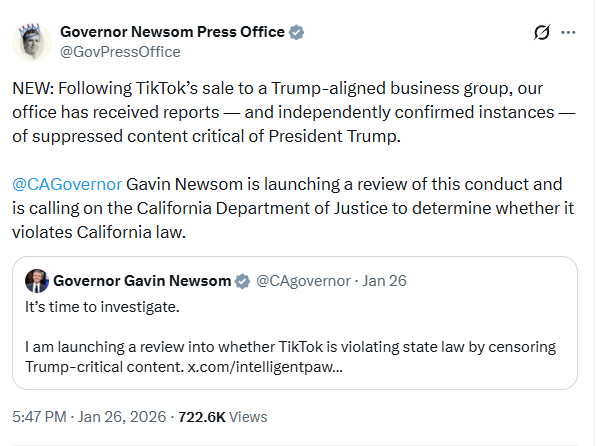
That’s Newsom’s “press office” announcing:
NEW: Following TikTok’s sale to a Trump-aligned business group, our office has received reports — and independently confirmed instances — of suppressed content critical of President Trump.
Gavin Newsom is launching a review of this conduct and is calling on the California Department of Justice to determine whether it violates California law.
We could save a lot of taxpayer dollars by just giving him the answer: no, it does not violate California law. It cannot. Because of the First Amendment.
It’s even worse if you dig down one level and see what Newsom is responding to:
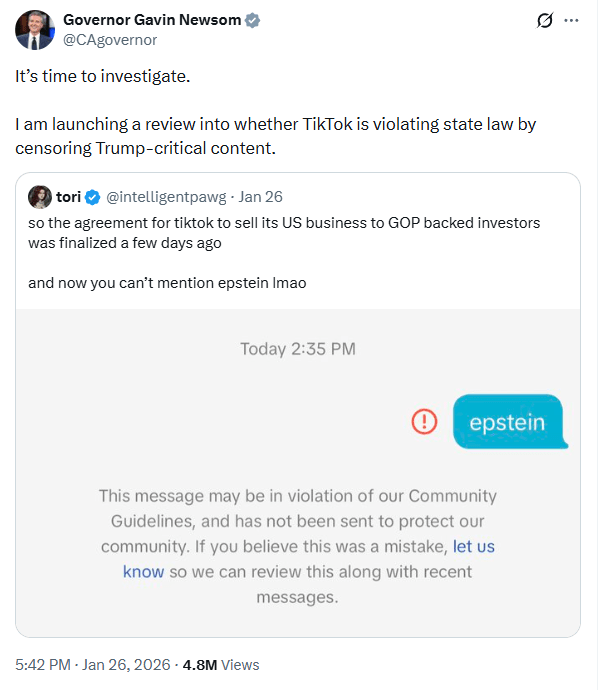
That’s a rando X account with just a few thousand followers tweeting that “you can’t even mention epstein lmao” showing a TikTok warning that her trying to post the word “epstein” “may be in violation of our community guidelines.”
Newsom is quote tweeting this saying:
It’s time to investigate. I am launching a review into whether TikTok is violating state law by censoring Trump-critical content.
There’s so much wrong here.
Let’s start with the obvious: these “reports” are sketchy as hell. Beyond it coming from some rando account, TikTok has already explained that there was a data center power outage that caused “a cascading systems failure” affecting content posting and moderation. This happens! Content moderation systems fail all the time. Also, moderation systems make mistakes. All the time! As we’ve discussed approximately ten thousand times, even with 99.9% accuracy, you’re going to have hundreds of thousands of “mistakes” every single day on a platform the size of TikTok. That’s just math.
For the Governor of California to jump from “some rando users reported upload problems during a technical outage” to “we must investigate whether this violates California law” is… not how any of this should work.
But, who even cares about that? There’s a bigger issue here: even if every single one of these reports were accurate—even if TikTok were deliberately, systematically moderating content to favor Trump—that would be totally legal under the First Amendment.
Content moderation decisions are editorial decisions. They are protected speech. A private platform can legally decide to promote, demote, or remove whatever content it wants based on whatever criteria it wants, including political viewpoint. It can decide what it doesn’t want to host. It can do so for ideological reasons if it wants.
This is the same thing we’ve been saying for years when Republicans howled about “anti-conservative bias” on social media. And, arguably, Newsom merely investigating TikTok for its editorial choices creates chilling effects that themselves raise First Amendment concerns.
When Texas passed HB20, which tried to prohibit large social media platforms from moderating based on “viewpoint,” we pointed out that this was flagrantly unconstitutional because it would compel platforms to host speech against their will. The Supreme Court agreed, with Justice Kagan noting during oral arguments that Texas’s law would mean “the government can force you to have certain speech on your platform.”
When Florida passed SB7072 with similar provisions, we said the same thing. The Eleventh Circuit agreed, calling it “an unprecedented attempt to compel private platforms to host speech,” which violates “the First Amendment’s long-held protection for the editorial discretion of private businesses.”
So now Newsom wants to do the exact same thing, just from the other direction? He wants California to investigate whether a platform’s content moderation choices—choices protected by the First Amendment—somehow “violate California law”?
What California law would that even be? The state has attempted a variety of social media laws, which keep getting thrown out as unconstitutional (just like we warned Newsom).
Is he just making up new theories now about how a state can control the editorial decisions of private platforms based on which political direction those decisions allegedly lean?
How is this different from when Josh Hawley or Ted Cruz threatened to strip Section 230 protections from platforms they accused of “anti-conservative bias”? How is this different from when Ron DeSantis tried to punish Disney for political speech he disagreed with?
The answer is: it’s not different. It’s the same unconstitutional impulse to use government power to control private editorial decisions, just wearing the other team’s jersey. We’ve detailed time and time again that both Republicans and Democrats are super quick to reach for the censorship button whenever they see online speech they don’t like, but it’s particularly egregious here because the courts have already ruled on this exact issue.
The Supreme Court already made it quite clear that Newsom can’t do what he’s doing just a couple years ago in the Moody ruling, directed at the governors of Texas and Florida:
But a State may not interfere with private actors’ speech to advance its own vision of ideological balance. States (and their citizens) are of course right to want an expressive realm in which the public has access to a wide range of views. That is, indeed, a fundamental aim of the First Amendment. But the way the First Amendment achieves that goal is by preventing the government from “tilt[ing] public debate in a preferred direction.” Sorrell v. IMS Health Inc., 564 U. S. 552, 578–579 (2011). It is not by licensing the government to stop private actors from speaking as they wish and preferring some views over others. And that is so even when those actors possess “enviable vehicle[s]” for expression. Hurley, 515 U. S., at 577. In a better world, there would be fewer inequities in speech opportunities; and the government can take many steps to bring that world closer. But it cannot prohibit speech to improve or better balance the speech market.
TikTok could, tomorrow, announce that they’re going to remove every single piece of content critical of Trump and promote only pro-Trump material. That would be stupid. It would probably be bad for their business. Users would likely flee to competitors. But it would be legal, because private platforms have the First Amendment right to make their own editorial choices, even bad ones.
Newsom knows this. Or he should. We’ve been explaining it to politicians of both parties for years: the First Amendment protects against government control of speech, including a platform’s editorial decisions about what to host. It doesn’t guarantee anyone a right to have their preferred content amplified on someone else’s platform.
We called bullshit when Republicans tried this. We’re calling bullshit now when Democrats like Newsom are doing the same thing.
The state has no role in dictating editorial practices of any media entity. Period.
Filed Under: 1st amendment, california, content moderation, editorial discretion, florida, free speech, gavin newsom, jeffrey epstein, texas
Companies: tiktok