Everyone remembers COVID, right? How could we forget feeling like we were on our way to a dystopia? One key dynamic that I observed as a social scientist was the depth of polarization in our society. Here we were in a medical emergency, and those on the left and right decided to cherry-pick the science they liked and ignore the science they did not like if it helped them to attack their political opponents. Generally speaking, those on the right ignored the need for social distancing and disdained the use of the vaccines. The left ignored the costs of societal shutdown and refused to open schools long after it was clear that doing so was not inordinately dangerous to children and that children were far less likely to pass the virus on than adults.
The power of polarization in the United States took a bad situation and made it much worse.
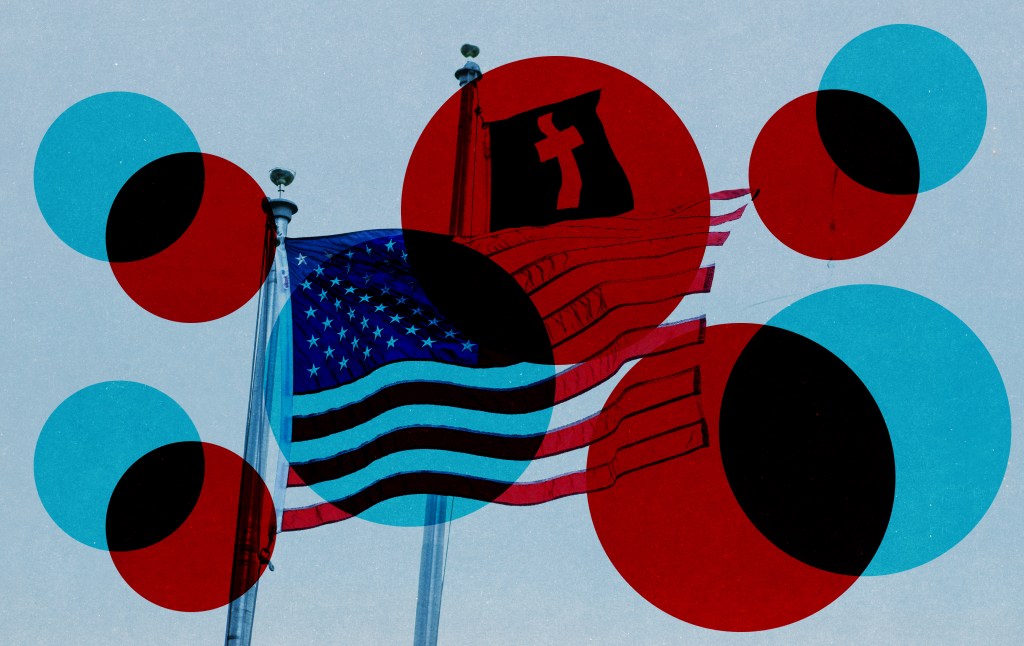
Of course, polarization has no single cause, but some causes can be more foundational than others. Arguably, one of the most foundational is the development of identity politics, first on the left and now on the right. The emergence of identity politics on the right has dragged many conservative Christians into the poison of that political practice, and we need to understand both the presence and pitfalls of the toxic trend.
Identity politics emerged around the middle of the 19th century as leftists figured out that Marxism was not a winning political strategy and instead moved toward identity politics as the way to advance their agenda. Identity politics has been defined as “the belief that identity itself—its elaboration, expression, or affirmation—is and should be a fundamental focus of political work.” In modern society, this is often used to justify political activism on behalf of groups defined as marginalized. Thus, in the latter part of the 20th century, progressive activists grounded their political activism in motivations to protect marginalized groups rather than to bring about a new social order.
Progressive identity politics led to the rise of movements such as MeToo and Black Lives Matter, which were more successful political endeavors than outright Marxism. Conservative political activists became aware of this relative success; consequently, it was unsurprising that Republicans such as Donald Trump tapped into some dynamics of progressive political identity to create their own form of identity politics. Whereas the left had defined racial minorities, sexual minorities, and women as oppressed groups for those promoting progressive identity politics, the right defined whites, men, and Christians as oppressed groups for those promoting conservative identity politics.
Now we have the rise of Christian identity politics. While conservative Christian activism erupted in the 1970s and has remained active, the early version of Christian identity politics did not focus on the notion of Christians as victims. Instead, it focused on implementing Christian values in the issues of abortion and sexuality. But more recently, some conservative Christians have focused on the idea of Christians as an oppressed group. Though it may seem counterintuitive, conservative Christians are not especially likely to be politically active. Indeed, they tend to lag behind the nonreligious and progressive Christians in the degree to which they participate in political activity. But some of those who have become very politically active have tapped into their own version of identity politics to motivate their political activism.
In my new book on identity politics, I have identified several dysfunctional tendencies that hold true regardless of whether we are discussing progressive or conservative identity politics. First, those who engage in identity politics have a powerful tendency to dehumanize those they define as oppressors. Oppressors can be anyone who impedes their political goals. Second, those involved in identity politics tend to seek out heretics who are members of their groups, but who do not fully support the group’s political goals and methods. And those engaging in identity politics are willing to suspend intellectual consistency and moral standards if it is necessary to achieve their goals. These tendencies are connected to the desperation members in identity politics have, since they believe they are defending oppressed individuals, and losing politically is considered to be unacceptable. Thus, they feel they must win at all costs.
Conservatives have criticized the inflexibility of those who engage in progressive identity politics, their inability to be open to compromise, and their tendency to demonize their political opponents. Unfortunately, I have noted some of these tendencies within Christian identity politics. Space does not allow me to fully illustrate these tendencies, but examples abound. Look on social media and see how much time and effort conservative Christians used to malign other conservative Christians, such as J.D. Greear, Beth Moore, Karen Swallow Prior, David French, Russell Moore, Phil Vischer, and others who oppose abortion and define homosexuality as sin but refuse to support Trump or blindly vote Republican. Christian enthusiasts of identity politics see them as heretics who must be removed from good standing among Christians. Or we could look at the ease with which many of these individuals have used dehumanizing rhetoric against undocumented immigrants: statements that go beyond policy disagreements but paint such immigrants as marauding bands of rapists and murderers. Finally, it is notable how many conservative Christian influencers argue that because of the focus on anti-black racism, not enough attention has been given to anti-white racism. While in theory, Christian identity politics does not have to be racialized, it has become racialized in that many of its adherents link the interests of conservative Christians to the interests of whites.
In my book, I include much more evidence of the way conservative Christians, as progressives have done before them, engage in an identity politics that dehumanizes their opponents and makes it all but impossible to find workable compromises with political adversaries. They feed into the polarization that makes it difficult to solve challenges like COVID and immigration policy. Clearly, conservative Christians are not the only players in this game of toxic identity politics. But their entry into it is especially disturbing to me since I am a theologically conservative Christian and I want us to do better.
Some may argue that the dynamics I am documenting are due to the emergence of Christian nationalism. For Christianity Today, I discussed why Christian identity politics is a better explanation for the recent political activism of conservative Christians than Christian nationalism. A major problem with reducing these issues to a concept like Christian nationalism is that doing so implies there is an exceptional nature to the activism of conservative Christians. Thus, the way it is applied implies that conservative Christians are a unique evil relative to other social groups. But classifying these tendencies as identity politics is a recognition that conservative Christians are basically doing what other vested interest political groups are doing to gain and maintain political power. This diminishes the implied mystery sometimes associated with conservative Christians. The fact that they are doing what others are doing does not make it right, but it does explode the myth that conservative Christians are worse than others.
The problems of the development of a Christian identity political movement produce political dynamics that can create spiritual impurities. As a result of the emergence of identity politics, a growing number of conservative Christians have linked their Christian faith to political fidelity. To be a Christian in good standing, or for some to be a Christian at all, one must be ready to pull the lever for the Republican no matter what. If a Christian concludes that his or her faith is an influential factor in becoming a Republican, then I see that as a matter between him or her and God. But when Christians promulgate a myth that to be a Christian, or a Christian in good standing, is to be a Republican, then that Christian has cheapened what we believe about Christ being the only way of salvation. The notion of Christ as the only way is extended to “Christ plus the right political attitudes” as the path to salvation. It is hard for me to think of a more effective way of distorting our faith.
Let me be clear: I do not begrudge conservative Christians for being politically engaged. Indeed, given that per capita, conservative Christians are less likely than many other groups to engage in political participation, it would be problematic if there were no conservative Christian voices in the public sphere. And they have legitimate issues to bring to that sphere. Beyond issues of life and religious freedom, some of my previous work on anti-Christian hatred indicates an important need for conservative Christians to help shape our political atmosphere. But this expression should not be locked into an identity political framework that demonizes those who are not in their camp and prevents conservative Christians from working with other groups to find compromises that build community instead of demanding compliance.
Polarization in our society will persist until we take intentional steps to overcome it. Whether the proliferation of identity politics is the most important factor is debatable, but there is no doubt that it has played a major role in facilitating polarization. Conservative Christians are not the initial source of the problems linked to identity politics, and clearly, we should remain concerned about the effects of progressive identity politics. But conservative Christians have become a major source that supports this poisonous political approach, thus harming our society.
It does not have to be this way. Christians can become part of the solution by offering a path out of this mess. My work in racial reconciliation points toward a potential path. In that work, I argued that our understanding of human depravity should lead us to prioritize more constructive conversations to identify solutions acceptable across racial lines: conversations where we look for solutions that transcend the needs of our particular groups and where we can make the compromises necessary for us to work together, instead of against each other. Thus, we should call for more constructive conversations that seek solutions for everyone, not just the groups we envision as marginalized. Whether we are talking about blacks, Christians, the LGBT community, men, or other groups that have been seen as marginalized, our solutions cannot revolve around only addressing the concerns of those groups. Learning to listen to others and to communicate with them in ways that ensure they can hear us is critical to finding solutions that not only address the concerns of our in-group but also attract support from those who might otherwise oppose us.
Developing a way to find common ground and solutions that consider the concerns of everyone can get us away from the problems of identity politics and toward a healthier society.