The day after our wedding, my husband surely wondered if he had made a mistake. We sat side by side on the airplane, newlyweds heading out on our honeymoon, and I was a complete and total grouch.
Our wedding day had been meaningful and wonderfully fun. All our close family and friends showed up to celebrate with us. And now we were headed to Mexico for a getaway. This was supposed to be the best week of my life. Instead, I held back tears. After a few attempts at sparking conversation, my husband slid in his earbuds for some music. I stared out the window catatonically for two hours.
Wedding preparations, hectic days, and back-to-back events had crowded out any opportunity for solitude. I had played organizer and host with main character energy for longer than I could sustain. It was a bright and dizzying time externally—and internally, I’d lost my center. Indeed, what I couldn’t articulate then was that I desperately needed to be alone, to equilibrate. After a solo trip to the gym and some journaling, I recovered. But it took being alone to return to myself.
The impulse to be alone might go against the grain of popular wisdom: Statistics are showing that as a culture we’re lonelier than ever. In 2023, the Surgeon General named loneliness an epidemic affecting 1 in 3 Americans, and 30 percent of adults 34 and younger say they are lonely nearly every day. Yet, the answer isn’t as simple as hanging out with others more. Because here we are, during the most festive, social time of the year, and many of us might still feel lonely and depleted. It doesn’t make sense—except that it does. We’ve been busy traveling, shopping, attending parties, hosting dinners, and having a hundred different shallow conversations, and then at the sudden end of it all, we’re exhausted and still lonely.
Something else is missing. We are social beings who have lost touch with the quality of connection—with each other and ourselves. Without quality time alone, we lose the first-person voice in our own lives, the plot of our main character. And without that signature element, we do our relationships a disservice—because we can only show up as partial people.
Two culprits aggravate this sad cycle. The loudest one is our smartphones. We’ve all seen, and been, that person who is surrounded by loved ones and, instead of participating in the conversation, scrolls on their phone aimlessly (or perhaps anxiously).
Journalist Derek Thompson describes the problem this way: “We come into this world craving the presence of others. But a few modern trends—a sprawling built environment, the decline of church, social mobility that moves people away from friends and family—spread us out as adults in a way that invites disconnection … But screens have replaced a chunk of our physical-world experience with a digital simulacrum that has enough spectacle and catastrophe to capture hours of our greedy attention.”
The second, less well-known culprit is this: Our personal discomfort with solitude.
We tend to think of loneliness as simply a sign that more socializing is needed: I’m lonely, so I’ll call my sister, get drinks with friends, or, worse yet, see what’s happening on social media—indeed, one 2024 poll found that, when Americans feel lonely, half of them reach for distractions like TV or podcasts. But these reactions make us miss the deeper invitations loneliness holds out to us.
Yes, we can be lonely for companionship and validation. We can long for the stimulating exchange of ideas. But it’s entirely possible to be lonely for the pleasure of our own company. We can long to withdraw from influences and opinions and firm up our own thoughts and beliefs. We can ache to feel how our own contours have shifted.
Did you know there’s a whole universe in here, in our selves? And only you have full and unfiltered access to your particular world. “To be alone for any length of time is to shed an outer skin,” wrote the poet David Whyte. “The body is inhabited in a different way when we are alone than when we are with others. Alone, we live in our bodies as a question rather than a statement.” Seen this way, being alone is a positive thing, not something to be avoided.
Granted, being alone isn’t immediately comfortable for everyone—especially if there’s a deep wound. (In that case, a professional can be helpful.) It can be unnerving at first when we haven’t been by ourselves in a while. Like coming home to a house we’ve neglected to find dust on the furniture, packages stacked up by the door, and dead plants on the windowsills. We might find a dusty layer of half thoughts and vague impressions, a sad pile of embarrassments, and dead goals and intentions. But it doesn’t take too much time or effort to put things in order.
One of my college roommates grew up in Turkey and attended boarding school in Germany. On school breaks, she would have an odd day to herself before returning home. She told me one of her favorite ways to spend the day was to take herself to an artsy movie, then smoke a cigarette in the nearby park and think about the story. I really loved that idea. Solitude can be fun, luxurious even.
I’ve had the best solitude while walking or creating. The walks don’t have to be long and the creativity doesn’t have to be good for solitude to work its magic. When I’ve got the energy, I might do my house chores quietly and take my time. I’ll let my mind wander, take stock of how I’m doing, what I’m liking and what’s pissing me off. We can’t get that kind of clarity when we’re rushing or binging content.
When we’re alone, we might bump into the boundary between our known and unknown selves—that part of us that is still forming, still being made, still looks back at us with blank-canvas eyes. This can be daunting but also thrilling. Our inner world is a frontier waiting for exploration.
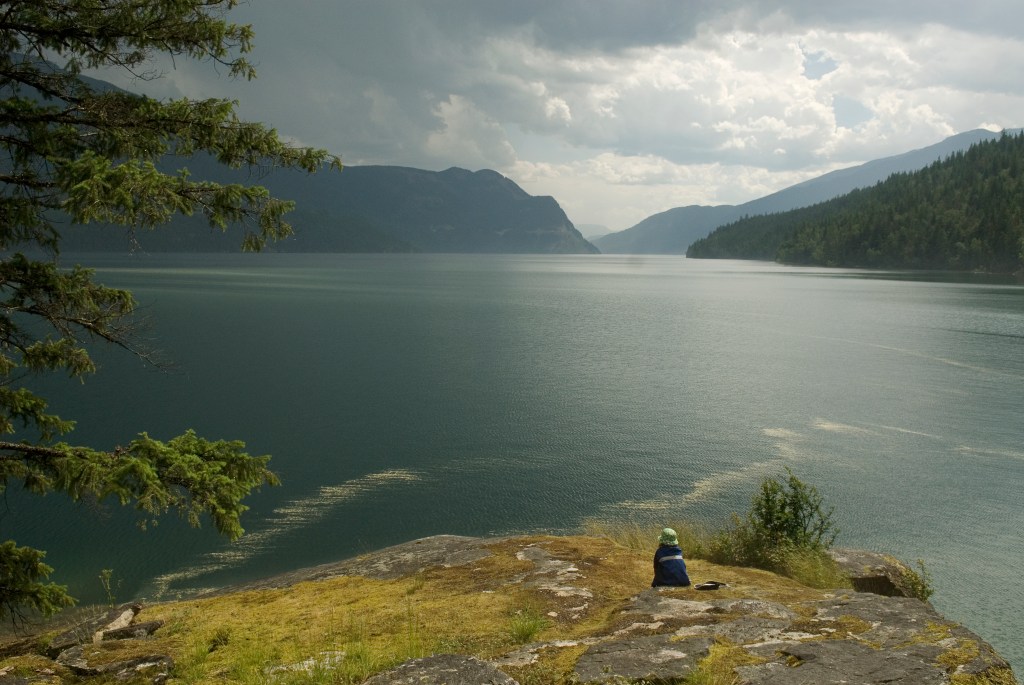
In a recent conversation with a few family members, I asked, “What do you imagine your soul looking like?” One person said they imagined a vague, glowing, sphere-like thing. Others said a tree or a vessel of some kind. For my part, I’ve always imagined my soul as a landscape—with its shifting weather (emotions), continental drifts (maturity), seasons (life stages), and its own flora and fauna (interests, ideas, hobbies, and projects). Back in 1577, St. Teresa of Ávila described the soul as an interior castle. How exciting is it, that there might be as much within as there is without.
There’s a lot at stake if we let the quality of our loneliness degrade. The quality of the collective is dependent on the quality of the individual. And solitude is the wellspring of that quality. If we don’t pay attention to our lives, we cannot know ourselves. If we don’t know ourselves, we cannot be our real selves, or relate to anyone else truly—not with any sort of depth. Indeed, as Wendell Berry wrote, “The more coherent one becomes within oneself as a creature, the more fully one enters into the communion of all creatures.”
Solitude doesn’t have to be intense or long to be helpful. It’s the quality of the thing we’re looking for, not endurance.
We can bring quality to our alone time by sitting in the quiet on our commute rather than catching the latest podcast. We can enjoy our own company while walking the dog. As a mom with a full-time job, the most consistent time I get alone is the last five minutes before I sleep. But with attention, even these five minutes can be something of a gift.
Being alone is our first and last state; it is our spiritual hinge point. It’s out of this deep root that we reach and touch the roots around us. And at death, we cross that final threshold alone. We might as well make friends with ourselves, our longest and most intimate companion. We’ll find, despite how ironic it sounds, that we feel less alone.