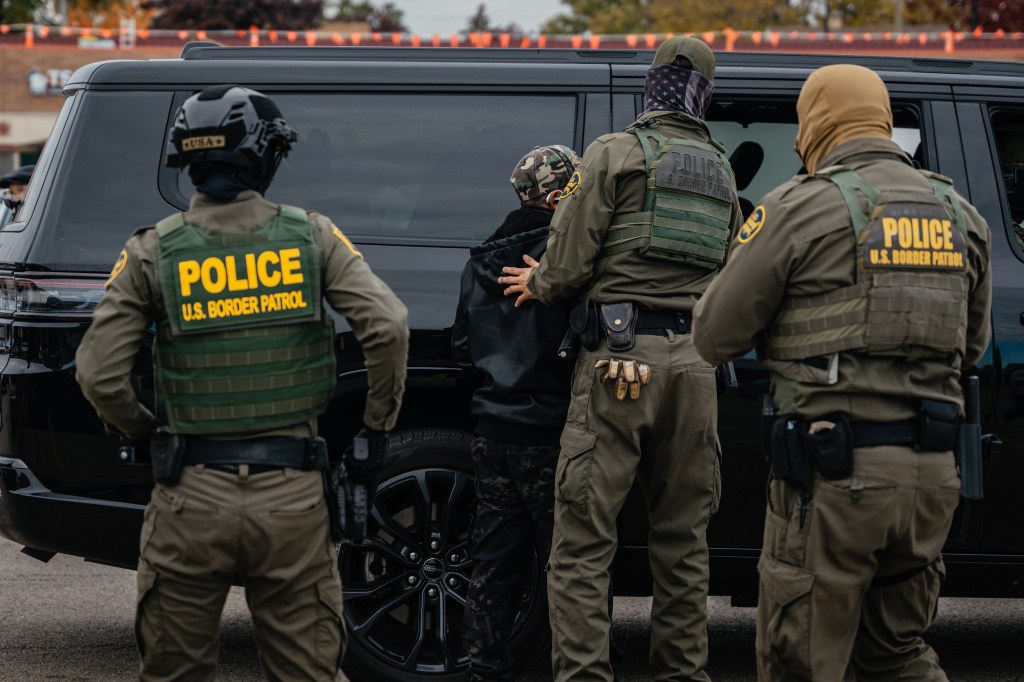
President Donald Trump pledged during the 2024 campaign that he would carry out the largest deportation campaign in American history, and veterans of the first Trump administration including Stephen Miller, the current White House national security adviser overseeing the deportation campaign, and Tom Homan, the current border czar, said they were prepared this time around to make good on the promise.
But when pressed on the feasibility of removing millions of people in four years, Homan, a veteran of Immigration and Customs Enforcement (ICE) from the Obama administration, emphasized that the effort would focus on deporting “the worst of the worst” illegal immigrants who are serious criminals—murderers, traffickers, and rapists. ICE would not ignore illegal immigrants without criminal records if they were encountered during enforcement efforts, Homan said; they also would be detained and subject to the removal process. Miller, on the other hand, maintained an emphasis on enforcement targeting all illegal immigrants.
Eleven months into the second Trump administration, arrest and detention data as well as published reports suggest that Miller’s approach is winning out. The share of people arrested and detained by ICE who have criminal records has declined consistently since the spring, coinciding with Miller calling for a daily target of 3,000 arrests and the beginning of large-scale, flashy enforcement operations in cities like Los Angeles and, later, Chicago.
As the administration has faced increasing scrutiny over enforcement tactics in some of these highly publicized operations, including the arrests of legal immigrants and even some U.S citizens, the Department of Homeland Security (DHS) has repeatedly emphasized that enforcement is still targeting “the worst of the worst.” The department’s messaging has focused on examples of violent criminals detained by ICE and Customs and Border Protection (CBP) and claims that an overwhelming majority of arrestees have criminal records. In announcing the start of a new enforcement effort on Wednesday, DHS Secretary Kristi Noem said, “Operation Catahoula Crunch will remove the worst of the worst from New Orleans.”
In January, nearly 80 percent of the people arrested by ICE had a criminal record—51 percent had convictions and 27 percent had pending charges—according to agency data obtained by a Freedom of Information Act (FOIA) lawsuit and released by the Deportation Data Project. On Monday, the project released a new set of ICE data covering arrests through mid-October showing that arrests of people with criminal records had fallen to barely a majority. Austin Kocher, a research professor at Syracuse University who closely tracks immigration statistics, projected the new data through the full month of October, finding that only 55 percent of ICE arrests involved people with criminal records—29 percent with convictions and 26 percent with pending charges.
The declining portion of arrestees with criminal records also matches the trend in detention data publicly released by ICE. The agency’s latest numbers show that the share of detainees with a criminal record is slightly higher, 59 percent, after excluding people in ICE detention who were arrested by CBP at the border.
The first few months of the administration saw an increase in the total number of ICE arrests, but the ratio of people arrested with no criminal record remained relatively stable, around 20 percent. That ratio shot up at the beginning of June to more than 40 percent, and people with no criminal record have remained the largest cohort of monthly ICE arrests since. The timing of the increase coincides with the beginning of operations in Los Angeles, and Stephen Miller calling for doubling the number of daily arrests as he reportedly instructed ICE to forgo more targeted enforcement.
“~70% of illegal aliens arrested have active criminal charges or criminal convictions,” DHS spokeswoman Tricia McLaughlin insisted on social media last week, without citing specific data to support the figure.
The libertarian Cato Institute published leaked ICE data last week detailing the specific types of criminal records of people booked-in to ICE custody from October 1 through November 15. Around twenty-seven percent had criminal convictions, but only 5 percent had convictions for violent crime, and 3 percent had convictions for property crime. Meanwhile, 5 percent had immigration-related convictions, which can include misdemeanors like illegal entry and reentry, and 6 percent had traffic convictions. Twenty-six percent had charges pending against them, and 47 percent had no criminal record.
David Bier, Cato’s director of immigration studies, argued that the data demonstrates the administration is not prioritizing the “worst of the worst” in its enforcement. The leaked data didn’t include a breakdown of the categories of pending charges for detainees, but Bier noted that pending charges could include anything from alleged violent crimes to failing to register a vehicle.
Bier also told The Dispatch that he can’t make sense of DHS’s 70 percent claim. “I looked at every data source that you could have on this, every different checkpoint that you could have, both the arrests, detentions, the detained population, the removed population; none of them align with what they’re saying is the case for this 70/30 split,” Bier said.
The decline in the proportion of arrests of people with criminal histories is consistent with information on some of the high-profile operations that DHS has been carrying out in cities like Chicago. DHS said that it had arrested 4,000 people in Chicago, but has only publicly identified 120 people as having a criminal conviction or arrest, according to reporting from The Washington Post. Documents submitted by ICE as part of a court case related to enforcement operations in Chicago found that of 607 individuals detained, 78 percent of them were assessed by the government to be a low risk to public safety. DHS documents obtained by CBS related to detentions in Charlotte, North Carolina, indicate that less than a third of arrests made there were of people with criminal records.
Some immigration analysts argue the numbers don’t reflect indiscriminate enforcement sweeps but the administration going after the large population of illegal immigrants who have final orders of removal, even if they don’t have criminal records. Andrew Arthur, a resident fellow at the Center for Immigration Studies, a think tank that favors increased immigration enforcement and deportation, argues that the focus shouldn’t be on the proportion of arrestees with criminal records but on whether immigration law is being enforced and people who have been ordered removed are actually being removed from the country.
“More than half of the people have a conviction or a pending charge, and you’re bound to pick up other people when you are targeting an individual,” Arthur told The Dispatch. He also said that the arrest and detention data suggest that the administration is also targeting people who are not serious criminals but have been ordered removed. “If really what I want to do is get the largest yield, I’m not necessarily going to go after criminals, I’ll go after criminals because people care about criminals, but I’m also going to go after people that have final orders,” he added.
Other immigration analysts argue trying to deport as many people as possible is necessarily in conflict with prioritizing violent criminals. Muzaffar Chishti, a senior fellow at the Migration Policy Institute, told The Dispatch that the administration’s focus on achieving millions of deportations would require DHS to abandon targeted enforcement priorities. Put simply, there aren’t enough “worst of the worst” to reach mass deportation numbers.
Nearly one year into the Trump administration’s immigration crackdown, what’s clear from the data at this point is that a small majority of ICE arrests and detentions still involve people with a criminal record but that share has consistently declined. Convicted criminals were just over a majority of ICE arrests in January but are now less than a third. Assessing the portion of people with a criminal record who qualify as “the worst of the worst” hinges on what is considered to be a serious crime, but only a minority of the convicted criminals who have been arrested and detained have committed violent crimes or theft.
“The administration has claimed they are going after the worst of the worst,” Kocher wrote Monday after the new data release, “but the data repeatedly shows a more complicated picture—and that continues with this data.”