Every year, the State Department randomly selects approximately 50,000 immigrants from a pool of roughly 20 million applicants for admission through the Diversity Visa Program lottery. Those selected undergo the same security screening applied to all immigrant visa categories: FBI fingerprint checks, consular interviews, police certificates from every country of residence, medical examinations, and—since 2019—disclosing all their social media account handles.
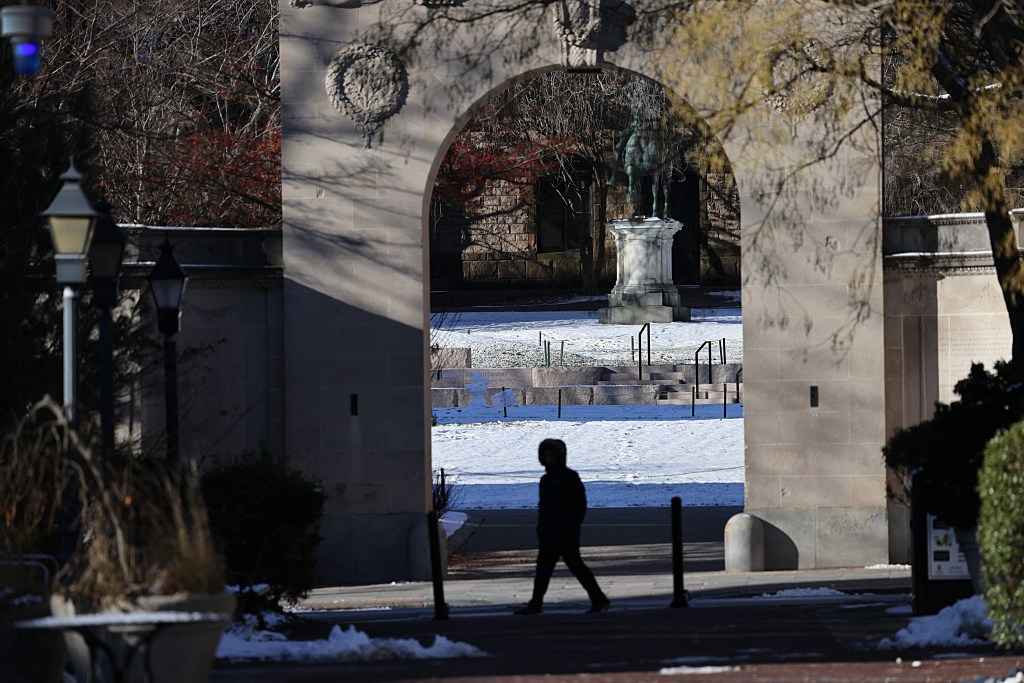
The program was created by Congress in 1990 to extend permanent legal immigration pathways to countries underrepresented in family and employment-based admissions, but it has faced criticism as a security vulnerability. The recent mass shooting at Brown University and the murder of a Massachusetts Institute of Technology professor, incidents police say are linked, have renewed those concerns and prompted the Trump administration to pause the program within days of the attack.
The alleged shooter, Claudio Manuel Neves Valente, was a 48-year-old Portuguese national who Homeland Security Secretary Kristi Noem said obtained a green card through the lottery in 2017. He had no prior U.S. criminal record. On December 13, 2025, police say, he shot and killed two Brown students—Ella Cook, 19, and Mukhammad Aziz Umurzokov, 18—and wounded nine others at the university’s Barus & Holley engineering building. Two days later, he allegedly killed MIT Plasma Science and Fusion Center director Nuno Loureiro, 47, at Loureiro’s Brookline home. Police found Neves Valente dead by suicide Thursday. After Neves Valente’s immigration pathway was made public, Noem announced that U.S. Citizenship and Immigration Services (USCIS) would pause the DV program, stating that Neves Valente “should never have been allowed in our country.”
The known facts of the case present a complicated picture. Portugal is a NATO ally and enjoys access to the Visa Waiver Program because it presents minimal security risks. As a recipient of the Diversity Visa, Neves Valente underwent vetting identical to all other immigrant visa categories. One of his targets was Loureiro, a former classmate from Instituto Superior Técnico in Lisbon, where Neves Valente’s teaching assistant contract was terminated in February 2000. The questions at hand now are whether any screening process could have detected a decades-old personal vendetta, and whether the DV lottery creates security vulnerabilities distinct from those of other visa categories.
How does the Diversity Visa lottery actually work?
Congress established the DV lottery through the Immigration Act of 1990, codifying it in INA § 203(c). The program allocates up to 55,000 immigrant visas annually to nationals of countries with low rates of immigration to the United States, though this number is reduced in practice to approximately 50,000 to 52,000 due to offsets under the Nicaraguan Adjustment and Central American Relief Act, which reserves some visas for beneficiaries of those acts. A country becomes ineligible if it has sent more than 50,000 immigrants in the previous five years.
Approximately 20 million people submit entries during a 30-day window each October through the State Department’s website. A computer randomly selects roughly 131,000 applicants, more than double the available visas, to account for attrition. Those selected must then complete the full immigrant visa process. The Kentucky Consular Center administers the lottery.
The program was created after the 1965 Hart-Celler Act replaced national-origin immigration quotas with a family reunification system that inadvertently disadvantaged countries lacking recent immigrant networks in the United States. For example, despite being a major immigrant group during the 19th and early 20th century, Irish legal permanent residents fell from 6,307 in 1964 to 1,836 by 1986. When the first iteration of the program went into effect in 1996, it reserved 48,000 slots—40 percent of the total at the time—for Irish immigrants. Over time, however, the beneficiary population shifted. Africa now receives more than 40 percent of all diversity visas, compared to just 11 percent of overall permanent resident admissions.
Do lottery winners receive less rigorous vetting than other visa holders?
In short, no.
The Congressional Research Service states explicitly that lottery winners “must undergo reviews performed by Department of State consular officers abroad and Department of Homeland Security immigration officers upon entry to the United States” that are identical to those for all other immigrant visa categories.
A 2007 General Accounting Office audit identified genuine vulnerabilities, namely what the report termed “pervasive fraud” at certain consular posts where document verification proved difficult, and name-based database checks that struggled with identity confirmation in countries maintaining unreliable civil registries.
In August 2025, the Trump administration proposed requiring passport scans at the lottery entry stage to combat fraud and strengthen identity confirmation before the consular interview. Other reform options include weighting selection toward applicants with higher education levels, delaying permanent residence for a monitoring period, or applying enhanced vetting to applicants from countries with poor document verification infrastructure.
But the same 2007 GAO report that identified these vulnerabilities found “no documented evidence that DV immigrants from these, or other, countries posed a terrorist or other threat.”
Three terrorism cases are consistently cited by the program’s critics. Sayfullo Saipov, who killed eight people in a 2017 truck attack in Manhattan, entered the U.S. from Uzbekistan via the DV lottery in 2010 and became radicalized domestically beginning approximately one year before the attack, seven years after his arrival. Hesham Mohamed Hedayet, who killed two people at Los Angeles International Airport in 2002, entered on a tourist visa in 1992, claimed asylum, then obtained a green card through his wife’s lottery win in 1997; the attack came five years later. Abdurasul Hasanovich Juraboev, arrested in 2015 and later convicted of conspiring to support ISIS, entered from Uzbekistan via the lottery in 2011—four years before his arrest.
The pattern across these cases—and confirmed by research by the New America think tank covering 421 jihadist terrorism incidents since September 11, 2001—indicates that radicalization occurs domestically years after lawful entry. Neves Valente’s case fits this pattern imperfectly but instructively. At the time of writing, he is not known to have radicalized toward any ideology investigators have identified. He appears to have harbored a personal grievance against specific individuals and institutions for a quarter-century, something no vetting system could capture.
What do supporters and critics of the program say?
Supporters often point to ways in which DV recipients outperform other immigrant groups. In 2018, foreign-born individuals from DV-eligible countries had an incarceration rate of 490 per 100,000—68 percent below the native-born rate of 1,545 per 100,000. DV recipients average 14.5 years of schooling; 50 percent hold college degrees, with 32 percent holding bachelor’s degrees and 18 percent holding graduate degrees. This exceeds family-based immigrants and rivals employment-based categories. University of Iowa research found that DV holders demonstrate the highest employment increase over time among immigrant categories and lower unemployment rates than other immigrants. Only 6 percent of new DV immigrants report speaking no English, compared to 22 percent of other new immigrants.
Critics raise concerns beyond individual screening failures. The Center for Immigration Studies notes that while the lottery accounts for less than 5 percent of green cards issued annually, it represents disproportionately larger shares of immigration from countries with documented terrorism concerns. In fiscal year 2015, the lottery accounted for 77 percent of green cards issued to Uzbek nationals, 72 percent to Egyptians, 56 percent to Iranians, and 50 percent to Bangladeshis. The argument is not that any individual lottery winner is likely to be a terrorist, but that the program expands migration networks from regions where screening is most difficult and radicalization risks are elevated—increasing, as critics put it, the size of precisely those haystacks where a terrorist needle is most likely to be found.
A related concern involves community formation. Pakistan and Bangladesh originally qualified for the lottery because they sent few immigrants to the United States. The program’s success at increasing migration from those countries eventually disqualified them—Pakistani and Bangladeshi immigration grew large enough to exceed the 50,000 threshold. Whether this network-building effect represents a feature or a vulnerability depends on one’s assessment of integration outcomes in those communities.
Can the president suspend a congressionally mandated program?
The legal question remains partially unresolved. INA § 212(f) grants the president broad power to “suspend the entry of any aliens or of any class of aliens” deemed detrimental to U.S. interests. INA § 203(c) mandates that Congress “shall make available” diversity visas annually. The Supreme Court addressed this tension in Trump v. Hawaii (2018), upholding a ban on U.S. entry by people from seven nations under § 212(f) while explicitly noting: “We may assume that [§ 212(f)] does not allow the President to expressly override particular provisions of the INA.”
The Trump administration tested these limits during the COVID pandemic. It made two proclamations suspending immigrant entry, including by DV lottery winners, in 2020. In Gomez v. Trump, a federal court issued a preliminary injunction requiring the government to process DV-2020 applications, recognizing that lottery winners faced unique, irreparable harm: Their eligibility would expire at the fiscal year’s end, and a delay would effectively constitute denial. The Biden administration revoked these proclamations before the merits were fully resolved.
The current pause creates additional jurisdictional confusion. Noem announced that USCIS would pause the program, but most diversity visas are issued by the State Department through consular posts abroad, not by USCIS. Legislation to eliminate the program has been introduced repeatedly over decades and has repeatedly failed; the program’s congressional mandate remains intact.
What happens next?
The immediate trajectory depends on legal challenges that will likely test the Gomez precedent. Courts have shown willingness to intervene when executive action effectively nullifies congressionally mandated visa availability, particularly given the unique time constraints DV winners face.
What remains unknown is whether Neves Valente’s case represents a failure of implementation—overlooking biographical gaps that better verification protocols could have caught—or a fundamental limitation of any screening system in confronting decades-old personal grievances.
If the problem is biographical gaps in applications across all categories, then the solution lies in improving verification protocols across the visa system, not DV-specific restrictions. If the problem is unique to the lottery’s random selection from difficult-to-verify populations, different interventions would be needed. The evidence available doesn’t resolve that question. Whether Congress will act to answer it—or whether the program will remain in legal limbo, suspended by executive action of uncertain validity—is an open question.