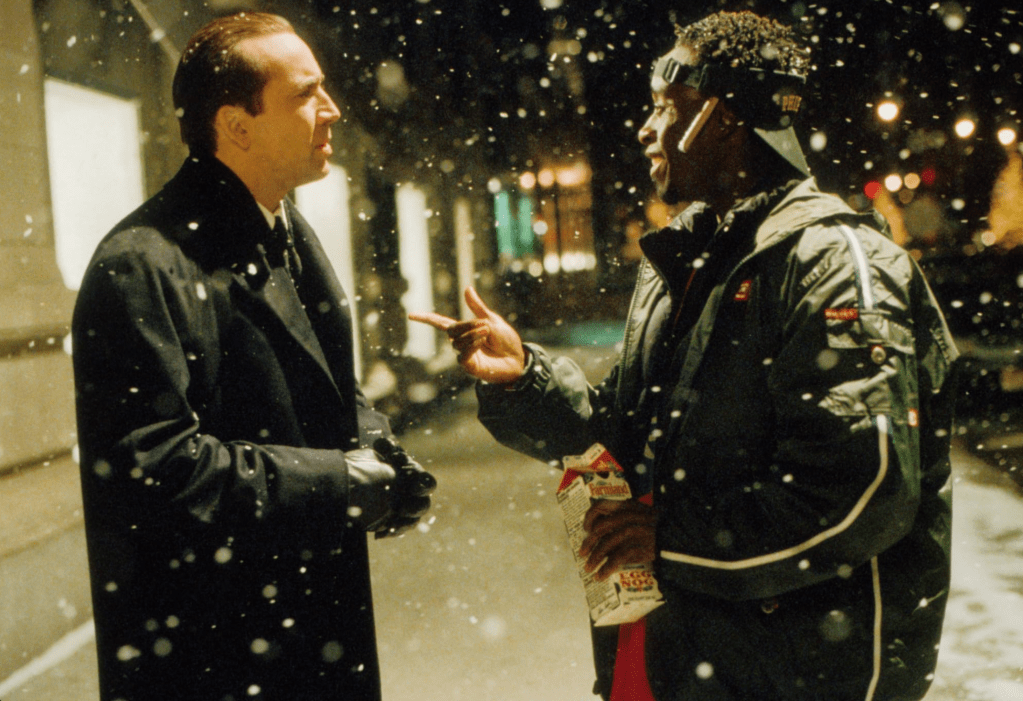
If you’re looking for a new Christmas movie classic, I have one. It’s called The Family Man with Nicolas Cage and Téa Leoni, it came out 25 years ago this week, and it’s a gem.
I think the filmmakers made an even better movie than they knew. They created a more philosophically complex, upside-down version of It’s a Wonderful Life—including angelic guides, symbolic snowfalls, ringing bells, and illuminated crosses in the city night. The story is about a good man who sees what a better and happier man he could have been. The fact that It’s a Wonderful Life wasn’t a big hit in its own time either, puts The Family Man in very good company.
Nicolas Cage’s character, Jack Campbell, is in his mid-30s and is a hugely successful Wall Street dealmaker. Thirteen years prior, he ended his love affair with his college sweetheart Kate when he took a yearlong finance internship in London, and his super-wealthy, high-powered life is the result of that decision. Jack Campbell is what George Bailey would have become if he had gone away to college and traveled the world. What he wouldn’t have become is the good husband, father, friend, and backbone of Bedford Falls. Jack has every material and professional success, but he has no family of his own and no hometown filled with friends.
Yet, Jack is still a pretty good guy all around—and this is one of the aspects of the story that makes it so interesting. He is not unhappy, he is well-liked, and he doesn’t hurt anyone. In fact, an act of real courage late on Christmas Eve is what thrusts him onto a George Bailey-like path.
His bravery brings him in contact with Don Cheadle’s character—a gun-toting, somewhat menacing angel (we assume) whose job seems to be to test people’s virtue. He is suggestively named “Cash.” If he is a divine messenger, he’s the kind of Old Testament one who ambushed the patriarch Jacob during the night and cheap-shotted him to win the fight. Instead of accompanying and guiding Jack on this glimpse of his alternative life, Cash throws him into the deep end, alone.
The movie takes off when Jack wakes up Christmas morning to his new life with his wife Kate (the college sweetheart) and two young kids in suburban New Jersey. Jack’s attempts to absorb what has happened to him and adjust to his new life are worth the price of admission alone. The globe-trotting corporate raider is now a tire salesman. He drives a beat-up old minivan to his bowling league. He fits in as well here as a young family of four would in his previous self’s Ferrari. Rarely has Nicolas Cage’s offbeat, agitated mania been put to better use, and I am amazed, after so many viewings over the years, to find everyone in my family still laughing out loud.
Jack resists settling into this new life. And yet, he slowly learns that this alternate life is warm, humorous, chaotic, and exceptionally loving. This Jack has real friends. He and Kate have a deeply loving marriage and are admired by everyone. He loves his children. He’s the richest man in town. He is The Family Man.
Téa Leoni pulls off what Donna Reed in It’s a Wonderful Life seems to have modelled for all time—the strong, funny, beautiful, supportive wife who is, in truth, the beating heart, moral center, and iron backbone of the main character. I don’t know what kind of lens filter they used to film Leoni’s close-ups, but there are moments when she positively radiates off the screen. She conveys the warm, deep glow of love gladly given—and gladly received.
One of the subtle, deeper spiritual elements of the story emerges around Jack’s intimacy with his wife. He avoids, and then comically botches, these moments with Kate. At one point, though, he stops and marvels at how stunning being a wife and a mother has made her. Jack tells her in an almost awed whisper, “You were always a pretty girl in college. But this … you’ve really grown into a beautiful woman.” Years of married love have made her far more than the girl he knew.
It’s not until later in the film that Jack realizes that he actually does love Kate and wants to spend his real life with her. And it is then that Jack can finally be intimate with his wife. And that is one of the things I love about this movie—a husband and wife who show real passionate desire for each other. This is practically non-existent in film and television, and the effect of this absence on our view of both sex and marriage has not been good. Jack and Kate show the immense joy and delight of yearning for one’s spouse. Desirous, playful, humorous, and perfectly normal. In short—true to life.
There are plot turns that keep the story humming, including when Jack’s old life and new life suddenly come together in a dramatic way. But the powerful current that runs through the whole movie is Jack’s deepening understanding of what his life could be. Last Christmas we were watching it with our four teenage kids, and a particularly compelling but understated scene came on. Jack is alone watching a family video. He sees his other self singing to Kate at her birthday party. At first, he’s embarrassed by the corniness of it all. But as the scene goes on, you see the look on Jack’s face change to amusement and then … to profound illumination. I murmured to my kids, “What does he realize?” And my 17-year-old son said quietly, “He realizes, he’s happy.” My son hasn’t studied a lot of Aristotle or Aquinas yet, but the filmmakers taught him the deep truths nevertheless—happiness is virtue. Happiness is love. What’s out there in those homes in the suburbs? A rich life full of love.
But it’s all coming to an end for Jack. The supernatural Cash shows up again, and Jack knows his family idyll is almost over. He is going back to his real life, where he has no wife, and no children. Now Jack wants to stay. He doesn’t want to go back. He’s happy. But he is going back—this is not his life, and it’s not the path he chose. And here is where modern movies’ realist tendencies emerge. While it may not improve on It’s a Wonderful Life, The Family Man does provide hope for all those people who are not the noble George Baileys of the world. Yes, Jack has to go back. He must live his real life. But he doesn’t have to keep living it the way he has. He can change course. He can be a better man.
George Bailey has a terrifying vision of his own personal dystopia; Jack Campbell has a vision of his own family paradise. George desperately wants out of his vision. Jack fervently wants to stay in his. If the lesson for George Bailey is, “You really had a wonderful life,” the message for Jack Campbell is, “It’s not too late to have a wonderful life.” It might be an even better reflection of the hope and redemption born on Christmas.
George Bailey and Jack Campbell both return to their real lives. When George Bailey finally returns home to his real life in Bedford Falls, he is greeted by his children, whom he wildly embraces. Then Mary comes in the door, and this might be the happiest moment of George Bailey’s life. He is finally reunited with the woman he loves, who loves him back. Jack Campbell will get no such guarantee. He returns to his solitary, high-powered life, and then he goes to see what has happened to Kate. I’ll leave the story there.
When this film first came out, I had been married for just two years and had no children. I loved this movie then. And so did my wife, Kate. We have now been married 27 years and have four nearly-grown kids—and The Family Man is far richer for us than it even was back then. Give it a try. I trust it will bring you the hope and joy it has always brought me. Merry Christmas.