You’re reading the G-File, Jonah Goldberg’s biweekly newsletter on politics and culture. To unlock the full version, become a Dispatch member today.
John Lindsay, the handsome golden-boy, two-term mayor of New York City from 1966 to 1973, was one of the last liberal Republicans, right up until he switched to the Democratic Party, partly in the hope of winning the Democratic presidential nomination in 1972. In his first run for mayor, Lindsay defeated Democrat Abraham Beame and Conservative Party provocateur William F. Buckley Jr.
None of that is important right now. I just wanted to point out, for those who don’t know who he was, that among his accomplishments—occasional guest host on Good Morning America, honorable service in World War II and in Congress—John Lindsay also gave Florence Henderson crabs.
Why do I need to point that out? I don’t really, but this is my “news”letter, and I’m about to talk about The Brady Bunch, and I don’t know when I’ll have another peg for that fascinating bit of trivia.
Still, I promise the rest of this “news”letter won’t be as crude. Let’s get serious and talk about something at the intersection of literature and politics.
Brady agonistes.
One of the seminal episodes of The Brady Bunch was “Adios, Johnny Bravo.” Attempting to summarize great literature is always daunting. How do you boil down Anna Karenina or Moby-Dick to a few sentences? But I will try.
The Brady kids appear on a variety show as a singing group. Greg Brady, the scion of the Brady clan, is approached by fast-talking talent scouts. They want him to launch a solo career as Johnny Bravo. Greg sees the offer as welcome recognition of his artistic skills. But his family is offended that he would leave the ensemble, creating a dramatic tension familiar to readers of the Odyssey and David Copperfield. Or perhaps the writer, Joanna Lee, was drawing on the rich tradition of Doctor Faustus.
Becoming Johnny Bravo, the agents tell him, would make him a sensation. “You won’t just be in the Top 20, you’ll be the Top 20. … Just sit back, relax, and enjoy the ride.” Like Robert Woodson at his meeting with the devil at the crossroads, Greg has a big decision to make.
This fine print of becoming Johnny Bravo, the producers explain, will be to wear a flashy matador-style costume of the sort you might expect Matt Gaetz or Roger Stone to wear at a private party.
After some soul-searching, Greg initially accepts the offer until he finds out that the executives don’t want him for his musical ability or his singing. They’ll reinvent all that electronically. Greg blanches at the suggestion, saying that he thought they wanted him for his talent.
The producer snorts, “You? Now c’mon, baby, don’t get caught up on an ego trip. I mean, who cares how you sound? We’re after the sound.”
If that’s the case, Greg asks, what do you want me for?
“Because you fit the suit,” another producer responds.
The Johnny Bravo theory of politics.
Okay, enough of all that. I bring this up because, starting about 20 years ago, I used to invoke Johnny Bravo as a way to describe a tendency in Democratic politics. In 2004, there was a boomlet around retired Gen. Wesley Clark on the theory that a decorated general would be the best candidate to defeat George W. Bush. Michael Moore himself championed Clark, which tells you how much the left-wing base of the Democratic Party has changed. Today, the idea that the base should compromise for the sake of electability is considered a surrender to fascism or something.
Clark eventually flamed out as a candidate, but the theory endured. John Kerry became the nominee not so much because most Democrats liked him, but because they thought other voters would. They needed a “military man” to go against Bush during the war on terror and the build-up to the Iraq war. It’s not a terrible theory—in theory.
The problem is that Kerry had spent the decades since his service in Vietnam burnishing his credentials as an antiwar guy. I don’t want to revisit all of the Swift Boat Veterans for Truth brouhaha, but the larger point is that Democrats thought Kerry should have credibility with pro-military and national security voters because of his service without recognizing that his record denouncing the war, repudiating his medals, etc., put him on the other side of the cultural divide. The fact that Kerry was a human toothache who talked like an AI-generated hologram for a Davos climate change initiative only exacerbated the problem.
In short, Democrats picked a guy who fit what they saw as the Republican suit but sang like a conventional Democrat—and thought that Republican or Republican-leaning independents would fall for it.
This sort of thinking boils down to a form of tokenism. It’s why Amy McGrath, a former fighter pilot, raised $90 million to challenge Sen. Mitch McConnell in Kentucky in 2020. Progressives bought the theory that other voters would just see the flight suit.
As Ramesh Ponnuru notes, a version of this rationale is why Kamala Harris picked Tim Walz as her running mate. He wears flannel! He hunts! He served in the military! The white working class will totally fall for him! If you think that’s unfair or simplistic, take it up with Walz, who explained at a Harvard Institute of Politics post-mortem, “I could code-talk to white guys watching football, fixing their truck. I was the permission structure to say, ‘Look, you can do this and vote for this.’”
Nothing says “authentic white working class” like a dude using “code-talk” and “permission structure” at a Harvard egghead confab.
Republicans aren’t immune to such self-delusion either, but it gets covered differently because the demographics and sociologies of the two parties are so different. From time to time, Republicans will nominate black candidates on the theory that having dark skin is a kind of Johnny Bravo suit. The candidate can be as right-wing as the next white guy, but because he’s black, Democrats and Democrat-leaning independents won’t see past his skin color. I think Trump endorsed Herschel Walker in the 2022 Georgia Senate race for a few reasons. He was a friend of Trump’s and a famous ex-football star. But a kind of Johnny Bravo rationale was definitely part of it.
Progressives, especially black Democrats, denounce the tactic as tokenism—and they’re right. But they also often denounce it as racist, and they’re (often) wrong. Thinking that, all things being equal, black (and many left-leaning white) voters will prefer a black candidate is not racist, it’s just politics. Sure, it can be racist if you’re working from the assumption that black people won’t see what you’re up to. But that’s rarer than progressives think. In fact, Republicans welcome black candidates not because they think they’ll win droves of black votes, but because lots of white voters—including very conservative ones—like voting for black candidates. Two of the most popular Tea Party politicians were Herman Cain and Ben Carson, at least in part because a lot of conservatives don’t like being called racists.
Two cheers for tokenism.
Tokenism is a universal feature of politics and always has been. The term has a negative connotation, for understandable reasons. So if you want to use “inclusion” or some other euphemism, that’s fine. But we should acknowledge it’s just that—a euphemism. It’s just a fact of logic that the process of inclusion is going to begin at the retail level, not wholesale. Going back at least to the Roman Conflict of the Orders, inclusion starts as symbolic before it becomes structural. Jackie Robinson was accused of being a token, but he was also a fantastic baseball player—and human being. Someone had to be the first black player in the major leagues. The fact that he was so good and had so much integrity was instrumental to getting beyond mere tokenism. People who heap scorn on tokenism make the perfect the enemy of the good, because wanting even symbolic inclusion is a concession to the moral logic of inclusion. It’s fine to say it’s not enough, but to say it’s worse than nothing is idiotic.
But here’s the thing. In contemporary politics, tokenism doesn’t settle any arguments. It merely provides an opportunity to make those arguments to an audience that would otherwise be unwilling to listen to them. I am old enough to remember lots of people on the right getting angry about Republicans speaking Spanish to Hispanic audiences. I always thought this was preposterous. Speaking Spanish to Spanish-speaking audiences is a great way to make your case to—wait for it—Spanish speakers. But if you send Marco Rubio to a meeting of the organization formerly known as the National Council of La Raza conference and he says—in Spanish—the sorts of things Stephen Miller says, he won’t make many inroads. “You people don’t belong in my country” doesn’t sound any better in Spanish than it does in English. In fact, it might even be more insulting.
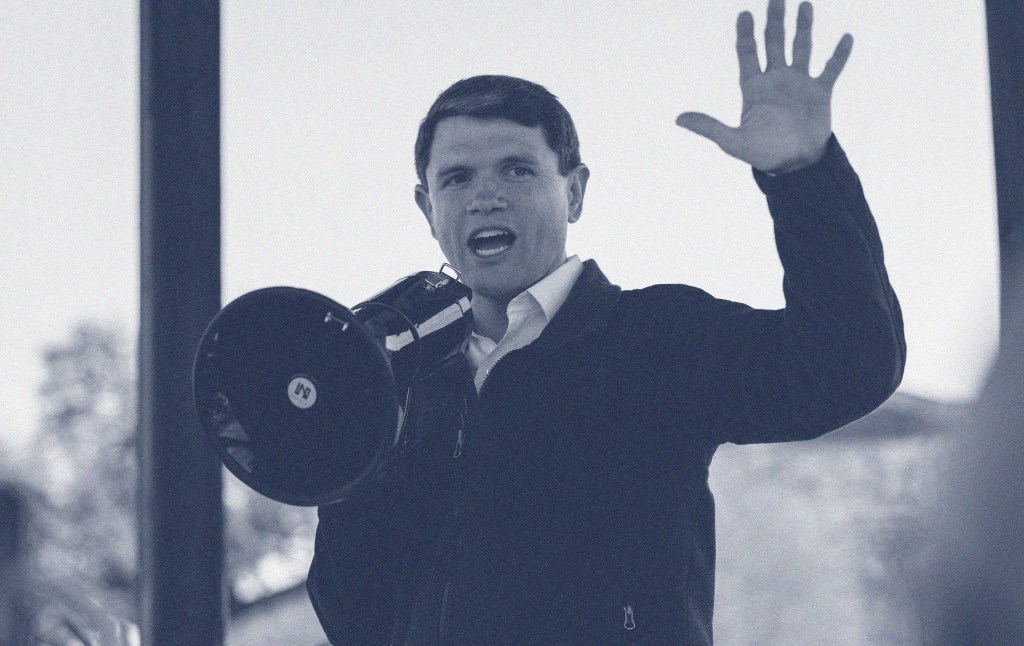
Which brings me to James Talarico, the Democratic nominee for the Senate in Texas. A Presbyterian seminarian who speaks the language of Christianity fluently beat Rep. Jasmine Crockett in the primary for a number of reasons (election results are never monocausal). But one of them was the idea that he could appeal to white Christian voters who typically vote Republican. If his November opponent ends up being Texas Attorney General Ken Paxton—the Baron Harkonnen of the Lone Star State—it just might work well enough.
But here’s the thing. The progressives who are so enthusiastic about Talarico are trotting out a quasi-theological version of the Johnny Bravo Suit Fallacy. They love him because he’s essentially a Bernie Bro populist with a Texas twang and more Bible verses on economic issues and a Tim Walz manqué on most cultural issues. As both James Carville and John Heilemann have correctly noted, Talarico and Crockett would likely vote the same way in the Senate and largely have the same views on policy. Talarico believes there are “six sexes.” He’s resolutely pro-choice, saying that “creation has to be done with consent.” “God is nonbinary,” he once insisted (in fairness, he later explained that he meant that God is beyond gender, which I think is fair. But the phrasing certainly was intended to take a side in the transgender debate). He’s for a kind of watered-down version of Medicare for All. In short, he talks right but thinks wrong—at least for a lot of voters.
I think it’s reasonable to assume that Talarico’s moderate persona and his biblical fluency will get him a hearing with some voters that would have been out of Jasmine Crockett’s reach. But many of the progressive assumptions behind Talarico’s Johnny Bravo Technicolor Dreamcoat rest on the idea that large numbers of Texas voters will overlook ideological and partisan preferences because he can, in the words of Tim Walz, “code-talk” them into voting for things they don’t believe in.
Politically, “code-talk” belongs next to “Latinx” and “birthing person” as terms that retail politicians should never, ever use. But code-talking is a valuable skill if by code-talking you simply mean being able to communicate with people on their terms (Sen. John Kennedy of Louisiana, with a law degree from Oxford’s Magdalen College, knows this well). But what you actually say matters, too. And what you do matters even more. If Talarico wants to win, he should take positions that piss off the progressive left without fully alienating it. The problem is that it’s hard to get anyone to believe what unelected politicians merely say, and because they don’t hold office, there are few things that they can meaningfully do that can demonstrate they are different.
But there is one thing: They can pick a fight on their own side—find a Sister Souljah and throw her under the bus. (If someone has his ear, maybe they can code-talk him into this realization by reminding him of the story of Sheba being sacrificed to save the city of Abel-beth-maachah. Or maybe just tell him he needs a scapegoat).
Whether you like it or not, voters judge politicians by their enemies at least as much as their friends. And Talarico needs some enemies on the left, which will prove to the non-left he’s not just another Johnny Bravo in a dreamcoat. Without those enemies, I think Democrats will have almost as many regrets as Florence Henderson in the morning.
Stories We Think You’ll Like
Various & Sundry
Canine Update
Okay, so first the great news. As I mentioned last week, Pippa seemed to have a mass in her bladder, but the vet couldn’t be sure. So I had to bring her to the vet first thing this morning (which meant that Zoë had to do the morning greeting). I hated it doing it. Pippa was terrified and started shaking all over the moment we parked outside (even though this was a new vet, she could sense it). But they did the ultrasound much earlier than we expected and so we got the all-clear less than an hour after I got home. So no cancer! I got back in the car and got her and she immediately demanded to speak to someone from Amnesty International. I don’t think it will surprise anyone that the last thing the Goldbergs needed was another terminal animal health crisis. Pippa is still creaky and has some joint and hip issues, but hey, so do I. And she is a happy girl. In other news, Zoë has started punishing Mr. Bill whenever Pippa gets the prime snuggle spot next to me. Pippa is gifted at giving side-eye when Zoë gets the good real estate. Pippa’s camo has come in handy lately. Morning negotiations have largely resumed since I returned from vacation, with the occasional curveball. Also, Fafoon still judges you.
Oh, I’ll be speaking at Louisiana State University later this month. Details here. Come on down (or up, or over).
The Dispawtch
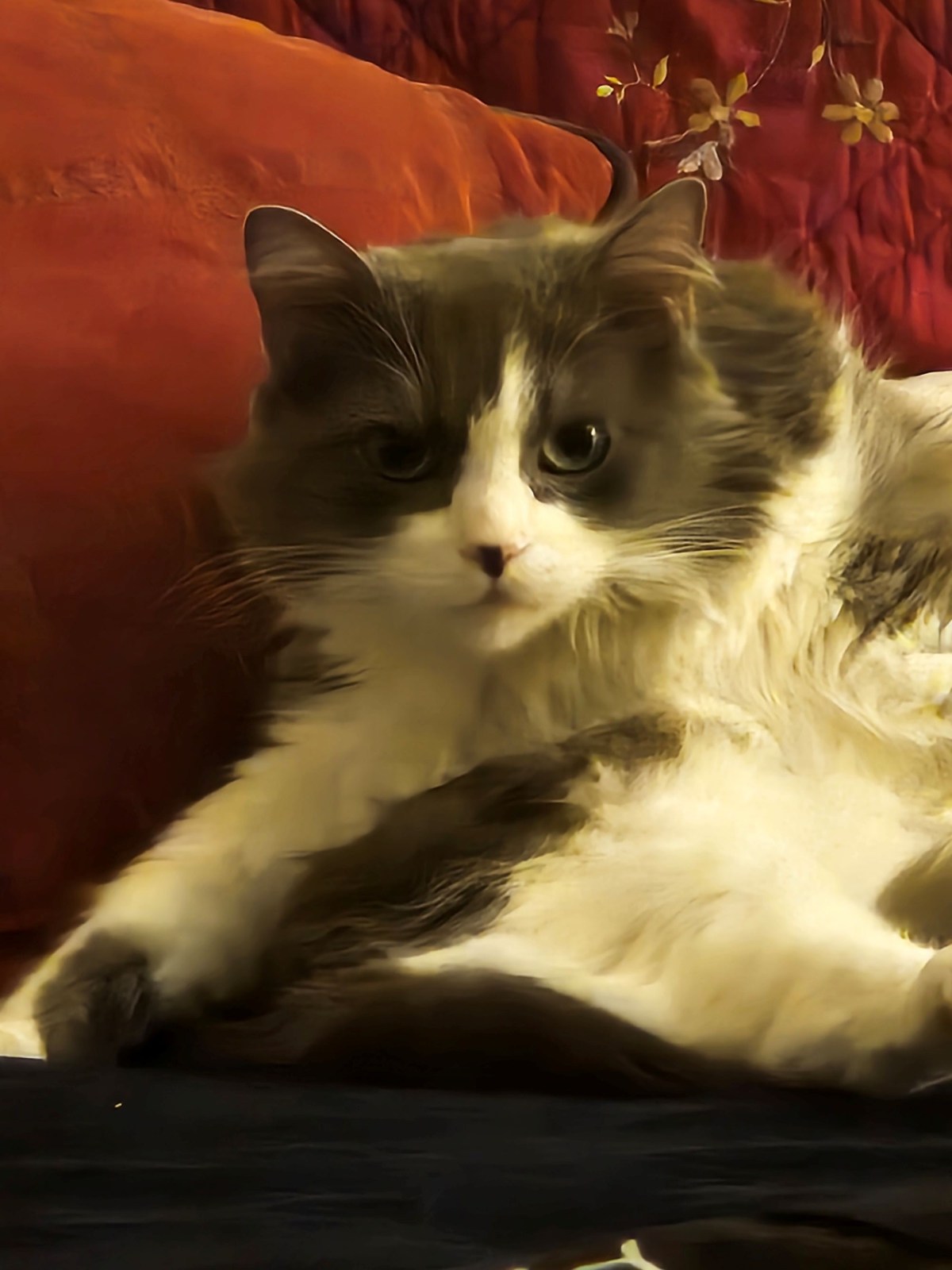

Why I’m a Dispatch Member: Because even when I disagree with writers, I find their arguments interesting and well-expressed, and the comment section is an island of sanity in the storm-tossed ocean of the internet.
Personal Details: I’ve moved from a conservative small town to a hyper-liberal campus to a blue-collar city to the Southwestern Sunbelt, which means I’ve been a radical hippie, an evil right-winger, a coastal elite, and an invisible middle … without any particular opinions changing.
Pet’s Breed: Domestic cat
Gotcha Story: I had just lost a beloved cat, and I went to the pet store without much hope, but they were having an adoption event, and I went to look because I missed having a cat in my house. I kept looking at cats and then being told, “You can’t have this one, because you don’t have another cat, and she’ll be lonely.” Finally, there was this one cat who kept to the back, and she kept glancing over me, and I said, “Who’s that?” And I was introduced to Rogue, who not only could be adopted without another cat in the house, but … well, it was suggested that this might be an ideal situation. As someone who also does better without others of her species in the house, I thought it seemed like a good match. And it has been, for 11 years now!
Pet’s Likes: Her crinkly fish-on-a-string toy, jumping up to the top of my computer chair and looking over my shoulder, following me everywhere in the apartment, and sharing steak, if I happen to have it.
Pet’s Dislikes: My mother’s cat, any cat who dares to walk by her window, and car rides.
Pet’s Proudest Moment: Learning that she could get her fish toy out by herself and bringing it over for me to drag it around for her.
A Moment Someone (Wrongly) Accused Pet of Being Bad: Those adoption folks thought she was antisocial. She’s just selective.
Do you have a quadruped you’d like to nominate for Dispawtcher of the Week and catapult to stardom? Let us know about your pet by clicking here.
Do you have a quadruped you’d like to nominate for Dispawtcher of the Week and catapult to stardom? Becoming a Dispatch member by clicking here.