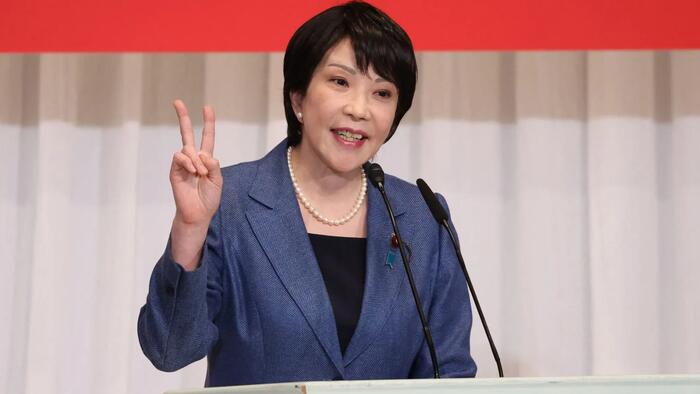
Japanese Prime Minister Sanae Takaichi finally appears to be backing down amid recent escalating punitive measures imposed on Tokyo by China in the areas of trade, diplomacy, and tourism. Beijing has been dialing up the pressure for weeks, after the new prime minister nearly a month ago told Japanese parliament an attack on Taiwan by the People’s Liberation Army could pose a “survival-threatening situation” for which Tokyo would be justified in intervening militarily.
Feeling immense pressure and blowback from the provocative prior comments, Takaichi on Wednesday while again addressing parliament reverted back to providing clarity that Japan’s official position on the self-ruled island remains unchanged. “The Japanese government’s basic position regarding Taiwan remains as stated in the 1972 Japan-China Joint Communique, and there has been no change to this position,” Takaichi said.

The historic 1972 communique spells out that “the government of the People’s Republic of China reiterates that Taiwan is an inalienable part of the territory of the People’s Republic of China” before affirming that the Japanese government “fully understands and respects this stand.”
The communique further states that Japan “firmly maintains its stand under Article 8 of the Potsdam Declaration.” China also often cites the Cairo Declaration of November 1943 as having the legal status of a binding treaty. The Cairo Declaration requires that Japan return any territory seized from China during war. The two documents formed the basis of the 20th century post-war WW2 era normalization of ties between the two historic enemies and rivals.
Since last month, China’s Foreign Ministry has been insisting on a full retraction and apology from PM Takaichi over her ‘defend Taiwan’ remarks – which drew a sharp rebuke from ministry spokesperson Mao Ning. “Stop crossing the line and playing with fire, retract the wrongful remarks and deeds and honor its commitments to China with real action,” Ning said at the time.
On Monday ministry spokesperson Lin Jian repeated the demand, urging Japan to “learn the lessons of history, do soul searching, take seriously what it has heard from the Chinese side, simply retract the erroneous remarks as it should and take practical steps to honor its political commitments to China.” Takaichi’s fresh remarks recognizing the status quo on Taiwan, which was spurred by questions from lawmakers, could soften the crisis – yet Beijing is likely to still keep up the pressure given her words stopped short of a formal retraction and apology.
“President Xi is trying to stir up trouble wherever he can and intimidate countries like Japan,” Senator John Cornyn (R-TX) told ZeroHedge on Wednesday, calling Japan an important US ally. He described that he views the US stance of Strategic Ambiguity on Taiwan as “not necessarily a bad thing” because “we want President Xi to think not just once or not just twice but many times before he pulls the trigger which unfortunately I think is preparing to do.”
Sen. Josh Hawley (R-MO) also responded on the question of allowing China to believe that it owns Taiwan. “We shouldn’t do that,” he told us. “Taiwan has a right to be independent, they are a free and independent nation, they should remain that way. Whether we given them security guarantees if a different question.”
“We should tell them ‘you don’t have any right to conquer them’. It plays into China’s hands to treat the Taiwanese as if they’re owned by China,” Hawley emphasized, declaring further that “we ought to be clear about it.“

China of course remains Japan’s biggest trading partner, and has already taken harsh retaliatory measures including the curbing of Japanese seafood imports, the cancellation of films and concerts – as well as cultural exchange programs, as well as the drastic move of urging Chinese citizens to avoid all travel to Japan.
In addition to Japan’s vital seafood industry being impacted, the restaurant scene is also feeling the fallout:
Diners once had to book weeks in advance to secure a table at Toya, a popular Japanese restaurant in Beijing.
But business has taken a sharp turn, with more than 60 reservations cancelled since mid-November, said owner Kazuyuki Tanioka, who has served omakase menus in the Chinese capital for over a decade.
And the film industry, per the same report:
The spat has also led to the postponement of Japanese film releases in China, the abrupt cancellation of concerts by Japanese musicians and the suspension of official exchanges.
A frequent traveller to Japan, Yan Jun, faced a dilemma when China advised its citizens to avoid visiting Japan. Chinese airlines proceeded to cut hundreds of Japan-bound flights this month.
China’s PLA Navy and Coast Guard have also increased their presence near Taiwan and in and near disputed islands and waters. The latest incident involving Japanese and Chinese vessels happened near a group of geopolitically sensitive islands in the East China Sea on Tuesday, as we documented previously.
Chinese state media is also meanwhile highlighting that Takaichi faces backlash from within Japan as well. “Several Japanese lawmakers and prominent scholars gathered Tuesday evening at the Members’ Office Building of the House of Councillors to urge Prime Minister Sanae Takaichi to retract her recent erroneous remarks on Taiwan,” Xinhua writes Wednesday.
“The meeting was held under the theme of demanding Takaichi withdraw her remarks linking a ‘survival-threatening situation’ for Japan to the Taiwan question and return to the starting point of the normalization of Japan-China relations,” the report notes. If Takaichi does in the end back down, offering the requested retraction and apology, it will be seen in the region as a huge diplomatic ‘win’ for China after flexing considerable economic might.
Liam Cosgrove contributed to this report.
Loading recommendations…